
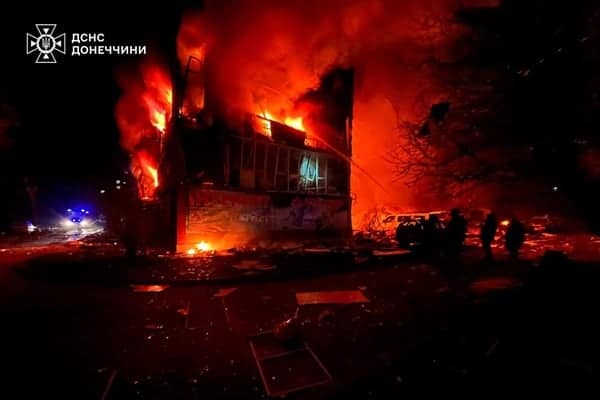
A Russian missile and drone barrage has killed at least six people in Zaporizhzhia and injured a further 19, according to Ukrainian President Volodymyr Zelenskyy, in one of the latest attacks to expose the vulnerability of Ukraine’s civilian infrastructure.
The overnight assault on August 11 combined North Korean ballistic missiles, Zircon missiles and guided aerial bombs, according to Zelenskyy. More than 120 drones were also launched against targets across Ukraine, most of them jet-powered Shahed drones.
The scale and composition of the attack point to an increasingly sophisticated Russian effort to overwhelm Ukrainian air defences by combining different classes of weapons and striking multiple regions simultaneously.
“It was a vicious attack, calculated to inflict maximum damage specifically to civilian infrastructure,” Zelenskyy said, confirming the death toll and expressing condolences to the victims’ families.
Emergency crews continued working through the aftermath into the day, with the destruction extending beyond residential areas. A hospital specialising in infectious diseases was damaged, alongside businesses in the city, according to the Ukrainian president.
The attacks were not confined to Zaporizhzhia.
Russian forces also struck electrical substations in Kherson and Kharkiv, causing power outages and adding further pressure to a Ukrainian energy system repeatedly targeted during the war.
“All services are working to restore power to families,” Zelenskyy said.
❗️938 Russian strikes on 58 settlements in the Zaporizhzhia region in just 24 hours.
According to the head of the regional administration:
• 23 airstrikes
• 651 drone attacks, mostly FPV drones
• 7 MLRS attacks
• 247 artillery strikesZaporizhzhia itself and dozens of… pic.twitter.com/fx5OtYnz6F
— zharynka (@tak_ya_anna) August 11, 2026
The simultaneous attacks on civilian, industrial and energy infrastructure underline the strategic dilemma facing Kyiv as Russia expands its use of drones to supplement its finite stock of precision missiles.
Frontline communities in Donetsk, Dnipro and Mykolaiv regions were also targeted, according to Zelenskyy. The sheer number of drones involved means that even where Ukrainian air defences intercept much of the incoming wave, debris, explosions and individual penetrations can still cause significant damage.
The use of North Korean ballistic missiles is particularly significant. Moscow has increasingly relied on military cooperation with Pyongyang to supplement its stocks of ammunition and missiles as the war enters another phase of sustained attrition.
The combination of North Korean ballistic weapons with Russia’s own Zircon missiles, guided bombs and large numbers of Shahed drones creates a complex challenge for Ukraine’s air-defence network.
Rather than relying on a single weapon system, Russian forces can force Ukrainian defenders to respond across several layers simultaneously — consuming interceptors while attempting to protect densely populated cities and critical infrastructure.
Images released by Ukraine’s State Emergency Service showed the aftermath of the bombardment, with damaged buildings and emergency crews working at affected sites.
For Ukraine, the attacks carry an increasingly familiar but still formidable economic cost. Damage to power infrastructure can interrupt industrial production and essential services well beyond the immediate blast zone, while repeated strikes force the government and private sector to divert scarce resources towards repairs and protection.
The attacks also come as Kyiv continues to argue that Russia’s campaign is designed to wear down Ukraine’s civilian population and economic resilience rather than simply destroy military targets.
The latest barrage suggests Moscow remains capable of sustaining that pressure.
For the Ukrainian government, the challenge is becoming twofold: protecting cities from increasingly diverse missile and drone attacks while keeping the country’s electricity network functioning under relentless bombardment.
In Zaporizhzhia, the human cost was already clear by morning.
Six people were dead, 19 wounded and emergency workers were still clearing the wreckage of another night of war.


Leave a Comment