
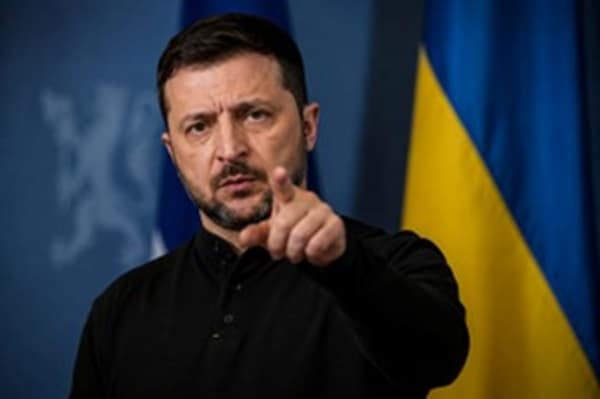
After nearly two weeks of political uncertainty, President Volodymyr Zelensky has sought to draw a line under one of the most turbulent episodes of his presidency since Russia’s full-scale invasion.
Speaking on Monday, Zelensky confirmed that the question of Ukraine’s defence minister is now closed.
He reaffirmed that Major General Yevhen Khmara will lead the Ministry of Defence and made clear that Mykhailo Fedorov will not be returning to the role despite sustained public demonstrations calling for his reinstatement.
The announcement effectively ends days of speculation that mounting public pressure might force another reversal.
It follows one of the largest domestic protest movements seen during the war with thousands of Ukrainians gathered in Kyiv and other cities after the abrupt dismissal of Fedorov, whose six-month tenure as defence minister won praise from many within the armed forces for accelerating drone production, digital procurement reforms and long-range strike capabilities.
Although Zelensky subsequently removed Commander-in-Chief General Oleksandr Syrskyi and appointed the widely respected General Mykhailo Drapatyi, many demonstrators argued that only half of their concerns had been addressed. Their second demand, Fedorov’s reinstatement, has now been firmly rejected.
Watch this space…
A difficult balancing act
The decision leaves Zelensky attempting to balance two competing priorities.
On one hand, Ukraine requires stability within its wartime leadership while facing relentless Russian missile attacks, manpower shortages and an increasingly complex battlefield, On the other, many Ukrainians believe Fedorov represented precisely the type of modern military leadership needed for the next phase of the war.
His emphasis on innovation, drone warfare, digitisation and defence-industrial reform resonated strongly with both soldiers and civilians, particularly as Ukraine increasingly relies on asymmetric capabilities to offset Russia’s numerical advantages.
Rather than returning Fedorov, Zelensky has instead placed his confidence in Khmara.which I am unsure of myself.
Khmara is widely regarded as one of the architects behind Ukraine’s expanding long-range strike campaign, helping to develop the special operations and drone capabilities that have increasingly taken the war deep inside Russia. There is little doubt he is an exceptionally capable appointment from a military perspective.
However, the Ministry of Defence today resembles the management of a vast multinational corporation as much as it does a military headquarters. It oversees billions in procurement, coordinates a rapidly expanding domestic defence industry, manages international partnerships and drives technological innovation at an unprecedented pace. Those were areas in which Mykhailo Fedorov excelled.
Before taking over the ministry, Khmara served within Ukraine’s Security Service (SBU) and played a central role in planning complex operations against Russian military infrastructure. His appointment signals that deep-strike operations and technological development will remain central pillars of Ukraine’s military strategy. The question, however, is whether he possesses the same willingness to challenge convention that made Fedorov so effective.
Innovation rarely comes from simply doing things well; it comes from thinking differently. Fedorov consistently demonstrated an ability to look beyond traditional military structures, approaching problems through the lens of technology, industry and rapid adaptation. Khmara is first and foremost a military professional, likely to view many of those same challenges through an operational lens. Neither approach is inherently better, but they are fundamentally different.
Whether Zelensky has made the right choice will not be determined by today’s headlines, but by whether Khmara can combine military expertise with the kind of disruptive thinking that has helped Ukraine stay ahead in one of the most technologically dynamic wars in modern history. Only time will tell whether that gamble pays off.
“He is a Nazi,” declared Dmitry Peskov, spokesman for the man responsible for Europe’s largest war of aggression since 1945, in response to the appointment of Ukraine’s new Commander-in-Chief, Mykhailo Drapatyi.
It’s always the same refrain from the Kremlin: “Nazi, Nazi, Nazi.”… pic.twitter.com/vnQVdoJEB5
— Shaun Pinner (@ShaunPinnerUA) July 24, 2026
Russia shows no sign of slowing and Putin’s ambitions continue to expand
The political debate in Kyiv comes as Moscow continues signalling that it has little intention of reducing its ambitions.
Last week, Vladimir Putin once again questioned Ukraine’s territorial integrity, claiming that parts of western Ukraine had been “gifted” to the Ukrainian Soviet Socialist Republic by Joseph Stalin following the Second World War. He went further still, arguing that “sooner or later” Ukraine would lose those territories while repeating his long-standing assertion that Russia had historically been the only guarantor of Ukraine’s borders.
Such rhetoric extends far beyond discussions surrounding Crimea or the occupied Donbas. It suggests the Kremlin continues to broaden, rather than narrow, the political justification for its war.
That should concern not only Ukraine, but Europe as a whole.
Governments genuinely preparing for negotiations tend to scale back their political objectives, creating space for compromise. Moscow appears to be doing precisely the opposite. Rather than limiting its ambitions to territory it already occupies, the Kremlin continues introducing new historical claims and expanding the ideological basis for the invasion. It is increasingly framing the conflict not simply as a dispute over borders, but as a struggle over the very legitimacy of the Ukrainian state.
Wars often end when one side concludes that the costs of continuing outweigh the potential gains so Putin’s public messaging can therefore provide valuable insight into a government’s strategic thinking. If senior Russian officials continue speaking in terms of historical restoration, questioning Ukraine’s sovereignty and expanding their territorial claims, it suggests the Kremlin still believes its objectives remain achievable through military force rather than negotiation.
Despite absorbing extraordinary battlefield losses, Russia continues recruiting tens of thousands of new personnel each month, expanding defence production and deepening military cooperation with North Korea. Pyongyang has supplied millions of artillery rounds, ballistic missiles and, according to multiple intelligence assessments, military personnel to support Russian operations. This is no longer an isolated transactional relationship but an increasingly important strategic partnership, allowing Moscow to sustain the tempo of a war that many expected would prove unsustainable.
The human cost remains staggering.
Earlier this month, CIA Director John Ratcliffe stated that newly deployed Russian recruits on some sectors of the front survive, on average, only 20 to 30 minutes before being killed or wounded. Whether that figure varies between sectors is almost beside the point. It illustrates the brutal reality of Russia’s current approach: overwhelming manpower and firepower remain central to Moscow’s battlefield doctrine, even at an appalling human cost.
Yet perhaps the most alarming aspect is that these losses have not fundamentally altered Kremlin decision-making.
Instead of seeking an exit strategy, Russia is expanding military production, investing heavily in drone and missile manufacturing, strengthening wartime economic controls and reportedly preparing for further mobilisation if required. Everything points towards a state reorganising itself for a prolonged conflict rather than searching for a negotiated settlement.
That is why understanding Putin’s rhetoric matters.
His speeches should not simply be dismissed as historical revisionism or domestic political theatre. They provide insight into how the Kremlin seeks to justify future military objectives. If Russian society is being conditioned to believe that ever-larger parts of Ukraine are historically Russian, then accepting anything less than continued military pressure becomes politically more difficult for the Kremlin itself.
For Ukraine, the implications are obvious. For NATO and Europe’s political leaders, they should be equally sobering.
What happens next?
For Ukraine, attention now shifts away from political uncertainty and back to military necessity.
Khmara inherits one of the most demanding positions in government, perhaps Europe.
He must maintain momentum in drone production, oversee procurement reforms, strengthen Ukraine’s air defences and work closely alongside General Drapatyi as both attempt to modernise the armed forces while fighting one of Europe’s largest conventional wars since 1945.
Whether Zelensky’s gamble succeeds will ultimately be measured not by opinion polls or political headlines, but by results on the battlefield.
For now, the defence minister question may finally be settled.
The war itself is anything but.


Leave a Comment