
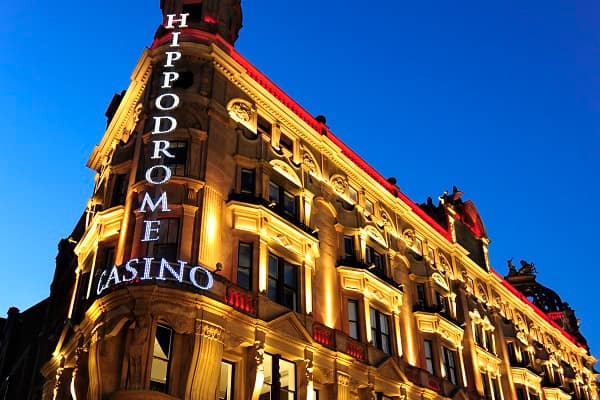
The listing entry for 7-10 Cranbourn Street runs to a single paragraph of Frank Matcham’s exterior and ends with eight words that explain most of what has happened since: “The interior with arena form auditorium much altered.”
What Historic England protects is the shell. The Grade II listing, first applied in January 1970, covers red sandstone, a balustraded parapet, two shaped pediments and an openwork metal cupola supporting a chariot. Everything inside has been gutted and rebuilt to suit whatever the West End was buying that decade, which is the building’s actual business model and always has been.
A century of changing the contents
It opened in January 1900 as a hybrid circus and variety house, with an arena that sank into a tank holding a hundred thousand gallons. Matcham reworked it in 1909 to enlarge the stage for variety, and from 1912 it ran revue.
In 1958 the interior came out entirely and Bernard Delfont, with Charles Forte, reopened it as the Talk of the Town. Peter Stringfellow restored the Hippodrome name and turned it into a nightclub in 1983. It closed in June 2009 after a run of burlesque cabaret. Six changes of use in a century, none of which touched the sandstone. The building survived because nobody was ever precious about the inside of it.
The 2012 rebuild and what it cost
Jimmy Thomas and his son Simon took the lease, spent three years converting it and the adjacent Cranbourn Mansions, and reopened on 13 July 2012 with Boris Johnson cutting the ribbon.
The investment figure moved as the job went on, which is instructive in itself. The Greater London Authority, in a press release seven weeks before opening, put it at £15 million and forecast 500 staff and up to 12,000 visitors. Trade press at the opening reported “more than £40m”. Simon Thomas has since described the original plan as two years and about £35 million and the outcome as three years and £45 million. Nobody hid the overrun. It is what happens when the contents of a listed shell are replaced wholesale.
What the money produced is 80,000 square feet over seven levels, on a footprint fixed in 1900. That is the essential point about a heritage asset of this kind. Capital goes into the inside because the outside cannot move. The company reported revenue of £76.5 million for 2018 and £118 million for 2023, and employed around 750 people by 2023.
The corporate history carries a detail that suits the story. The operating company was incorporated in July 2005 under a different name entirely and only became Hippodrome Casino Limited in November 2010. The vehicle predates the brand.
Where a fixed floor runs out
A gaming floor has a hard ceiling. Cranbourn Street holds a certain number of terminals and tables, set by the square footage, and no amount of demand changes it. A heritage venue in Zone 1 has the least room to grow and the most expensive room to grow into.
A digital estate is the only route past that, and it is a genuinely different proposition rather than a copy of the venue. It carries a catalogue no floor could hold, operates outside opening hours, and reaches customers who will never be within walking distance of Leicester Square. What it cannot do is be a destination, which means the brand does work online that the building does for free.
What actually went online, and when
Heritage brands reach the internet by licensing the name outward, because building a remote platform means becoming a software company and very few of them want to be one. It is the same instinct that put a steak house and a Magic Mike residency inside a listed theatre: bring in an operator who knows the format, keep the name over the door.
The Hippodrome online casino runs on a British remote licence held separately from the venue’s, a split anybody can read off the Commission’s public register. What travelled first was the name, the visual identity and the association with a specific address, which is the part of the asset nobody else was ever going to reproduce.
Then the venue company began building its own remote position, taking a remote betting licence in October 2025 and adding a remote casino licence in February 2026, thirteen years after the building reopened. Read in register order, that is a brand extended by licence first and the technology brought closer to home afterwards, which is the ordinary sequence for a leisure operator that reaches the internet before it builds for it.
The blueprint, such as it is
The lesson for other West End operators is less about digital than about what a heritage brand owns. It is not the interior, which will be replaced. It is not the operating licence, which can sit with different companies at different times. It is the name and the address, which is what Matcham’s shell has been carrying for a hundred and twenty-six years while everything behind the sandstone was ripped out and replaced. London’s leisure sector is not short of buildings with that quality. What it is short of, at a moment when Westminster is being accused of dismantling the character of Soho, is operators willing to treat the inside of them as temporary.
Please play responsibly. For more information and advice visit https://www.begambleaware.org
Content is not intended for an audience under 18 years of age



Leave a Comment