
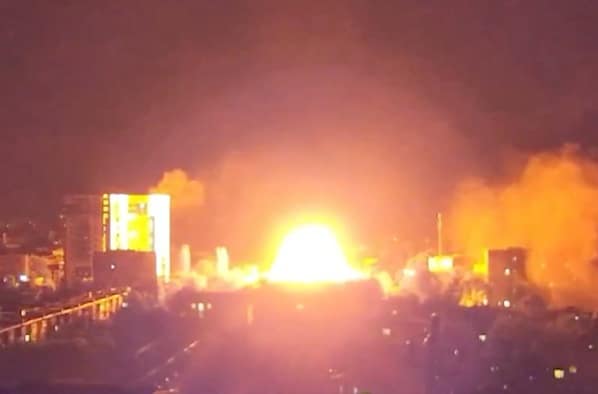
Ukraine’s military intelligence agency has revealed details of an increasingly sophisticated drone warfare strategy designed to overwhelm and exhaust Russian air defence systems through coordinated waves of decoy and armed unmanned aerial vehicles.
The Main Intelligence Directorate (HUR) outlined the approach in remarks attributed to a field commander with the callsign “Vector”, during a report broadcast by CNN, offering rare insight into the mechanics of Kyiv’s long-range strike operations.
According to the account, Ukrainian forces deploy large-scale formations of drones in which only a proportion carry explosive payloads, while a parallel stream of decoy aircraft is used to saturate Russian radar networks and draw fire from expensive interceptor systems.
Read more related news:
Belarus warns of counter-strike after Kyiv identifies 500 targets
Secret Russian missile site near NATO border raises fears amongst officials
Footage shows Russia’s ‘invincible’ frigate blown up in Black Sea
Kremlin threatens to strike nuclear plants across NATO in chilling escalation warning
“These are decoys,” the commander said. “We have sent hundreds of them. Some are empty, some carry a combat load.”
The strategy is designed to force Russian air defence units into rapid engagement cycles, depleting ammunition stocks while simultaneously exposing radar and missile positions through activation and tracking emissions.
Ukrainian operators also described the use of high-speed, jet-powered decoy drones engineered to mimic the radar signatures of cruise or ballistic missiles, further complicating Russian threat identification systems.
Once activated, Russian air defence systems are compelled to respond to multiple simultaneous tracks, creating conditions in which defensive coverage becomes fragmented and vulnerable to follow-on armed strikes.
The system is supported by what Ukrainian operators describe as highly decentralised command-and-control software, allowing drone operations to be coordinated via dispersed laptop-based networks rather than centralised military facilities.
“Laptops are our biggest advantage,” the commander said, adding that the structure made it difficult for Russian forces to disrupt planning or communications. He said the system allowed operators to coordinate “thousands of UAVs” across multiple locations.
Military analysts say such distributed architectures are increasingly central to modern drone warfare, reducing vulnerability to pre-emptive strikes on command centres while enabling rapid adaptation in contested airspace.
The revelations come amid a sustained Ukrainian campaign targeting Russian energy and logistics infrastructure deep inside the country.
In recent operations, Ukrainian forces have struck multiple sites, including oil refineries, pipeline infrastructure and fuel storage facilities, according to Ukrainian military statements. Among those reported to have been hit were facilities in Russia’s Volga region and other strategic energy nodes supporting domestic supply chains.
Ukrainian officials say the objective of such strikes is to degrade Russia’s military logistics capacity and impose sustained pressure on its industrial base, particularly fuel supply chains linked to military operations.
Russia has previously acknowledged damage to energy infrastructure following Ukrainian drone activity, but maintains that its air defences continue to intercept the majority of incoming threats.
The Kremlin has not commented specifically on the latest operational details described by Ukrainian sources.
While independent verification of battlefield claims remains limited, the scale and frequency of long-range drone strikes have become an increasingly prominent feature of the conflict, underscoring the growing role of unmanned systems in modern warfare.
As both sides continue to adapt, analysts say drone saturation tactics and countermeasures are likely to define the next phase of the aerial conflict between Kyiv and Moscow.


Leave a Comment