
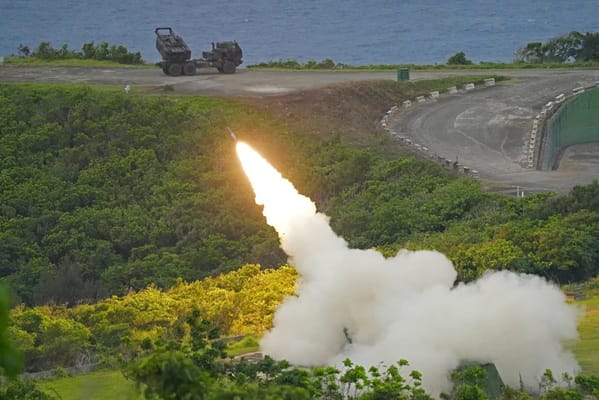
Taiwan is preparing to deploy US-supplied HIMARS rocket systems on islands just miles from mainland China, in a significant escalation of its deterrence posture against Beijing.
The high-mobility artillery systems (HIMARS) will be stationed on the Penghu archipelago and Dongyin — two strategically exposed outposts positioned close to China’s eastern seaboard — in what military planners describe as an effort to create a forward “dead zone” designed to deter any potential amphibious assault.
A military source cited by local media said that positioning the systems outside Taiwan’s main island would “exponentially increase” their tactical impact, allowing them to strike Chinese military infrastructure in coastal provinces, including Fujian and Zhejiang.
“The objective is to establish a deterrent buffer that forces PLA units to operate at a much greater distance from the shoreline,” the source said, describing the strategy as rooted in an “offence is the best defence” doctrine.
The deployment comes amid rising tensions across the Taiwan Strait, where Beijing continues to assert sovereignty over the self-governing island and has not ruled out the use of force to bring it under control.
The Chinese military regularly conducts air and naval exercises around Taiwan, which Taipei views as rehearsals for a blockade or invasion scenario.
The HIMARS systems, supplied by the United States, are capable of firing precision-guided rockets at long range and have become a central component of Taiwan’s effort to modernise its forces and adopt asymmetric warfare tactics.
Taiwan already fields more than 500 Army Tactical Missile System (ATACMS) missiles, which have a reported range of up to 185 miles. From Dongyin, these systems would be capable of targeting PLA Rocket Force and naval installations across parts of eastern China.
The island’s defence strategy has increasingly focused on dispersal, mobility and long-range strike capability, drawing lessons from recent conflicts in Ukraine and the Middle East.
Officials in Taipei have also developed the so-called “T-Dome” concept — a layered defensive approach intended to complicate any Chinese military operation and slow down advances long enough to allow external support to arrive.
The decision to position HIMARS systems on frontline islands follows a series of live-fire drills on Penghu earlier this year, during which Taiwanese forces tested missile units under combat conditions.
Taiwan took delivery of its first HIMARS systems in 2024, with total planned shipments expected to reach 111 units.
The move is likely to draw a sharp response from Beijing, which has consistently opposed US arms sales to Taiwan and regards such deployments as a violation of its sovereignty claims.
It also comes ahead of a planned summit between Chinese President Xi Jinping and US President Donald Trump, at which Taiwan’s military posture is expected to feature prominently.
Washington has repeatedly urged Taipei to accelerate defence spending and procurement, warning that parts of its budget have been delayed or scaled back in recent negotiations.
An American official recently described Taiwan’s revised defence allocation as “disappointing”, arguing that key capability upgrades had been left unfunded.
Taiwan’s legislature last week approved a special defence package worth around £18.8 billion, significantly lower than the £29.3 billion initially proposed by President Lai Ching-te.
Beijing, meanwhile, continues to pressure countries and arms manufacturers to curtail military cooperation with Taiwan, framing US support as destabilising and provocative.
The latest missile deployments are likely to be seen in Beijing as part of a broader shift towards a more forward-leaning Taiwanese defence doctrine — one that increasingly prioritises deterrence through proximity and precision strike capability rather than static defence of the main island.


Leave a Comment