
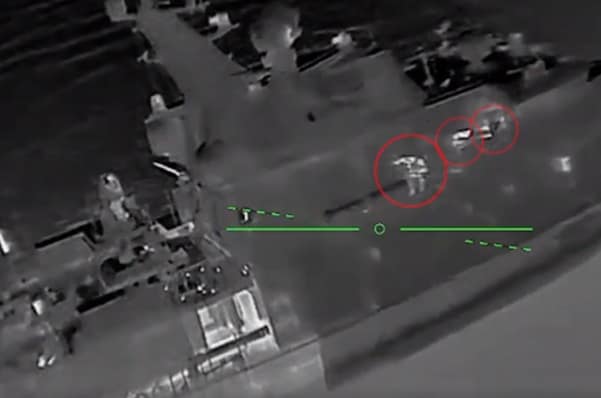
Ukraine has launched a fresh wave of long-range drone strikes against Russian military targets in occupied Crimea and deep inside Russian territory, underlining Kyiv’s growing ability to threaten assets once considered safely beyond the reach of its armed forces.
According to Robert “Madyar” Brovdi, commander of Ukraine’s Unmanned Systems Forces, Ukrainian drones struck a Russian Svetlyak-class border patrol vessel in occupied Crimea during a coordinated overnight operation targeting naval, air defence and logistical infrastructure, RBC-Ukraine reports.
The vessel, a Project 10410 Svetlyak patrol ship stationed near the Crimean settlement of Yurkine, is designed to protect ports and coastal waters, conduct anti-submarine operations and provide air defence support.
Armed with anti-aircraft systems, artillery and machine guns, the ship forms part of Russia’s wider security architecture around the occupied peninsula.
Read more related news:
Ukrainian drone ‘set fire’ to Russian warship parked safely far from the front
War spills deeper into Russia during Putin’s flagship forum
Explosions rock Putin’s hometown of St Petersburg as Ukraine expands long-range campaign
NATO chief tells Russians ‘you are being sold a raw deal’ and you ‘will die in the mud’
The strike marks the latest demonstration of Ukraine’s increasingly sophisticated drone warfare capabilities, which have transformed the nature of the conflict and steadily eroded Russia’s ability to operate freely in the Black Sea.
Alongside the naval strike, Ukrainian forces said they targeted a Pantsir-S1 air defence system in the Kherson region, a navigation and radar facility near Saky in Crimea, locomotives used for military logistics and a series of fuel and power infrastructure sites across occupied territories.
Military analysts have long argued that Ukraine’s strategy is focused not merely on destroying individual targets but on systematically degrading Russia’s ability to sustain military operations. By targeting air defences, rail infrastructure, fuel depots and command systems simultaneously, Kyiv aims to increase the cost of occupation while stretching Russian resources across an increasingly wide front.
The latest operation follows a series of high-profile attacks against Russian naval assets.
On June 3, Ukrainian forces reportedly struck military facilities and vessels in the port of Kronstadt near St Petersburg, including the corvette Boykiy. Although the full extent of the damage remains unclear, the attack demonstrated Ukraine’s ability to project force hundreds of miles from the battlefield.
Ukrainian drone forces continue to decimate Russia‘s maritime forces, this time near Yurkine in Russian-occupied Crimea in Ukraine. One „Svetlyak-class“ patrol boat (Project 10410) even while moving was precisely hit.
Furthermore, drones hit the following targets:
– Pantsir-S1… pic.twitter.com/SMsRnveCGE
— (((Tendar))) (@Tendar) June 4, 2026
Earlier, on May 23, Ukrainian drones targeted the Russian naval base at Novorossiysk, one of Moscow’s most important Black Sea Fleet hubs, following repeated attacks on facilities in Crimea. Ukrainian sources claimed the operation damaged the frigate Admiral Essen and a Project 1239 missile ship.
Taken together, the strikes illustrate the mounting pressure facing Russia’s Black Sea Fleet. Since the start of the war, Ukrainian missile and drone attacks have forced Moscow to relocate vessels, disperse assets and adapt operational planning in response to a threat that continues to evolve.
For Kyiv, the campaign carries both military and symbolic significance. Every successful strike against Russian naval assets weakens Moscow’s ability to project power in the Black Sea while reinforcing Ukraine’s message that occupied Crimea remains a legitimate military target.
The growing reach of Ukraine’s drone forces has emerged as one of the defining features of the conflict. What began as relatively modest uncrewed operations has developed into a sophisticated long-range strike capability capable of reaching deep into Russian-held territory and challenging critical military infrastructure.
As the war enters another summer of attritional fighting, Ukraine’s drone campaign is increasingly becoming a central pillar of its strategy — one designed to offset Russia’s advantages in workforce and conventional firepower by striking vulnerable targets far behind the front lines.
For the Kremlin, the message is becoming increasingly difficult to ignore: nowhere connected to Russia’s war effort can be considered entirely beyond Ukraine’s reach.


Leave a Comment