
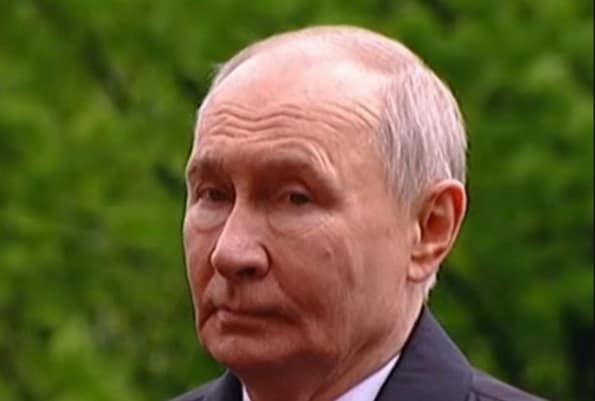
Vladimir Putin’s war in Ukraine is increasingly colliding with economic reality, with senior officials warning that Russia’s finances are under mounting strain and that the Kremlin is facing uncomfortable choices over how long it can sustain current levels of military spending.
According to reports from Bloomberg, officials within Russia’s finance ministry and central bank have privately cautioned that defence expenditure is on a trajectory that could significantly widen the budget deficit in the coming year.
Their concerns reflect a broader anxiety within parts of the economic establishment that the war is beginning to impose structural costs on the Russian state that can no longer be easily absorbed.
The warnings have exposed what appears to be an emerging divide inside Moscow’s policymaking elite. On one side are technocrats focused on macroeconomic stability, who are reportedly urging restraint and proposing cuts in non-military spending. On the other hand is the defence establishment, which continues to press for sustained or even increased funding to support the war effort in Ukraine.
Read more related news:
Russian plant in Dublin is funding Putin’s war in Ukraine ‘that kills civilians’
Moscow rations petrol as Russian refineries burn
The battle for Crimea could decide Putin’s war
Ukraine hit by massive assault, but Crimea is the strategic flashpoint
Ultimately, however, the decision rests with Putin himself. No meaningful fiscal adjustment can be made without his approval, and early indications suggest the Kremlin is unwilling to countenance reductions in military spending at a moment when it still frames the conflict as strategically decisive.
Instead, reports suggest the president has instructed officials to find savings elsewhere in the budget, effectively insulating defence from any immediate restraint. That position risks intensifying pressure on other areas of public spending, at a time when Russia’s economy is already showing signs of strain.
Officials are said to have identified a potential funding gap running into trillions of rubles in the second half of 2026, a shortfall that could deepen if oil revenues weaken further or if wartime costs continue to escalate. The defence sector, which has become a central pillar of industrial output, complicates any attempt to rebalance the books, given its deep embeddedness in Russia’s wider economy.
The backdrop to these discussions is a slowing economy that is beginning to lose momentum after years of wartime expansion. Growth forecasts have been downgraded, inflationary pressures remain persistent, and official data has already pointed to contraction in parts of the economy earlier this year.
What makes the situation more sensitive for the Kremlin is that Russia’s war economy is not simply a question of military expenditure, but of political stability. Defence contracts support employment, sustain regional industries and underpin a network of state-aligned business interests that would be directly affected by any attempt to scale back spending.
That reality helps explain why the defence ministry is reportedly resisting any notion of restraint and, in some accounts, is instead seeking additional funding. In effect, competing centres of power are pulling in opposite directions, with economic officials warning of fiscal limits while the military establishment argues that the war cannot be slowed without strategic cost.
Putin’s own intervention earlier this year, ordering officials to explain weaker-than-expected economic performance, reflected growing irritation at signs of slowdown. But the underlying tension remains unresolved: a war that demands ever-greater resources, and an economy that is increasingly being asked to stretch to accommodate them.
There were once assumptions in parts of the Russian system that the conflict might reach a political resolution following high-level diplomacy involving the United States. Those expectations have faded, replaced by a longer and more expensive confrontation than many in Moscow originally anticipated.
For now, the Kremlin continues to project confidence. But beneath that surface, the debate over how to fund the war is becoming harder to conceal. And in the background of Russia’s political system, the most sensitive question of all is beginning to emerge more clearly: how long can the state afford a war that shows no sign of ending?


Leave a Comment