
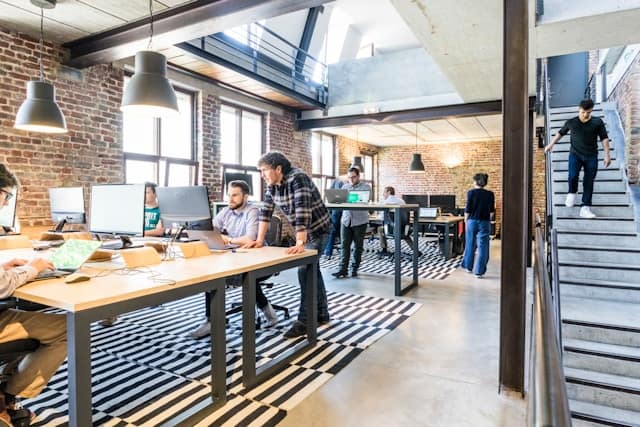
For a few years, the future of the London office was talked about as if it were a simple question. Would people come back, or had the working week changed for good?
The answer is clearer now, but more interesting. People are coming back, and businesses have not given up on physical workplaces. What has changed is the old deal between employer and employee. The office no longer wins by default.
Before hybrid working became normal, the office did not have to justify itself in quite the same way. It was where the desk was, where the manager was, where meetings happened and where work culture lived.
Now every commute is measured against the alternative.
For many employees, working from home has become the easiest option for reasons that are hard to argue with. It removes the dead time of travel. It cuts personal costs, from rail fares and petrol to parking, lunches and vehicle wear and tear. In a city like London, those savings are certainly not minor perks. They can change how someone feels about the whole working week.
This is why some return-to-office arguments miss the point. Many people are not anti-office. They are anti-pointless office days.
Home working also gives people more control. They can start focused work sooner, avoid rush hour and shape the day around their own routines. For some, it is calmer and more productive.
But it is not perfect. At the end of the day, it can be much harder to switch off from work when you are working from home.
When work and home happen in the same place, the day does not always have a clear finish. There is no walk to the station, no drive home and no change of scene that tells your brain the working day is over. For some people, home working is easier during the day but harder to leave behind in the evening.
That is where the office still has an opportunity. Not as a place people are forced to attend, but as a place that gives structure, separation, energy and useful time with other people.
Centre for Cities found that full-time central London office workers were spending 2.7 days a week in the office in June 2024, still below the 3.9 days recorded in January 2020.
So the return to office is real. It is just not a return to 2019.
The businesses handling this well are not only asking, “How do we get people back to their desks?” They are asking, “What makes the office worth choosing?”
A good office now needs to offer:
- A clear reason to make the journey in
- Spaces for focused work as well as collaboration
- Meeting rooms that are actually available when people need them
- Quiet areas for calls, confidential work and thinking time
- Reliable temperature, lighting, ventilation and connectivity
- A clean, well-maintained environment that feels cared for
These are the things people notice across the day. They decide whether someone leaves the office thinking it was useful, or whether they spend the journey home wondering why they came in at all.
Comfort is often invisible when it works, but impossible to ignore when it fails.
A stuffy meeting room can drain the energy from a discussion within minutes. A cold corner of an open-plan floor can become the place nobody wants to sit. Poor lighting makes an afternoon feel longer. Bad acoustics can turn a simple day of work into a day of interruptions.
Leesman workplace data shows why this matters. Its global benchmark has found that 66% of employees consider air quality important, while only 52% are satisfied with it in their workplace. Noise is even more revealing. Leesman data shows that 70% of employees consider noise levels important, but only 35% are satisfied.
London employers often talk about collaboration, mentoring and culture. Those are good reasons to bring people together, especially for younger staff who learn by watching how experienced colleagues handle problems in real time.
But culture is not created by saying the word often enough. It is created in the ordinary moments of the day: a useful conversation after a meeting, a quick bit of advice from someone nearby, a team working through a problem in the same room. If the office is uncomfortable, noisy or poorly run, those moments become harder to create.
This is why facilities teams should be part of the return-to-office conversation from the start. Ventilation, lighting, acoustics, cleanliness, layout and air conditioning services are not just background maintenance. They are part of whether an office feels like a professional environment worth travelling to.
This is especially true in London, where many businesses operate from older buildings, converted spaces and dense urban locations where temperature, airflow and external plant restrictions can be more complicated. An office can look impressive in photographs and still feel uncomfortable by 3pm on a warm Thursday.
There is a commercial point here too. Savills reported that Central London leasing reached 2.2 million sq ft in the first quarter of 2026, slightly above the ten-year average. Demand has not disappeared, but occupiers are becoming more selective.
The next phase of London’s office comeback will not be won by companies that simply mandate more days on site. It will be won by employers that understand why people hesitate in the first place.
Many employees are not rejecting the office entirely. They are rejecting expensive journeys that end in poor facilities, crowded rooms and work they could have done more easily at home.
If London businesses want people back, the office has to earn the commute. It has to offer focus, comfort, connection and a clearer line between work and home.
The city’s offices may be filling again, but the winners will be the workplaces people are quietly pleased to return to!




Leave a Comment