
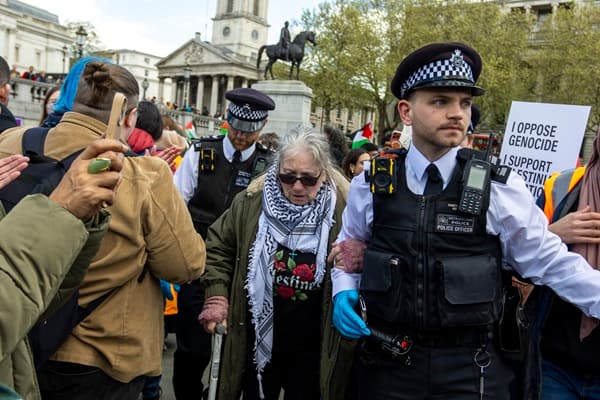
The chants had barely begun when police moved in.
Outside the Royal Courts of Justice on Monday, protesters holding placards in support of Palestine Action shouted “shame” at officers as Britain’s legal establishment delivered a judgment that may define the future boundaries of protest for a generation.
Within minutes, arrests were underway.
As police officers led demonstrators away from the steps of the High Court, the significance of what had just happened inside the courtroom was becoming clear.
After months of legal wrangling, five of the country’s most senior judges had sided emphatically with the Government, ruling that the decision to ban Palestine Action as a terrorist organisation was lawful.
For ministers, it was a landmark victory.
For supporters of the activist group, it was a devastating defeat. And for hundreds of campaigners already facing prosecution, it could prove a turning point with profound consequences.
The scenes outside the court reflected the intensity of a battle that has long since moved beyond legal argument. To supporters, Palestine Action represents a direct-action movement targeting businesses and facilities linked to Israel. To ministers, it is an organisation whose increasingly aggressive tactics crossed a line that criminal law alone failed to deter.
That argument ultimately prevailed. In a blistering judgment, Lady Chief Justice Baroness Carr rejected attempts to portray the group as part of a proud tradition of civil disobedience. Comparisons with the suffragettes, she said, were “seriously flawed”. Far from being a conventional protest movement, the court heard, Palestine Action had developed into a covert network whose campaign was escalating and being pursued “without restraint”.
The country’s most senior judge concluded that the Home Secretary had acted within her powers when she proscribed the organisation.
“The proscription decision was consistent with the Home Secretary’s proscription policy and was proportionate,” Lady Carr declared.
“It was not unlawful.”
The ruling represents a dramatic reversal of fortunes for campaigners. Earlier in the year, judges had raised serious questions about the legality of the ban, prompting hopes among activists that the Government’s decision could be overturned. Those hopes evaporated on Monday. Instead, the Court of Appeal delivered a judgment that not only upheld the ban but reinforced the Government’s argument that existing criminal sanctions had proved inadequate.
For ministers, the case centred on a simple proposition. Repeated arrests, prosecutions and convictions had failed to stop activists carrying out increasingly disruptive operations. The line between organised criminality and terrorism, Government lawyers argued, was not always clear-cut. Sir James Eadie KC, representing the Home Office, told the court that traditional criminal penalties had “demonstrably failed” to deter campaigners.
The judges agreed. Their decision means the ban introduced last July remains firmly in place. Membership of, or support for, Palestine Action remains a criminal offence carrying a potential prison sentence of up to 14 years.
The implications stretch far beyond Monday’s protests. More than 700 cases involving individuals accused of supporting the organisation are now expected to proceed through the courts. At the same time, the judgment sought to draw an important distinction between support for the Palestinian cause and support for a proscribed organisation.
The judges stressed that backing an objective or political belief was fundamentally different from expressing support for the organisation pursuing it. Yet for critics of the ban, concerns remain. Lawyers representing Palestine Action’s co-founder, Huda Ammori, argued throughout proceedings that the legislation risks creating a chilling effect on legitimate protest.
They warned of a growing “culture of fear” among activists concerned that expressions of solidarity could expose them to criminal sanctions. The political debate surrounding the group has become increasingly combustible. Only days before the judgment, activist Samuel Corner was jailed for seven years and eight months after striking a police officer with a sledgehammer during a protest, causing life-changing injuries.
The case reignited fierce arguments about the nature of direct action, the limits of protest and the consequences of political violence. Against that backdrop, Monday’s ruling felt less like the conclusion of a legal dispute and more like a defining statement from the British state. As protesters were escorted into police vans and supporters continued to shout from behind barriers outside the court, the message from the judiciary was unmistakable.
The Government’s ban stands. The law will be enforced. And for those willing to test it, the consequences are now clearer than ever.


Leave a Comment