
Walking peacefully through the beautiful countryside surrounding Dnipro, a city of around one million people, you are never far away from the war. As a friend of mine once remarked, “If there’s a way to make things worse, Russia usually finds it.”
It is almost an art form.
On cue, a Russian Shahed drone appeared low over the treeline, its distinctive engine note cutting through what had otherwise been a peaceful spring afternoon. One moment we were enjoying the countryside, the next we were reminded that in Ukraine, even the most ordinary moments exist in the shadow of war.

For months, Russia has warned of devastation, escalation and even nuclear catastrophe while continuing its daily campaign of drone and ballistic missile attacks against Ukrainian cities. Yet despite the threats and rhetoric, Moscow’s grand ambition of pushing westward in pursuit of some imperial victory appears increasingly out of reach.
After more than four years of war, battlefield success remains elusive. Russian forces continue to suffer staggering losses, reportedly losing the equivalent of around two battalions per day, roughly +1200 service personnel, while the Kremlin increasingly relies on fear, intimidation and nuclear sabre-rattling to distract from the growing challenges facing its war effort.
Read more related news:
France takes fight to Putin’s shadow fleet on the high seas
Ukraine eliminates major target in a ‘significant achievement’
Kremlin threatens to strike nuclear plants across NATO in chilling escalation warning
EU could ‘exclude men of conscription age’ from Ukraine as many refuse to fight
Kyiv, and Ukraine as a whole, continue to endure daily drone attacks, ballistic missile strikes and constant warnings from Moscow that the war could spread far beyond Ukraine’s borders.
The truth is, it already has.
Despite attempts by some commentators to downplay the wider consequences of this conflict, the evidence is visible for everyone to see. The war has reshaped global energy markets, fueled inflation, disrupted supply chains and drawn in countries across Europe, the Middle East, Asia and North America.

From sanctions and energy security to the growing military cooperation between Russia, Iran and North Korea, this conflict extends far beyond the front lines of Ukraine with the consequences now being felt in financial markets, diplomatic relations and national security calculations around the world.
More importantly, the war has exposed a darker reality that Russia is not simply fighting just a conventional military campaign. Across occupied territories, investigators, human rights organizations and survivors have documented systematic torture, filtration camps, forced deportations and the abduction of Ukrainian children, yet while the world focuses on Russia’s threats of escalation, nuclear warnings and apocalyptic rhetoric, the Kremlin appears increasingly determined to distract attention from a far more immediate problem.
Crimea.
Russian officials regularly invoke the language of nuclear confrontation, conducting exercises and issuing increasingly frequent threats that often dominate Russian state media coverage. At times, Moscow appears far more interested in discussing hypothetical nuclear scenarios than addressing the growing military challenges facing its forces in Crimea.
Most recently, during a visit to Kazakhstan on 29 May, Vladimir Putin warned that Russia has “all the means necessary” to destroy any force that threatens Russian territory, while also declaring that any location posing a threat to Russia could become a “legitimate target.”
Despite attempts by some commentators to downplay the wider consequences of this conflict, the evidence is visible for everyone to see. The war has reshaped global energy markets, fuelled inflation, disrupted supply chains and drawn in countries across Europe, the Middle East, Asia and North America.
From sanctions and energy security to the growing military cooperation between Russia, Iran and North Korea, this conflict extends far beyond the front lines of Ukraine with the consequences now being felt in financial markets, diplomatic relations and national security calculations around the world.
More importantly, the war has exposed a darker reality that Russia is not simply fighting just a conventional military campaign. Across occupied territories, investigators, human rights organizations and survivors have documented systematic torture, filtration camps, forced deportations and the abduction of Ukrainian children, yet while the world focuses on Russia’s threats of escalation, nuclear warnings and apocalyptic rhetoric, the Kremlin appears increasingly determined to distract attention from a far more immediate problem.
For more than four years, Russia has attempted to convince Western audiences that supporting Ukraine carries unacceptable risks. Every time Ukraine receives long-range weapons, every time Western governments discuss new sanctions, and every time Russian military positions come under pressure, Moscow responds with warnings of Armageddon.
But think back to 2022.
The idea of Ukrainian strikes deep inside Russia was considered unthinkable.
Today, such strikes are becoming increasingly frequent. Ukrainian drones and long-range weapons regularly reach strategic targets deep inside Russian territory, while Moscow has been forced to reposition valuable air defence assets around the capital itself.
What was once presented as a red line has quietly become the new reality.
While Russian drones have also repeatedly crossed into NATO airspace since the invasion began, but the incidents are becoming more frequent, more dangerous and increasingly complex.
The recent drone strike that hit a residential building in Galați, Romania, injuring civilians, marked one of the most serious incidents involving NATO territory since the start of the war.
NATO leaders responded by reaffirming that every inch of Alliance territory would be defended, while countries along the eastern flank have accelerated efforts to strengthen air defence, surveillance and anti-drone capabilities.
In Latvia, repeated concerns over air defence preparedness, drone incursions and broader national security challenges contributed to mounting political pressure on the government. The issue became so politically damaging that it formed part of the wider crisis that ultimately led to the resignation of Prime Minister Evika Siliņa and the collapse of her coalition government, underscoring just how seriously the region now views the threat posed by Russia.
While also, in neighbouring Lithuania, authorities went so far as to issue air raid alerts, move senior political leaders into shelters and temporarily suspend transport following a drone incursion. These are not the actions of countries that believe the threat is distant or theoretical, but states that understand Russia all too well.
For decades, the Baltic States have warned Western Europe that Russian aggression would not stop with threats alone. Today, they find themselves on NATO’s front line, watching a war unfold just beyond their borders while preparing for the possibility that miscalculation, accident or deliberate escalation could bring the conflict closer still.
That concern is amplified by growing uncertainty surrounding the future of Western support. While NATO remains committed to collective defence, questions persist about the long-term direction of the Trump administration. Mixed signals on Ukraine, debates over burden-sharing and differing views on America’s role in European security have left many allies seeking greater self-reliance, even while remaining confident in NATO’s collective strength.
For countries such as Latvia, Lithuania, Estonia, Poland and Romania, the challenge is not simply preparing for today’s threats, but ensuring they are ready should tomorrow’s security guarantees become less certain.
And that brings us back nicely to Crimea.
Putin’s ‘forever Russian’ Crimea starts looking less permanent by the day
Because while the headlines focus on nuclear threats, NATO incidents and missile strikes, the battlefield reality is shifting in a way that could have profound consequences for the Kremlin.
For years, Crimea has been the centrepiece of Putin’s entire invasion narrative, but Crimea is only valuable if Russia can supply it.
And that is where the Southern Land Corridor becomes critical.
The corridor stretching through occupied Donetsk, Zaporizhzhia and Kherson regions serves as the logistical lifeline connecting mainland Russia to Crimea. For much of the war, this corridor represented one of Putin’s greatest strategic successes, but today, it is increasingly under threat.
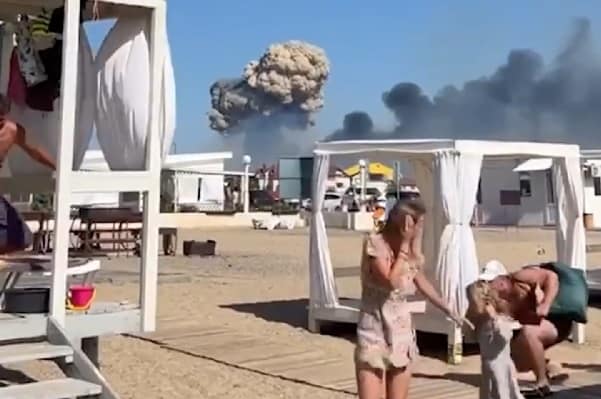
Ukraine’s long-range strike campaign has steadily targeted fuel depots, logistics hubs, rail infrastructure and military supply routes across southern occupied Ukraine. Reports emerging from occupied Crimea now indicate growing fuel shortages, long queues at petrol stations and restrictions on fuel purchases as Russian logistics come under increasing pressure.
⛽️ Fuel shortages in occupied Crimea are becoming increasingly difficult to ignore.
The occupation authorities have now limited sales of AI-95 petrol to just 20 litres per person, once per day, as long queues continue to form at filling stations across the peninsula. pic.twitter.com/mIDkNAo7nB
— Shaun Pinner (@ShaunPinnerUA) May 31, 2026
This is precisely why Moscow’s rhetoric is becoming louder. The more pressure Ukraine places on Crimea, the more Russia appears compelled to change the subject, because losing Crimea would not simply represent a military setback, it would undermine one of the central justifications for Putin’s entire war, because Crimea is more than territory, it is political symbolism.
It is legitimacy.
It is one of the foundations upon which Putin built his image as the leader who restored Russian power and the loss of Crimea would shatter the illusion of inevitability that Putin has carefully constructed.
But more importantly for the first time in a long time, Ukraine is not simply surviving. It’s creating strategic pressure on one of Russia’s most important vulnerabilities & Crimea increasingly appears to be the place where that calculation may eventually be made.
Which is perhaps why Putin spends so much time talking about NATO, nuclear weapons and escalation.
Because the one conversation the Kremlin cannot afford to have is about Crimea.


Leave a Comment