
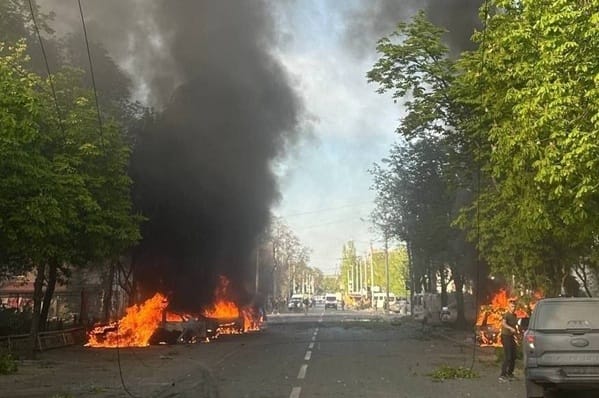
I was actually a guest on Letters from Ukraine, an X Space discussing the growing pressure on Crimea and Russia’s increasingly vulnerable southern land corridor, when the air raid alarm sounded.
Moments later, explosions reverberated through the floor beneath me. In the early hours of the morning, I made my exit from the broadcast, grabbed the cat, and followed my wife to the shelter.
At first, it was difficult to tell whether it was a ballistic missile impact or air defence engaging incoming targets. These days, Ukrainian air defence systems often fire in coordinated volleys from around the city, a notable change from even 12 months ago and a reflection of how the war, and Ukraine’s ability to defend itself, continues to evolve.
Overnight, Russia launched one of the largest aerial attacks of the war, firing an estimated 656 drones and 73 missiles against targets across Ukraine in a coordinated assault stretching from Kyiv, Dnipro, Zaporizhzhia, Kharkiv, Poltava, and beyond.
Ukrainian officials reported at the time of writing this that at least 11 people were killed, but that figure is expected to rise, while more than 100 were injured as residential buildings, infrastructure and civilian areas came under sustained attack. Ukrainian air defence forces reportedly intercepted 602 drones and 40 missiles, but dozens of impacts were still recorded across the country.
Kyiv was once again the primary target. Residential buildings were struck across multiple districts, with emergency services continuing rescue operations throughout the morning. In Dnipro, six people were reported killed, including an emergency responder who died while responding to an earlier strike. Across Ukraine, homes, schools, transport infrastructure and civilian facilities were damaged.
Let’s be clear about what happened.
This was a terrorist attack.
A young victim of Russia's overnight attack on Dnipro was a 3-year-old boy.
Rescuers recovered his body from beneath the rubble of a four-story apartment building destroyed by a Russian strike.
A child who should have had his whole life ahead of him.
My deepest condolences to… pic.twitter.com/4pvXk1RLu5
— Yulia Svyrydenko (@Svyrydenko_Y) June 2, 2026
The overwhelming majority of impacts occurred in or around civilian residential areas, continuing a pattern that Ukraine has endured for more than four years. These attacks are designed not merely to destroy infrastructure, but to spread fear among the civilian population and undermine public morale.
President Volodymyr Zelensky had warned only days earlier that Ukrainian intelligence indicated Russia was preparing another large-scale strike. Following the attack, Ukrainian officials renewed calls for additional air defence systems, particularly anti-ballistic capabilities, as Russia continues to rely heavily on missile attacks against civilian centres.
The scale of the attack is significant, but it is equally important to understand what may be driving it.
In my previous analysis, I examined the growing pressure on Crimea and Russia’s southern land corridor.
Let’s talk about Crimea. Because Putin wants you talking about everything else.
NATO. Nuclear threats. Belarus. Escalation. Red lines.Anything except the one issue that could become the greatest strategic failure of his entire reign.
Crimea is the prize he built his legacy on.… pic.twitter.com/MCYBdLrfPI
— Shaun Pinner (@ShaunPinnerUA) June 2, 2026
It is difficult to ignore the timing.
For four years, that corridor has been one of the Kremlin’s most important strategic achievements, connecting occupied Crimea directly to mainland Russia through occupied parts of southern Ukraine. It serves as the logistical lifeline that allows Russia to move troops, ammunition, fuel and equipment into occupied territory.
That advantage is now under increasing pressure.
Only hours before the attack, Zelensky stated that Ukrainian forces now have the capability to strike Russian military logistics throughout virtually the entire occupied south and east. He went further, declaring that there are now “practically no safe roads left” for Russian forces across large parts of occupied territory.
He also revealed that Ukraine has struck 15 Russian oil refineries between January and May alone, contributing to growing fuel shortages and increasing logistical strain.
Recent reports of fuel rationing in Crimea, restrictions on gasoline sales, strikes against refineries, oil depots and transport infrastructure all point to a wider campaign aimed at weakening Russia’s ability to sustain operations in the south.
The battlefield effects may not be immediately visible on a map, but they are becoming increasingly visible throughout Russia’s logistics network.
This is why Crimea matters.
If Russia loses its ability to effectively supply Crimea, the peninsula becomes far more difficult to defend and far less useful as a military hub. More importantly for Vladimir Putin, Crimea is not simply territory, it has become one of the central pillars of his legitimacy and one of the few achievements he can still point to after years of war.
Which is precisely why the distractions will continue.
The Kremlin wants the conversation focused on nuclear threats, NATO escalation, mass drone attacks, missile barrages, and fears of wider war. It wants headlines dominated by destruction and fear.
But beneath the noise, the strategic reality remains unchanged, the question that increasingly matters is not how many missiles Russia can launch at Ukraine, but whether Russia can continue to hold Crimea if the corridor that sustains it is slowly being strangled. If that pressure continues to grow, the consequences for Putin could be far greater than any single overnight attack.
And that may be exactly why he wants the world talking about everything else.


Leave a Comment