
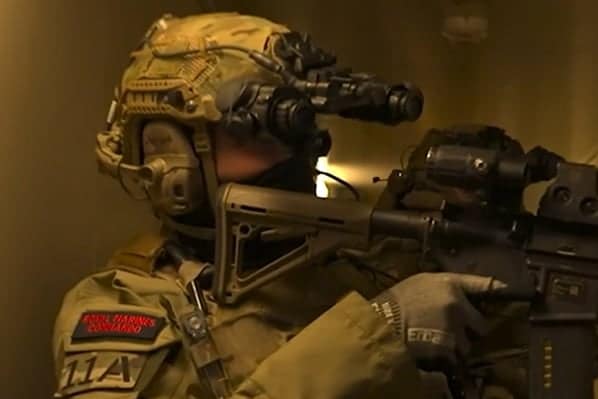
In the dead of night, as most of Britain slept, Royal Marines descended on a vessel at the heart of one of Vladimir Putin’s most important wartime operations.
Fast ropes dropped from helicopters. Warships closed in. Surveillance aircraft circled overhead.
By dawn, the Russian-linked tanker had been intercepted, boarded and placed under British control.
The dramatic six-hour operation in the English Channel marks the first time Britain has directly targeted a vessel from Russia’s notorious “shadow fleet” — the sprawling armada of ageing tankers that has helped keep billions flowing into the Kremlin despite years of Western sanctions.
For Downing Street, it represents a significant escalation in the economic war against Moscow.
For the Kremlin, it is a warning that the net is tightening.
Sir Keir Starmer described the operation as “another blow to Russia”, declaring that those helping to fund Putin’s invasion of Ukraine “cannot hide”.
But behind the political statements lies a far larger strategic battle.
Since the invasion of Ukraine, Russia has built a vast maritime network designed to evade Western sanctions and keep its oil exports moving across the globe.
The so-called shadow fleet has become one of the Kremlin’s most valuable weapons.
For the first time, Great Britain 🇬🇧 seized a Russian ship: a video of the night operation by British forces from the tanker "Smyrtos". pic.twitter.com/VxCj3dq61a
— Shaun Pinner (@ShaunPinnerUA) June 14, 2026
Operating behind layers of shell companies, obscure ownership structures and foreign flags, the vessels transport millions of barrels of oil that help fund Russia’s military machine.
Many switch off tracking systems.
Some broadcast false locations.
Others conduct clandestine ship-to-ship transfers far from the gaze of regulators.
The result is an enormous floating grey market that Western governments have struggled to contain.
Sunday’s operation suggests Britain has decided merely tracking the fleet is no longer enough.
According to the Ministry of Defence, the sanctioned tanker Smyrtos was intercepted by a force involving Royal Marine commandos, National Crime Agency officers, Royal Navy warships and RAF surveillance assets.
HMS Sutherland and HMS Ledbury supported the mission while helicopters and maritime patrol aircraft monitored the vessel’s movements.
The tanker will now remain anchored off the south coast under British supervision.
Defence Secretary Dan Jarvis hailed the operation as a direct strike against the financial foundations of Putin’s war.
“Russia relies on its shadow fleet to fund their conflict in Ukraine,” he said. “Our interdiction delivers a blow to Putin’s illegal war.”
The significance of the operation extends far beyond a single ship.
Western intelligence agencies increasingly believe Russia’s ability to sustain its military campaign depends heavily on revenues generated through sanctions-busting oil exports.
Every tanker disrupted creates additional pressure on a Russian economy already straining under the weight of war.
The shadow fleet has also become a growing security concern in its own right.
Many of the vessels are ageing tankers purchased cheaply and operated with minimal oversight.
Maritime experts have repeatedly warned that an accident involving one of these ships in European waters could trigger a major environmental disaster.
For Britain, therefore, the operation serves multiple purposes: enforcing sanctions, protecting shipping routes and demonstrating resolve at a time when the confrontation between Russia and the West shows little sign of easing.
Attorney General Lord Hermer said the Government had promised to pursue the shadow fleet using “the full force of international law”.
The message was unmistakable.
For years, Russia’s ghost fleet has operated in the shadows, exploiting loopholes, false identities and weak enforcement.
Now Britain has shown it is willing to go beyond sanctions lists and diplomatic statements.
The battle against Putin’s war machine is no longer being fought solely in Ukraine’s trenches.
It is being fought on the high seas, in shipping lanes and oil routes that stretch from the Baltic to the English Channel.
And in the early hours of Sunday morning, one of those routes suddenly became a far more dangerous place for Moscow’s shadow fleet.


Leave a Comment