
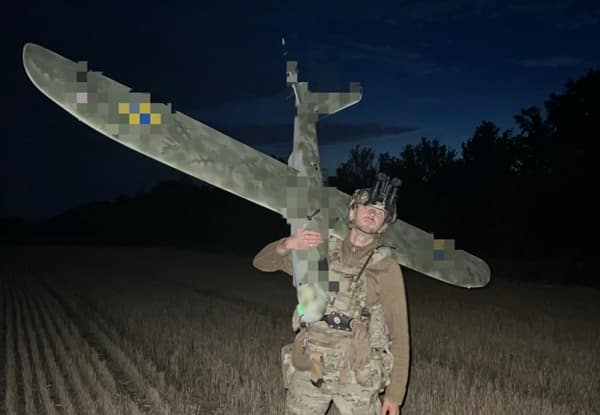
In a war increasingly defined by technology, few people are better placed to explain Ukraine’s battlefield transformation than Dimko Zhluktenko.
A Ukrainian soldier, former drone pilot, author, charity founder and one of the country’s leading experts on drone warfare, Dimko joined me this week for an in-depth discussion on the realities of modern combat, the evolution of unmanned systems, and why Ukraine may now hold the initiative after more than four years of full-scale war.
For many Ukrainians, the war began long before February 2022. For Dimko, who spent years travelling the world as a successful IT professional and digital nomad, Russia’s invasion abruptly ended a life that had revolved around freedom, travel and technology.
“We were enjoying our best lives,” he explained. “Travelling around the world, visiting places like Colombia and working remotely.”
Everything changed on the morning of February 24th.
Awoken by a phone call informing him that Russia had launched its long-anticipated invasion, Dimko quickly found himself facing the same question as millions of Ukrainians: what now?
His answer was simple.
Ukraine’s survival depended on ordinary people stepping forward.
“Our existence as Ukrainians depends on whether we fight or not,” he told me.
Initially, Dimko focused on supporting the war effort through his charity organisation, Dzyga’s Paw Fund. Named after his dog, the charity has since raised more than $6 million to support Ukraine’s military, particularly in technological innovation and drone procurement.
Eventually, however, he felt compelled to do more.
Healthy, capable and determined to contribute directly, he joined the Armed Forces of Ukraine, later becoming a drone operator on the eastern front.
The discussion quickly moved to the subject that has made Dimko one of Ukraine’s most recognised military commentators: drone warfare.

When Russia launched its invasion in 2022, drones played a relatively limited role. Most were used for reconnaissance or targeting high-value military assets. Today, they have fundamentally reshaped the battlefield.
According to Dimko, more than 80 percent of Russian casualties are now caused directly by drones.
That figure alone demonstrates how dramatically warfare has changed.
What was once a battlefield dominated by artillery, tanks and infantry assaults has become a contest of sensors, software, electronic warfare and unmanned systems.
FPV drones now hunt individual soldiers. Bomber drones deliver precision munitions onto trenches and vehicles. Mid-range strike drones target Russian logistics hubs, fuel convoys and supply routes dozens or even hundreds of kilometres behind the front line.
Meanwhile, long-range Ukrainian strike drones continue reaching deep inside Russia itself.
The strategic implications are enormous.

One of the most fascinating aspects of the conversation was Dimko’s explanation of how Ukraine has turned Russian geography against itself.
Russia’s greatest military advantage has traditionally been its size. Today, Ukraine’s growing arsenal of long-range drones is exposing the weaknesses that size creates.
“There isn’t enough air defence Russia can build quickly enough to defend everything,” he explained.
Fuel depots, military factories, training grounds, ammunition stores and transport infrastructure have all become viable targets.
As a result, Ukraine is increasingly able to impose what Dimko described as “Ukrainian sanctions” on Russia’s war economy.
The discussion also touched on Crimea, which both of us agreed remains central to the future of the conflict.
For years, Ukraine’s strategic objective was simple survival. Today, there is a growing sense that Kyiv can see a potential pathway to victory.
Pressure on Russian logistics routes running through occupied southern Ukraine, combined with sustained attacks on military infrastructure in Crimea, is creating new opportunities.
Dimko believes Ukraine currently holds the initiative.
“We have the technological advantage,” he said. “We are making them feel the consequences of their decisions.”
That does not mean liberating occupied territory will be easy.
Defensive warfare still favours Ukraine. Large-scale offensive operations remain extremely difficult in an era where drones can dominate vast stretches of battlefield.
Nevertheless, the conversation highlighted a significant shift in thinking.
For much of the war, discussion focused on whether Ukraine could survive.
Now, increasingly, analysts are asking how Ukraine might eventually win.
One of the more sobering moments came when discussing the future of warfare beyond Ukraine.
Dimko was unequivocal that NATO militaries must learn from Ukraine’s experience.
Many Western armies continue to structure themselves around concepts developed decades ago. Yet Ukraine’s battlefield has already demonstrated that even the most sophisticated armoured formations are vulnerable to mass drone attacks.
“FPV drones and bomber drones are essential capabilities now,” he said.
The lessons learned in Ukraine are already influencing military planners across Europe and North America, but Dimko warned that many countries remain dangerously behind.
Finally, our conversation returned to the human dimension of war.
Despite discussing drones, logistics and battlefield innovation, Dimko repeatedly emphasised that Ukraine’s greatest strength remains its people.
The sacrifices made by soldiers, volunteers and families continue to underpin the country’s resistance.
When I asked what he hoped future generations would understand about this period, his answer was simple.
“Freedom isn’t free.”
It was perhaps the most important lesson from our discussion.
Behind every drone strike, battlefield map and military innovation are ordinary people who chose not to walk away when their country needed them.
As Ukraine’s war enters another critical phase, voices like Dimko’s provide a valuable reminder that while technology may be changing warfare, the courage required to fight it remains very much the same.


Leave a Comment