
A night of violence on the streets of Belfast has reignited a fierce debate over immigration and community tensions in Northern Ireland after a Sudanese asylum seeker was charged in connection with a brutal stabbing that left a man fighting for his life.
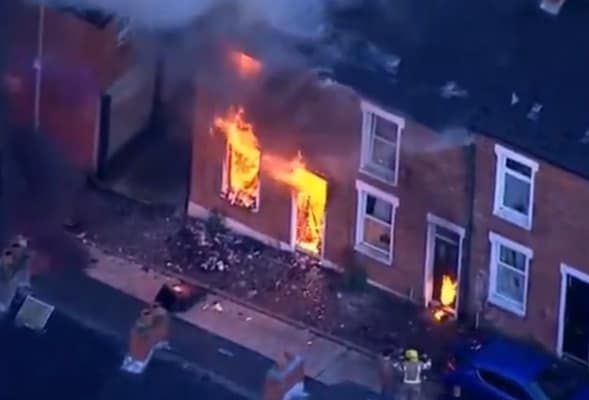
What began as public anger over Monday night’s attack quickly descended into disorder, with vehicles torched, homes damaged and residents forced to flee as crowds gathered across parts of the city.
Police charged a 30-year-old Sudanese man with attempted murder, possession of a bladed article and making threats to kill following the incident in Kinnaird Avenue. He is due to appear before Belfast Magistrates’ Court.
The attack has sent shockwaves through the city after graphic footage circulated online, appearing to show a man repeatedly stabbing another in a residential street.
As news of the suspect’s identity spread, crowds gathered in several parts of Belfast on Tuesday evening. What began as protests rapidly escalated into scenes of disorder.
A Glider bus was set ablaze in east Belfast, while cars were torched and roads blocked. In one area, families had to be evacuated from their homes after fires spread to residential properties.
Fire crews and police were deployed across multiple flashpoints as authorities struggled to contain the unrest.
Political leaders moved swiftly to condemn the violence.
BREAKING: Protesters in Belfast are going house to house looking for migrants and evicting them. pic.twitter.com/2Dchx5sWHq
— World Source News (@Worldsource24) June 9, 2026
Ulster Unionist leader Jon Burrows described the scenes as “absolutely horrendous”, claiming many of those involved were teenagers and younger children.
“These were mostly children less than 16, faces covered and believing that their patriotic duty was to go and set fire to a bus and target homes linked to immigrants,” he said.
“There is no place for this in our society.”
However, the disorder has also exposed growing public anxiety over immigration, asylum accommodation and community integration — issues that have become increasingly contentious across the United Kingdom.
Critics argue that public confidence has been eroded by rising asylum numbers and concerns about how accommodation is allocated, while ministers insist communities must not use isolated criminal incidents to stigmatise entire groups.
In Belfast, the rioters are vandalising houses marked to be of Non-White immigrants. pic.twitter.com/nF5ZyEumdu
— DOZA🧐 (@lil_doza) June 9, 2026
Northern Ireland Justice Minister Naomi Long blamed far-right activists for inflaming tensions online, accusing agitators of exploiting the stabbing to fuel racial hostility.
“We saw a rush to social media from commentators clearly trying to stoke racial tension,” she said.
Her intervention is unlikely to end the political argument.
🛑#BREAKING this is EXCLUSIVE footage from the streets of Belfast as we speak the main steam media is not doing justice on there reporting people are really angry tonight❗️❗️❗️❗️#belfast #uk #news #riot #protest pic.twitter.com/icVwe2IeZL
— RTI OSINT (real time intelligence) (@RTI_imtel) June 9, 2026
Immigration has become one of the defining issues of British politics, with concerns over illegal migration, asylum processing and integration dominating public debate ahead of future elections.
For many residents, the violence in Belfast represented the collision of two separate crises: public anger over a shocking act of violence and deep frustration over wider immigration policy.
Police have stressed that the investigation into the stabbing remains ongoing and have urged the public not to speculate about the motive or share graphic footage circulating online.
But with a man critically injured, streets scarred by fire damage and political leaders trading blame, the events in Belfast have once again exposed how quickly local tragedies can become flashpoints in Britain’s increasingly polarised immigration debate.


Leave a Comment