
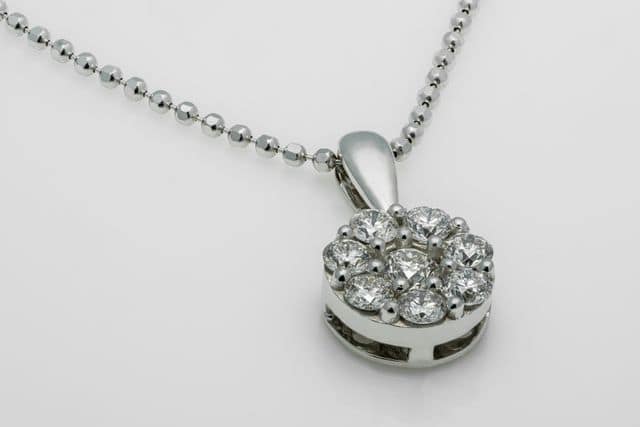
A floating diamond necklace looks like a small trick. The stone sits against the skin with nothing visibly holding it, catching light from every angle because almost no metal interrupts it.
The obvious question follows immediately. If you cannot see what is holding the diamond, what exactly is holding the diamond?
Key takeaways
- Floating settings work by minimising or hiding metal rather than removing it.
- Drilled diamonds are pierced with a laser and threaded directly onto the chain, which is the most invisible method.
- Bezel settings surround the stone with a thin rim of gold that reads as almost nothing from any normal distance.
- Chain gauge matters as much as carat weight, because a heavy chain destroys the effect.
- Solid gold rather than plated is the practical requirement for a piece worn daily against skin.
What floating actually means
The term describes an appearance rather than a specific technique. A floating diamond appears suspended, with no prongs reaching over the stone and no visible mount beneath it.
Traditional settings work the opposite way. Prongs grip the stone from above, and a gallery or basket sits underneath, both of which are visible and both of which block light entering from behind.
Removing that structure is what produces the effect. Less metal means more light reaching the stone from more directions, which is why a modest floating diamond often reads brighter than a larger stone in a heavy setting.
The three ways it is achieved
Drilled or pierced diamonds. A fine hole is laser-drilled through the stone and the chain passes directly through it. Nothing sits above or below the diamond at all, which makes this the most literally floating of the three.
Bezel settings. A thin rim of gold wraps the girdle of the stone, holding it securely while keeping the profile very low. From arm’s length, the rim reads as a faint outline rather than as a setting.
Minimal prong and illusion mounts. Slender prongs are positioned so they disappear against the stone’s own facets, sometimes combined with a mount finished to reflect light rather than absorb it.
Each trades differently between invisibility and protection. Drilled stones give the purest effect, bezels give the most protection, and minimal prongs sit between the two.
Worth knowing that not every stone can be drilled. The technique suits round brilliants and certain fancy shapes, and a jeweller will steer away from stones where drilling would sit too close to an inclusion.
Are they actually secure?
This is the question that stops people buying, and it deserves a straight answer. The stone is held properly in all three methods, though the security profile differs.
A bezel is arguably the most secure setting in fine jewellery, prongs included, because it surrounds the entire girdle rather than gripping at four or six points. There is nothing to catch on clothing and nothing to bend out of position.
Drilled diamonds are secure in a different way. The stone cannot fall out of a setting because there is no setting to fall out of, and the drilling is done to a diameter that leaves the stone structurally sound.
The genuine weak point in any delicate necklace is the chain and clasp rather than the stone. That is where wear happens and where a failure will occur first, which is why chain quality matters more than most buyers realise.
Chain gauge is half the design
Get this wrong, and the effect disappears entirely. A floating diamond needs a chain fine enough to recede visually, because a substantial chain reasserts itself and the stone stops looking suspended.
The tension runs against durability. Finer chains produce a better illusion and are more vulnerable to snagging, so the sensible middle ground is a fine cable chain in solid gold rather than the thinnest available option.
Check the clasp and the extender too. A well-made piece uses a clasp proportionate to the chain, and an extender lets you wear the same necklace at two lengths for layering.
Choosing a carat size
Floating settings change the maths on stone size. Because no metal blocks light, a smaller diamond in a floating mount can appear livelier than a larger one in a traditional setting.
Very small stones, in the region of a tenth of a carat, read as a point of light rather than as a recognisable diamond. That is often exactly the intention for everyday wear.
Larger stones shift the piece from subtle to noticeable, and beyond roughly half a carat the chain needs to step up slightly in gauge to carry the weight comfortably. Ask about that pairing rather than assuming any stone works on any chain.
Millimeter diameter is often more useful than carat weight here. Two stones of identical weight can differ in face-up size depending on cut, and face-up size is what you actually see.
Metal colour changes the illusion
Yellow gold contrasts with a white diamond, so the setting is marginally more visible while the stone reads brighter against warm metal. It is the traditional choice and the most forgiving on most skin tones.
Consider what else you wear before deciding. A floating necklace is usually layered with other pieces, and mixing metals works far better when it looks deliberate rather than accidental.
White gold disappears against the stone more completely, which strengthens the floating effect. The trade-off is that white gold typically carries a rhodium finish that needs periodic reapplication.
Rose gold sits between the two and reads as the most contemporary. The diamond stands out clearly against it while the setting stays quiet.
Solid gold versus plated

Photo by Diai Desai on Unsplash
For a piece worn daily against skin, this matters more than the diamond. Plated jewellery wears through at contact points, and the base metal underneath can react, while solid gold does not tarnish, peel, or leave marks.
Karat affects both colour and hardness. Fourteen karat is the common choice for fine chains because it balances warmth with enough hardness to survive daily wear, while ten karat is harder still and eighteen karat is softer and richer in tone.
Anyone browsing ENEA’s floating diamond necklaces will notice pieces offered in both ten and fourteen karat, which is a genuine choice rather than a pricing tier.
Handcrafting in solid gold with lab-grown stones is a fair benchmark for what this category should look like.
Lab-grown diamonds in delicate settings
Lab-grown diamonds share the same crystal structure, hardness, and optical properties as mined stones. They are diamonds rather than simulants, which matters in a setting this exposed.
Hardness is the practical point. A floating stone sits proud of the chain and takes contact that a recessed stone would not, so material that scores ten on the Mohs scale is doing real work.
Ask for the stone specification regardless of origin. Cut quality affects brilliance more than any other factor, and in a floating setting there is nowhere for a poorly cut stone to hide.
Care and everyday wear
Take it off before swimming, showering with product, and applying anything sprayed. Chlorine, sulfur compounds, and residue from lotions and perfumes all dull a diamond and can affect alloys over time.
Clean gently with warm water, a drop of mild soap, and a soft brush, then dry fully. Diamonds attract grease readily, and a film of it dims the stone faster than any scratch will.
Store pieces separately rather than tangled together. Fine chains knot easily, and diamonds scratch other gemstones and softer gold surfaces.
Have the chain and clasp checked periodically if you wear a piece daily. A jeweller can spot a thinning link or a tiring clasp long before it fails, and replacing either is far cheaper than replacing the necklace.
Conclusion
The floating effect is engineering rather than illusion. Drilling, bezel work, and carefully positioned prongs each remove visible metal differently, and each holds the stone properly while doing it.
Judge a piece on the chain as much as the diamond, choose solid gold if it will be worn daily, and match stone size to the chain it sits on. Those three decisions determine whether a floating necklace still looks right in five years.
Floating diamond necklace FAQs
What is a floating diamond necklace? A necklace where the diamond appears suspended with no visible metal above or below it. The effect comes from drilled stones, bezel settings or minimal prongs.
How is the diamond held in place? Either by a laser-drilled hole through the stone that the chain passes through, by a thin bezel around the girdle, or by slender prongs positioned to disappear against the facets.
Are floating diamond necklaces secure? Yes, when well made. Bezel settings are among the most secure in fine jewellery, and a drilled stone cannot fall out of a setting because there is none.
Does drilling damage the diamond? Not when done correctly. The hole is fine and positioned so the stone remains structurally sound.
What carat size should I choose? Around a tenth of a carat reads as a point of light for everyday wear. Half a carat and above becomes noticeably more prominent and may need a slightly heavier chain.
Which gold colour works best? White gold gives the strongest floating effect, yellow gold is the traditional and most forgiving choice, and rose gold sits between them.
Is solid gold necessary? For daily wear against skin, yes. Plated pieces wear through at contact points, and the base metal beneath can react.
Are lab-grown diamonds real diamonds? Yes. They share the same crystal structure, hardness, and optical properties as mined diamonds.
Can I layer floating necklaces? Yes, and they suit layering well because the fine chains sit flat. Vary the lengths and use an extender to avoid tangling.
How do I clean one? Warm water, a drop of mild soap, and a soft brush, then dry fully. Remove it before swimming or applying lotions and sprays.





Leave a Comment