
The British pound’s move against the US dollar is no longer simply a reflection of the interest-rate differential between the Bank of England and the Federal Reserve.
Instead, it has become the result of a complex interaction between monetary policy expectations, the inflation trajectory, the resilience of the UK economy, the direction of the US dollar, and geopolitical risks that continue to reshape the global energy landscape.
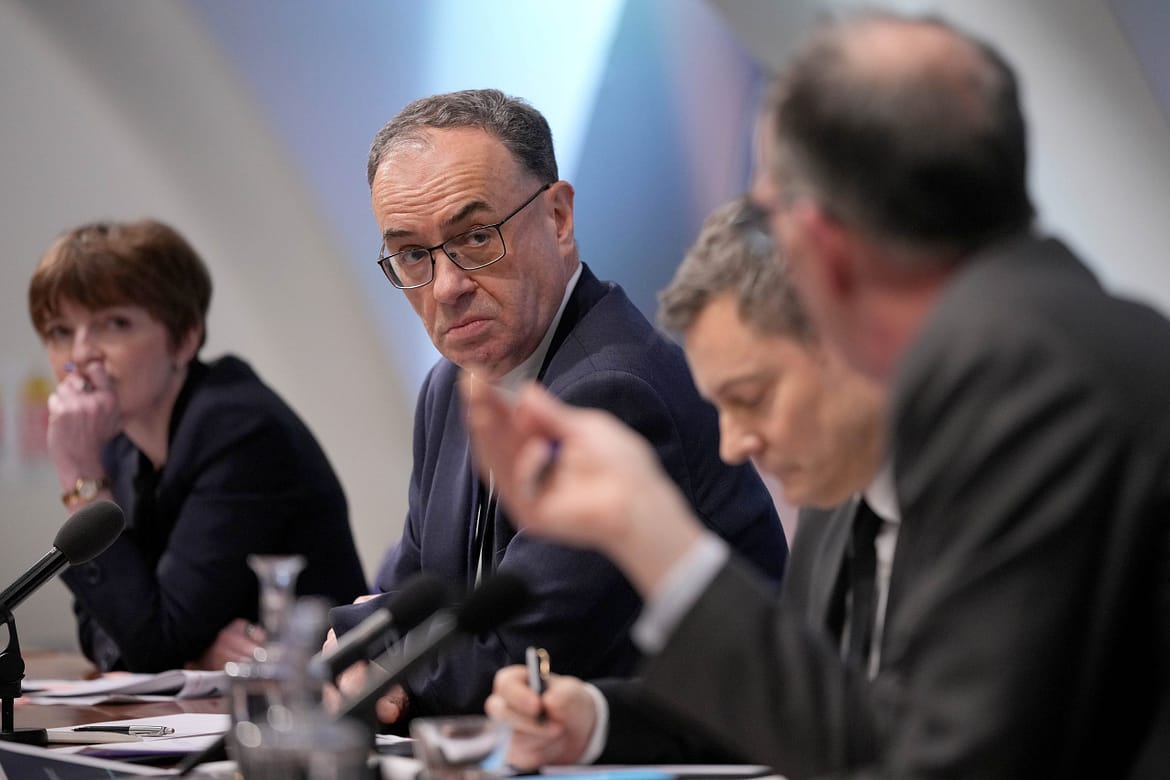
In my view, the pound’s latest marginal rise toward the 1.3548 level does not yet represent the beginning of a strong bullish wave, but it does signal an important shift in investor sentiment, particularly following the messages delivered by Bank of England Governor Andrew Bailey during his testimony before the UK Treasury Committee, where he sought to ease concerns about the British economy slipping into recession.
I believe the significance of Bailey’s remarks goes beyond simply ruling out an imminent recession scenario.
They came at a particularly sensitive time for sterling, as markets have increasingly been weighing weakening labour-market conditions and slowing economic activity against persistent inflationary pressures driven by higher energy prices.
When the central bank governor states that the economy is not on the verge of falling into recession, he gives markets room to reassess the Bank of England’s ability to keep monetary policy restrictive for longer without triggering a severe economic contraction. In my view, this represents a fundamental supportive factor for sterling, even if the near-term boost remains limited.
However, I do not believe Bailey’s comments alone are enough to transform the broader GBP/USD trend into a sustained bullish move. The key challenge for sterling is that the Bank of England itself remains divided over the appropriate path for monetary policy.
While some members of the Monetary Policy Committee believe that keeping interest rates at restrictive levels provides necessary protection against inflation risks, others are pushing for additional tightening should price pressures remain persistent, particularly amid the current energy shock. The Bank has kept interest rates at 3.75%, while market expectations continue to reflect considerable uncertainty over its next move.
From my perspective, this policy divide is not necessarily negative for sterling. In fact, it could become a supportive factor if upcoming UK data begin to show that inflation is proving more persistent than expected, or if energy prices continue to rise. Under such circumstances, the Bank of England would have less room to manoeuvre, potentially forcing markets to reprice expectations toward a more hawkish monetary-policy stance.
This scenario could provide additional support for the pound, as sterling would benefit from higher expected returns on pound-denominated assets. At the same time, however, I would rule out the prospect of an aggressive and sustained rate-hiking cycle, as weakness in the labour market and subdued economic growth will remain significant constraints on the Bank of England.
The other side of the equation is the US dollar, and this is where I believe the future direction of GBP/USD will not be determined by the UK alone. US inflation data, particularly the Producer Price Index and Consumer Price Index, will remain among the most powerful catalysts for reshaping market expectations regarding the Federal Reserve. If inflation figures come in above expectations, this could revive demand for the dollar and put pressure on sterling, even if the UK economic picture remains relatively stable. Conversely, if the data confirm that US price pressures continue to ease, sterling could have a genuine opportunity to extend its recent gains, particularly if this coincides with declining expectations for US interest-rate returns.
This is where I believe the market faces an important paradox. Rising global energy prices are not a risk exclusive to the British economy; they could also reignite inflationary pressures across the major economies. The Bank of England has already warned that higher energy prices could push inflation higher again, while oil prices are approaching elevated levels amid geopolitical tensions. In my assessment, if this shock persists, it could become a medium-term supportive factor for sterling from a monetary-policy perspective. At the same time, however, it could weigh on risk appetite and increase market volatility, making the overall outlook considerably more complicated.
As for GBP/USD price action, I believe the 1.35 area has now become an important psychological zone. It is not merely an isolated technical level, but rather an area reflecting the delicate balance between sterling strength and US dollar weakness. The pair’s ability to remain firmly above this level, alongside improving expectations for the UK economy and easing pressure on the dollar, would strengthen the case for a gradual move toward higher levels. However, a decisive return below 1.35, particularly if triggered by stronger-than-expected US inflation data, would signal that the market is still not prepared to assign sterling a sustainable bullish trend.
My base-case outlook for the coming period is that GBP/USD will remain in a volatile range with a cautious bullish bias, rather than immediately entering a strong upside trend. I believe sterling has the underlying fundamentals to remain resilient, particularly if the Bank of England continues to maintain a relatively hawkish stance relative to expectations for rate cuts. Nevertheless, I see little justification at this stage for betting on large and sustained gains before the trajectory of US inflation and the Bank of England’s monetary-policy outlook become clearer. In other words, I view sterling’s current strength as conditional rather than as a confirmed trend.
Ultimately, I believe the GBP/USD battle has entered a new phase in which the key question is no longer simply whether sterling will rise or fall, but rather which central bank will force markets to reprice their expectations first. Bailey’s comments have helped reduce recession fears and provided some support for the pound, but they have not settled the debate over the future path of UK monetary policy. At the same time, US inflation could rapidly shift the balance in favour of the dollar or against it.
Therefore, I believe the most likely scenario is continued volatility with a limited bullish bias for sterling, provided the UK economy maintains a degree of resilience, the Bank of England remains cautious about cutting interest rates, and US inflation data do not deliver a major upside surprise capable of restoring strong momentum to the dollar. In my view, for sterling to break decisively higher, it will need a clear catalyst from the US side more than it needs additional comments from UK policymakers. The British message has already reached the market; now, the direction of GBP/USD will depend largely on the US data.


Leave a Comment