
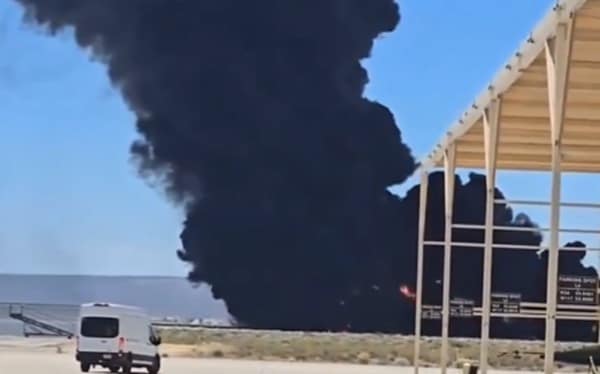
Eight people have been killed after a US Air Force B-52 Stratofortress crashed moments after taking off from one of America’s most important military testing facilities.
The ageing nuclear-capable bomber plunged to the ground shortly after departing from Edwards Air Force Base in California on Monday morning, triggering a major emergency response and prompting the immediate closure of the airfield.
Military officials confirmed that all eight people on board are believed to have been killed.
The victims include a combination of US Air Force personnel, government civilians and defence contractors, highlighting the significance of the mission being conducted at the time of the disaster.
Among the dead were two employees of aerospace giant Boeing, which is currently overseeing a major modernisation programme designed to keep the Cold War-era bomber flying for decades to come.
The aircraft crashed at approximately 11.20am local time, according to officials at Edwards Air Force Base, the vast desert installation that serves as the US Air Force’s premier flight-testing centre.
Emergency crews raced to the scene as thick plumes of smoke rose above the Mojave Desert.
Within minutes, the base was effectively locked down.
“The airfield has been closed, and all inbound aircraft are being diverted,” military officials said in a statement.
Watch 🚨: 𝐀 𝐔.𝐒. 𝐀𝐢𝐫 𝐅𝐨𝐫𝐜𝐞 𝐁-𝟓𝟐 𝐛𝐨𝐦𝐛𝐞𝐫 𝐜𝐫𝐚𝐬𝐡𝐞𝐝 shortly after takeoff from Edwards Air Force Base.
Thick black smoke was seen rising as emergency crews rushed to the site. (Representative video) pic.twitter.com/wy2by9FBcl
— FalconUpdatesHQ (@FalconUpdatesHQ) June 16, 2026
Operations have since been suspended while investigators begin the painstaking task of determining what brought down one of the most iconic aircraft in American military history.
The identities of those killed have not yet been released as officials work to notify next of kin.
The loss is likely to reverberate throughout the US military and defence industry alike.
Edwards Air Force Base occupies a unique place in aviation history.
From experimental fighter jets to cutting-edge bombers, generations of aircraft have undergone testing in the vast airspace above California’s high desert.
The B-52 involved in Monday’s crash was reportedly being used as part of an ambitious programme to modernise the bomber fleet.
The Air Force confirmed the aircraft was participating in testing connected to a sophisticated radar upgrade.
For Boeing and the Air Force, the work represents a crucial effort to extend the lifespan of a bomber first introduced during the Eisenhower administration.
The B-52 entered service in the 1950s as America prepared for the possibility of nuclear war with the Soviet Union.
More than seven decades later, it remains one of the most recognisable symbols of US military power.
Despite its age, the aircraft continues to serve as a cornerstone of America’s long-range strike capability.
The Air Force currently operates a fleet of 76 B-52s, many of which are undergoing extensive upgrades designed to keep them operational into the middle of the century.
Under a multibillion-dollar modernisation programme, the bombers are receiving new Rolls-Royce engines, advanced avionics and upgraded radar systems.
The revamped aircraft will eventually be redesignated as the B-52J and are expected to remain in service until at least 2050.
Monday’s disaster casts a shadow over that effort.
While the B-52 has experienced accidents throughout its long history, fatal crashes have become increasingly rare.
The most recent deadly incident occurred in 2008 when a B-52 crashed into the Pacific Ocean near Guam, killing all six personnel on board.
The loss of an aircraft during a modernisation test programme is likely to trigger intense scrutiny from military investigators.
Questions will inevitably focus on whether the crash was linked to the bomber’s upgrades, a mechanical failure, human error or another factor entirely.
For now, officials have refused to speculate.
As investigators comb through the wreckage in California’s desert landscape, attention is turning to a programme regarded as essential to America’s future strategic deterrent.
The B-52 was designed to survive a nuclear age.
It has outlasted presidents, wars and rival aircraft once expected to replace it.
Yet on Monday morning, one of the world’s most enduring military machines fell from the sky, leaving eight families awaiting answers and the US Air Force confronting one of its darkest days in years.


Leave a Comment