
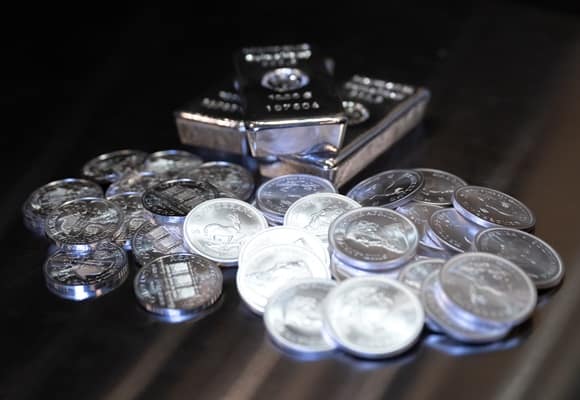
Gold gets the headlines, but silver is the more interesting metal to think about, and a more demanding one to own well. It behaves partly like a precious metal and partly like an industrial commodity, which gives it a different risk profile from gold and a different set of drivers. Handled carelessly it disappoints; handled with a bit of discipline it can be one of the more rewarding tangible assets available to a private investor.
Here is the case for silver, and the practical detail that decides whether it works for you.
Two metals in one
Silver’s dual nature is the key to understanding it. Roughly half of annual demand is industrial: silver is used in solar panels, electronics, electric vehicles, and a growing list of applications that rely on its conductivity. The other half is investment and jewellery demand, where silver plays the same store-of-value role as gold.
That split pulls the price in two directions. In a risk-off, safe-haven move, silver tends to follow gold. In an industrial expansion, it can rise on manufacturing demand even when gold is flat. And because the silver market is far smaller than gold’s, the same flow of money moves the price further, which is why silver is more volatile than gold in both directions. Investors often describe this as silver’s higher beta: it tends to fall harder than gold in a sell-off and rise faster in a rally. For a buyer who can tolerate the swings, that convexity is much of the appeal.
The gold-silver ratio
One of the most-watched gauges in the metals world is the gold-to-silver ratio, the number of ounces of silver it takes to buy a single ounce of gold. In early July 2026 the ratio sat around 67, easing from the low 70s in late June as silver’s industrial demand narrowed the spread.
The ratio is used as a relative-value signal. A historically high ratio suggests silver is cheap relative to gold and has room to catch up; a low ratio suggests the reverse. It is not a precise timing tool, and the “normal” range has drifted over the decades, but as a gauge of how the two metals are priced against each other it is a useful reference, and one reason some investors rotate between them rather than treating them as interchangeable.
The cost that quietly decides your return
Here is the practical detail most first-time silver buyers underestimate. You never pay the spot price. You pay spot plus a premium, the dealer’s markup over the metal value, and in silver that premium is proportionally much larger than in gold.
The reason is simple arithmetic. Silver is cheap by weight, so the fixed costs of fabrication, handling, and distribution are a far bigger share of the final price. A few percentage points of premium on a low-value metal is real money, it varies significantly between sellers, and it compounds across a buying programme. On a sustained silver position, the premium you pay on entry can matter as much to your return as the direction of the silver price itself.
That makes comparison shopping more valuable in silver than in almost any other bullion purchase. Before buying, it is worth using a tool that lets you compare silver bar prices across dealers on a like-for-like basis, so you pay the smallest justified premium rather than the first figure quoted. It is one of the few entry costs entirely within your control.
Bars or coins?
The premium also drives the main format decision. Silver bars carry the lowest premium over spot, especially in larger sizes where fabrication costs spread across more metal. For an investor focused on getting the most silver for their money, bars are the efficient core of a holding.
Coins carry a higher premium but buy flexibility and liquidity: they are widely recognised, easy to authenticate, and simple to sell in small increments. Many investors hold a mix, using bars for cost-efficient bulk exposure and recognised coins for the portion they may want to liquidate piecemeal. One practical note for any cross-border buyer: tax treatment of silver varies by country, so it is worth checking how your jurisdiction treats bullion before committing, since that can shift the maths between formats.
Storage and the long view
Physical silver takes up far more space than the equivalent value in gold, so storage is a genuine consideration at scale. Home storage carries security questions; third-party vaulting adds an annual cost. Neither is a dealbreaker, but both belong in the calculation, because silver’s lower value density is one of the trade-offs that comes with its higher upside.
The takeaway
Silver is a legitimate investment with a real case behind it: a genuine industrial-demand floor, a monetary role alongside gold, and more upside than gold in a strong rally. But it is not a like-for-like substitute for gold. It is more volatile, more premium-sensitive, and more demanding to buy well. Approached deliberately, with the premium kept tight and the format matched to your goal, it can earn a place in a diversified portfolio. Approached on the assumption that it behaves exactly like gold, it tends to frustrate. With silver, the discipline of the purchase matters almost as much as the thesis behind it.
The above information does not constitute any form of advice or recommendation by London Loves Business and is not intended to be relied upon by users in making (or refraining from making) any finance decisions. Appropriate independent advice should be obtained before making any such decision. London Loves Business bears no responsibility for any gains or losses.


Leave a Comment