
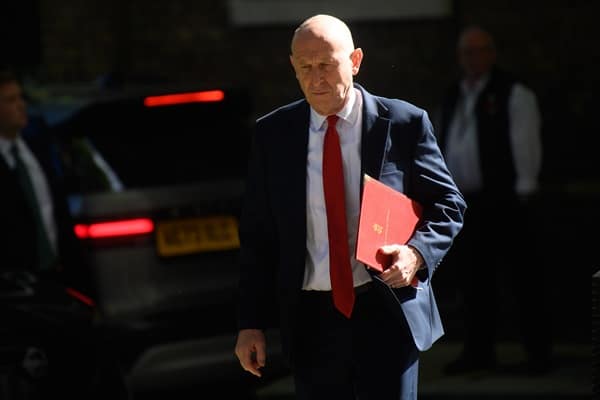
John Healey has triggered a fresh political storm over Labour’s economic credibility after refusing to guarantee that Britain’s £350bn welfare bill will begin falling before the next general election, leaving the Government exposed to accusations that its promises to control public spending lack a credible timetable.
The Chancellor insisted that the overall benefits bill “will come down under Labour”, but declined to say whether that would happen during the current parliament. His distinction between the timing of welfare reforms and the delivery of actual savings has intensified scrutiny of a Budget already criticised for failing to convince markets that the Government has a sustainable plan for the public finances.
The exchange has created an uncomfortable political problem for a government confronting mounting pressure over borrowing, taxation and the cost of sickness and disability benefits. It has also handed the Conservatives an opportunity to portray Labour as unwilling to confront the consequences of its spending commitments.
Speaking on the BBC’s Sunday With Laura Kuenssberg programme, Mr Healey rejected reports that he had committed to reducing the welfare bill before the next election.
“The overall bill will come down under Labour,” he said. “We’ll start the changes next year, and we’ll bring that bill down.”
But when challenged over the timetable, he sought to draw a distinction between introducing reforms and realising their financial benefits.
“We’ve set out the timetable for changes. We’ve never set out the timetable for savings, and some of the reporting earlier in the week was simply wrong,” he said.
That qualification is significant. The Government has committed to beginning legislative changes next year, but has not established when those measures will translate into a reduction in total welfare expenditure. The distinction leaves ministers with considerable room to argue that reform is under way even if the headline cost continues to rise.
For critics, however, it raises the question of how voters are supposed to judge whether the Government is delivering on its promises.
The financial stakes are substantial. The Office for Budget Responsibility has warned that sickness and disability benefits could cost £100bn a year before the end of the decade, adding to a wider benefits bill of approximately £350bn. The figures underline the challenge facing ministers as the number of people claiming health-related support places increasing pressure on the public finances.
Mr Healey argued that Labour had already slowed the rate at which welfare spending was increasing since taking office, contrasting its record with what he described as the rapid expansion under the Conservatives.
“Since the election, we’ve already slowed down the rate of increase in the benefits bill, which was – the numbers were booming under the Tories,” he said.
“This is a system which is not working. We have to make big changes. We will.”
The Government is awaiting two reviews that will shape its next phase of welfare policy. Social security minister Sir Stephen Timms is examining personal independence payment, or PIP, while former health secretary Alan Milburn is reviewing the relationship between young people and employment. Both reports are due this month, with a Government White Paper and legislation expected next year.
But the political difficulty is that reforms designed to reduce long-term expenditure can take years to produce measurable savings. Changes to eligibility, assessments and employment support may be announced quickly, while their effects on the overall budget emerge much more slowly.
That creates a potentially damaging gap between the Government’s rhetoric and the figures against which its performance will ultimately be judged. With the next general election due by August 15, 2029, ministers could reach the end of the parliament without demonstrating that the total welfare bill has actually fallen.
Speculation about an earlier election has added another dimension to the argument. Andy Burnham has ruled out calling a national vote in the next 12 months, but the possibility of an election before the statutory cut-off has sharpened attention on whether Labour can demonstrate tangible progress on spending before voters return to the polls.
The welfare dispute is only one part of a broader argument about the Government’s fiscal credibility.
Mr Healey also signalled that further difficult decisions on public spending would be necessary, after the Institute for Fiscal Studies questioned whether the Government could deliver its planned reductions in departmental budgets over the coming years.
Britain’s public debt stands at more than 97 per cent of national economic output, leaving ministers under pressure to demonstrate that borrowing can be brought under control without undermining essential services. Questions have been raised about whether some departments could face cuts of approximately 6 per cent over several years.
The Chancellor defended the Government’s willingness to make difficult choices.
“In this Budget, we’ve already demonstrated we are prepared to take hard decisions about the priorities in Government,” he said.
“We will carry that through into the 10-year plan and the spending review next year.”
Yet the Institute for Fiscal Studies’ concerns point to a wider problem: the credibility of spending plans depends not simply on the targets ministers announce, but on whether they can withstand the political and economic pressures that emerge when those targets have to be implemented.
Mr Healey also declined to guarantee that Labour would meet its manifesto pledge to ensure younger workers on the minimum wage receive the same rate of pay as older workers before the next election. He said the Government would “take it one step at a time”, raising the prospect that the commitment to end what Labour calls “discriminatory age bands” could be delayed.
The accumulation of qualifications has provided fresh ammunition for Conservative leader Kemi Badenoch, who has accused Labour of leaving a £49bn “black hole” in the nation’s finances.
The Conservatives claim the Government could ultimately need to raise taxes by £1,700 per household annually by 2030-31 to meet unfunded spending commitments and wider pressures on public expenditure.
Their calculation includes an estimated £17bn for a National Care Service, £4bn for council house-building and a further £28bn in what they describe as plausible spending pressures identified by the Institute for Fiscal Studies.
The figures are Conservative estimates rather than announced tax increases, but they have intensified the political argument over whether Labour’s spending ambitions can be reconciled with its commitment to fiscal discipline.
In an article for the Sunday Telegraph, Ms Badenoch seized on comments by the Prime Minister suggesting he would have written Labour’s 2024 election manifesto differently.
“The Prime Minister gave the game away on Friday when he said he would have written the 2024 manifesto differently,” she wrote.
“Let me translate that. He wishes he had more room to raise taxes even further.”
The Treasury rejected the Conservatives’ allegations, saying: “This is fiction. The Budget meets our fiscal rules, fully funds our Defence Investment Plan and puts borrowing on a clear downward path.”
But the Government faces criticism from beyond the Conservative opposition. Andy Haldane, the former Bank of England chief economist and a former economic adviser to Mr Burnham, described the Budget as insufficient to reassure investors about the direction of economic policy.
Haldane was asked about his earlier observation that the market “suspects that this is a traditional tax-and-spend socialist government with better TikTok videos”.
He suggested that the Budget had done little to dispel that perception.
“The markets still have those fears,” he said. “We are in a public finance mess.”
He described the Budget as “small beer”, arguing that it had failed to deliver a decisive response to concerns over economic growth or the Government’s fiscal position.
“A no score draw Budget for growth, a no score draw Budget for burnishing our fiscal credentials,” he said.
“More is needed of a radical nature. This week’s Budget was not that radical budget.”
His intervention highlights the challenge facing ministers as they attempt to reassure financial markets while maintaining the political coalition that brought Labour to power. A government promising to improve public services, strengthen defence, reform welfare and support economic growth must also explain how it intends to pay for those commitments.
The welfare bill has become a particularly exposed test because it combines an immediate fiscal problem with difficult questions about employment, disability and the capacity of public services to support people back into work.
For Labour, announcing reforms is only the beginning. The Government must persuade voters that those changes will produce meaningful savings without abandoning people who genuinely need support. It must also convince investors that its spending plans are more than aspirations.
Mr Healey’s refusal to specify when the benefits bill will fall may have bought ministers time to complete their reviews and prepare legislation. But it has left the central question unanswered: if the welfare bill is to come down under Labour, when will the public actually see it happen?
With debt elevated, departmental budgets under scrutiny and the next election approaching, that question is becoming harder for the Chancellor to avoid.


Leave a Comment