
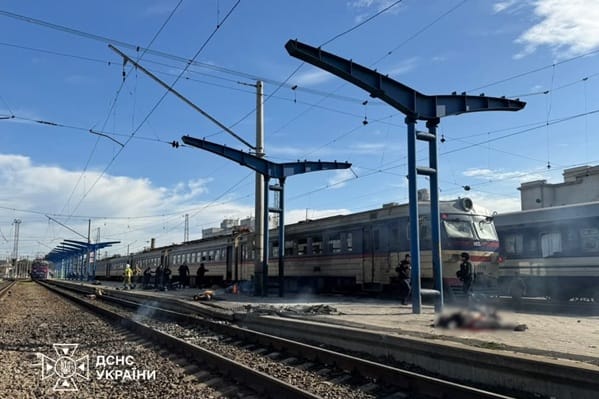
Thirteen people have been killed and at least 13 wounded after a Russian jet-powered drone struck a crowded railway platform in my home city of Dnipro on Thursday morning, 29 October.
A civilian railway station, ordinary passengers and another devastating reminder of the reality of Russia’s war against Ukraine and its population.
The attack occurred shortly before 11:00 am, with Ukraine’s Air Force reporting a jet-powered Russian drone over Dnipro at approximately 10:50 am.
Within minutes, reports began emerging of a devastating strike on the city’s main railway station, where passengers were waiting to board trains or preparing to depart.
Ukrainian Railways said the drone struck a platform where Train No. 866, operating between Dnipro and Zaporizhzhia, was standing.
President Volodymyr Zelenskyy immediately condemned the attack, confirming that both a commuter train and a scheduled passenger service were at the station.
In a statement following the attack, Zelenskyy said: “A horrific Russian strike on the railway station in Dnipro. The Russians launched a drone attack on a platform where an ordinary commuter train and a scheduled passenger train were standing. Unfortunately, 13 people have been confirmed killed as of now.”
Read more related news:
From ‘the Kremlin to The Hague? UN findings renew questions over accountability for Russia’s war in Ukraine
‘The risk of being killed is very high’ Russian children sent to the front as Putin’s war grinds on
Putin and Iran’s President deliver chilling nuclear message to Trump
As emergency services rushed to the scene, ambulances began transporting the wounded to hospitals across the city. Regional governor Oleksandr Hanzha subsequently confirmed that 13 people had been injured, four of them seriously, including an 11-year-old boy, two men aged 40 and 53, and a 26-year-old woman.
Ukrainian Railways confirmed that an elevated threat warning had been issued before the strike, but passengers were still present on the platform when the drone hit. Rescue workers, paramedics, and police were deployed to help the injured and secure the area.
These were ordinary people going about their lives, travelling to work, visiting family or simply trying to get from one Ukrainian city to another. Instead, they found themselves caught in another deadly Russian attack, this time against a transport network used by millions of Ukrainian civilians.
And this is precisely what I have been warning about in my reporting on Russia’s increasingly dangerous campaign against Ukraine’s railway infrastructure. The targeting of passenger services, railway stations and civilian transport routes is no longer an isolated occurrence. It is an escalating threat, and today’s appalling loss of life in my own city demonstrates exactly why those warnings must be taken seriously.
The railway campaign I warned about
Over recent months, I have repeatedly reported on Russia’s escalating attacks against Ukraine’s railway network, including strikes on passenger services, locomotives, stations and critical transport infrastructure.
My reporting has highlighted the increasing danger to civilian rail travel, particularly as Russian drones become more capable of reaching moving targets and infrastructure far beyond the immediate frontline.
Ukraine’s railway system is not simply a transport network, but a lifeline connecting families, evacuating civilians and maintaining essential services across a country at war. In September alone, Ukrainian Railways reported that passengers had been evacuated from more than 5,800 services because of Russian drone threats.
Today’s massacre in Dnipro demonstrates just how deadly that threat has become.
There is an important distinction between attacking a legitimate military transport target and striking a platform crowded with civilian passengers, and this is far from the first time, while International humanitarian law demands that distinction be respected. Russia’s conduct must be examined against the mounting evidence of attacks on civilian infrastructure across Ukraine, but the salience id deafening.
The United Nations has already reached its conclusions
Just three days ago, on 26 October, the United Nations Independent International Commission of Inquiry on Ukraine published findings concluding that Russian authorities had committed war crimes through intentionally directing attacks against civilian objects, alongside crimes against humanity arising from systematic attacks on Ukraine’s energy infrastructure.
The Commission found evidence that these attacks were carried out deliberately, under a state policy intended to deprive civilians of electricity and essential services, causing widespread suffering.
These findings concern energy infrastructure, rather than a legal determination about today’s railway strike, nevertheless, they establish something profoundly important, international investigators are documenting criminal conduct, examining intent and identifying patterns of state responsibility.
The evidence is accumulating, while The United Nations has also verified that at least 328 civilians were killed and 2,105 injured across Ukraine in September alone.
Yet the attacks continue, despite the Humanitarian efforts continuing around Oleshky
The question is no longer whether war crimes exist
Russian captivity, torture and a politically manufactured death sentence, I know personally what the Russian state’s detention system is capable of, today, I am pursuing accountability through legal proceedings against the Russian Federation.
It is about ensuring those responsible cannot simply walk away from what they have done, the central question is no longer whether there is evidence of Russian war crimes, there is, the question is when those responsible will face trial, and whether the international community has the political determination to make that happen.
Investigators must still establish individual criminal responsibility, including for today’s attack, but accountability cannot remain an endless exercise in collecting evidence while civilians continue to die.
Every destroyed railway carriage, every murdered passenger and every devastated family adds to the case for justice, and as I write this from Dnipro, watching the consequences of another attack unfold in my own city, I cannot escape one conclusion.
We do not lack evidence, we lack the political will to turn that evidence into accountability, and there can be no lasting peace without justice.


Leave a Comment