
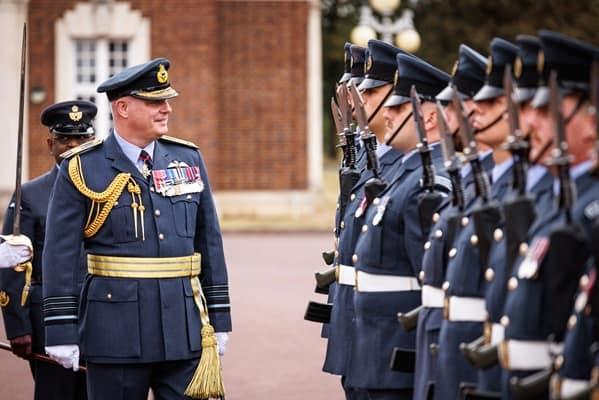
Britain faces “rapidly evolving” and potentially “existential” threats from hostile foreign powers, the head of the Royal Air Force has warned, as senior defence figures call for an urgent transformation of the military to meet the demands of modern warfare.
Air Chief Marshal Sir Harv Smyth said the international rules-based order that had safeguarded the UK’s security and prosperity for generations was being “actively challenged and dismantled”, warning that the dangers facing the country were no longer confined to distant battlefields.
“The threats we face are no longer distant storm clouds on the far horizon,” he said. “They are proximate, they are rapidly evolving, they are multifaceted and, if left unchecked, could prove existential.”
Read more related news:
Army chief warns ‘war is no longer unthinkable’ and MPs will have to tell Brits ‘where the risk lies’
Britain prepares troops for Ukraine deployment as Trump deepens rift with NATO allies
Labour MP urges Burnham to ‘get the whole of society behind it’ to follow Finland’s conscription model
Brits warned ‘we have a little over 1,000 days’ to prepare for war with Russia
Speaking at the Lord Trenchard Memorial Lecture at the Royal United Services Institute on Monday, Sir Harv argued that Britain’s armed forces must embrace emerging technologies, including artificial intelligence, autonomous weapons and increasingly sophisticated military systems, to remain effective against adversaries.
His remarks underscore growing concern among British defence leaders that traditional military capabilities may prove inadequate against a combination of conventional warfare, cyber attacks and covert operations.
Sir Harv called for a shift towards a doctrine of “autonomy, not flesh”, suggesting that greater use of technology could reduce the human and financial costs of combat.
The military must embrace “the emergent technology of the day”, he said, adding that artificial intelligence would be “fundamental to the changing character of war”.
The warning comes amid intensifying debate over Britain’s readiness for a potential conflict with a major adversary. Defence Secretary Wes Streeting recently argued that the UK must be prepared to fight alongside its allies by 2030.
“That gives us a little over 1,000 days to complete our mission; to be ready with our allies to fight and win,” he wrote in the Telegraph. “This Government will make sure it is mission accomplished.”
Streeting has also urged the public to prepare for sophisticated cyber attacks and disruption to essential supply chains caused by hostile states.
Russia remains a central concern. Senior British defence officials have warned that Moscow is using so-called hybrid warfare, including cyber operations, drone activity and potential interference with critical undersea infrastructure, to probe western vulnerabilities.
The head of the Royal Navy, Sir Gwyn Jenkins, said last month that Russia posed “the greatest threat to our security today”.
Meanwhile, Moscow continues its missile and drone campaign against Ukraine, as Kyiv faces uncertainty over the reliability of American support and the future direction of Washington’s policy towards the conflict.
For Britain’s military leadership, the message is increasingly stark: the next conflict may be shaped as much by autonomous technology, cyber capabilities and industrial capacity as by traditional firepower.
The challenge, Sir Harv’s warning suggests, is ensuring Britain adapts before the threats it faces become impossible to contain.


Leave a Comment