
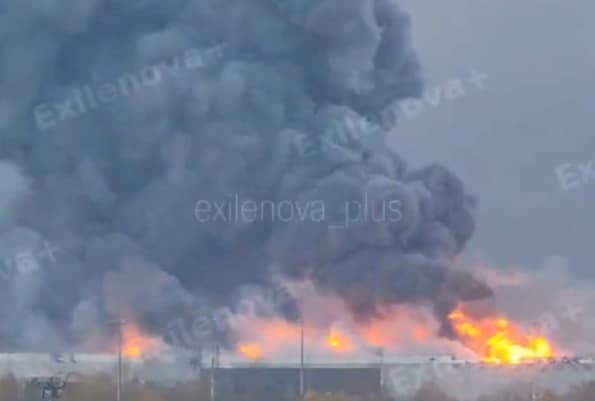
Ukraine’s expanding long-range drone campaign reaches a major Baltic export hub as fires erupt across St Petersburg and disruptions are reported at Russian digital infrastructure, exposing the vulnerability of facilities far from the front line.
Ukrainian forces struck a major oil terminal in St Petersburg overnight, triggering a fire and intensifying Kyiv’s campaign against Russian infrastructure deep inside the country, according to Ukraine’s defence industry.
Fire Point, a Ukrainian defence company, said on October 18 that its FP-1 drones had hit the St Petersburg Oil Terminal, one of the region’s largest facilities for handling, storing and exporting petroleum products. The terminal has an annual throughput capacity of 12.5mn tonnes, according to the company.
The strike highlights the strategic significance of Russia’s Baltic-facing energy infrastructure, which supports the movement of petroleum products to international markets. The extent of the damage and any resulting disruption to operations had not been independently established.
Other incidents were reported across St Petersburg and the surrounding Leningrad region during the overnight attacks.
Read more related news:
‘Why are we sparing these islands?’ Kremlin ally threatens Britain with destruction
Opinion: Trump’s Russian business empire, the deals, the money and the questions that never went away
Britain prepares troops for Ukraine deployment as Trump deepens rift with NATO allies
Unidentified flying object’ sparks red alert on NATO’s Eastern flank
Russian news outlet ASTRA reported that a drone struck a cable-stayed bridge spanning the Korabelny Fairway, part of the Western High-Speed Diameter toll road connecting the city’s northern and southern districts. Authorities were assessing the damage. The bridge is about 4.5km from the oil terminal, according to the supplied reports.
A separate attack reportedly set fire to an Ozon logistics hub in St Petersburg. A data centre associated with the VKontakte social media platform was also reported to have been targeted in Leningrad Oblast, with disruptions affecting the service.
The incidents could not be independently verified, and the full extent of damage to the oil terminal, bridge, logistics facility and data centre remained unclear.
The reported strikes point to the breadth of infrastructure potentially exposed to Ukraine’s long-range drone operations, spanning energy exports, transport, logistics and digital services.
For Moscow, attacks on facilities far from the battlefield present a challenge beyond immediate physical damage: they raise questions about the protection of critical infrastructure in one of Russia’s most important urban and industrial centres.
The fires in St Petersburg underline how the war’s reach can extend well beyond the front line — towards the networks that keep Russia’s economy moving.


Leave a Comment