
Ukraine has warned that Russia’s escalating attacks on critical infrastructure will provoke increasingly forceful retaliation, raising the prospect of a widening campaign against the systems that keep both countries’ economies and cities functioning.
President Volodymyr Zelensky said on Sunday that Kyiv had already responded to Russian strikes and would continue to deliver what he described as proportional attacks against Russian infrastructure.
Speaking alongside German Chancellor Friedrich Merz in Kyiv, Zelensky questioned the strategic logic of Moscow’s intensifying campaign against Ukrainian civilian infrastructure, warning that Russia’s own telecommunications, transport and commercial networks were exposed to the same vulnerabilities.
“Honestly, I am not surprised by such an approach to war – hatred toward Ukraine from Russia. But I am surprised by this specific approach, because they struck our warehouses: Nova Poshta, Ukrposhta, and others.
They struck, and we gave them a worthy response against Wildberries,” Zelensky said.
“Now they are striking bridges. Do they really think we will not respond?”
The comments point to a potentially dangerous new phase in the war, in which infrastructure is becoming not merely collateral damage but a central element of economic warfare.
Russian forces have increasingly targeted systems supporting everyday life in Ukraine, including telecommunications installations, corporate data centres and transport infrastructure. Zelensky argued that Moscow should understand that the same vulnerabilities exist inside Russia.
“Does [Russian President Vladimir] Putin not realise that mobile communications are used not only in Kyiv, in Ukraine? They are used in Moscow as well,” he said.
The warning carries particular significance as Ukraine approaches another winter in which energy supplies, communications and transport networks will be critical to economic resilience.
Zelensky accused the Kremlin of deliberately pursuing escalation rather than creating conditions for negotiations.
“I am simply, honestly, surprised by this beastly desire to escalate every day. That is, he relies on continuous escalation; he wants this very much. This is an answer to all those who believe that one just needs to simply ask Putin and he will definitely end the war. It simply will not work.”
For Moscow, attacks on infrastructure offer a means of imposing economic costs without relying solely on battlefield advances. For Kyiv, however, the strategy creates a powerful incentive to demonstrate that Russian infrastructure is equally vulnerable.
That retaliation could increasingly extend deep into Russia, placing commercial networks and essential services under pressure and potentially raising the economic costs of the conflict far beyond the front lines.
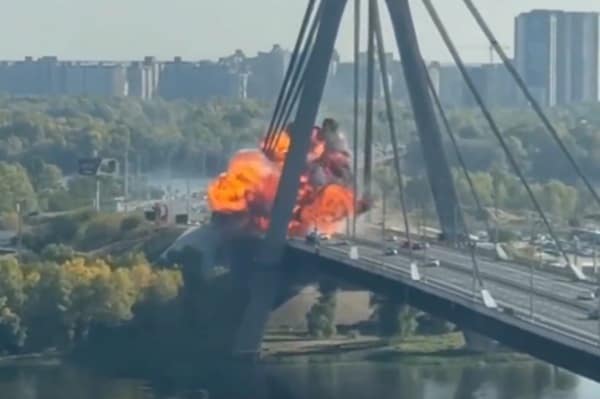
The immediate flashpoint is Kyiv’s bridge network. Russian forces struck the capital’s North Bridge on two consecutive days, compounding disruption across one of Ukraine’s most important transport corridors.
On Sunday morning, Russian munitions hit the bridge’s road deck for a second time in 24 hours, leaving a crater in the asphalt spanning the Dnipro River. Kyiv mayor Vitali Klitschko said emergency services and transit engineers were deployed to assess the structure. Two civilians were injured, with one taken to hospital.
The latest strike followed a direct hit on Saturday, when a Russian turbojet loitering munition damaged the road surface and severed overhead electrical wires used by municipal trolleybuses.
The North Bridge attacks came after Kyiv’s South Bridge was completely closed to vehicular traffic on Friday following


Leave a Comment