
Some 24 hours after leaving Dnipro, I finally reached the Polish border, around six hours later than planned and with every onward connection I might have booked long since missed.
But after what had happened along the way, being late seemed almost irrelevant because I had just completed what was possibly the most dangerous train journey I have made across Ukraine since the beginning of the full-scale invasion.
It had begun in Dnipro with a two-hour delay and Russia attacking the city, something that, unfortunately, has become increasingly normal.
What followed wasn’t.
As the train travelled west, we were repeatedly forced to stop and evacuate because of the threat from Russian drones, passengers climbing down from the carriages and moving away from the railway to take shelter in treelines until it was considered safe enough to return.
Then we got back onboard, found our seats and carried on with the journey, only to repeat the process again shortly afterwards as another threat developed.
There was no panic, no great drama among the passengers, just people doing what they were told, moving to safety, waiting and then climbing back aboard when the danger had passed.
Read more related news:
Putin is preparing for more war as Macron warns Kremlin is to mobilise 300,000 troops
Danish intelligence warns of a Russian attack within months as jets scramble over Finland
General tells Brits ‘be prepared’ for conscription ‘as army of 70,000 is not going to cut the mustard’
Poland warns Russia is preparing ‘something big’ as winter approaches
Burnham does the ‘unthinkable’ and invites Putin to G20 sparking security fury in Whitehall
In some ways, that almost made what was happening feel even more surreal because something that would be extraordinary almost anywhere else was simply being dealt with as another part of travelling across Ukraine.
While increasingly, that is exactly what it is becoming.
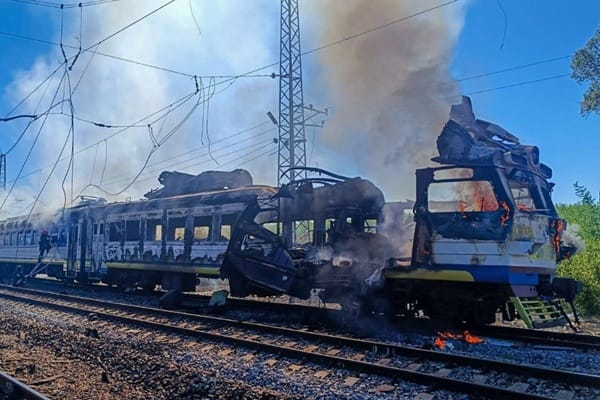
Russia’s attacks against Ukraine’s railway network have intensified significantly, with the threat no longer confined to damaged tracks, freight infrastructure or delays.
Only days before my journey, Russian strikes had hit railway infrastructure in Kyiv, injuring a railway worker and causing major disruption, while Ukrzaliznytsia warned passengers to leave railway facilities and seek shelter during alerts as it dealt with the consequences of repeated attacks.
Earlier in September, a Dnipro-Zaporizhzhia passenger train was also targeted by Russian drones after railway monitoring teams detected the threat and stopped the train, allowing passengers to evacuate. A train attendant, however, was killed during the attack, another reminder that the people operating this enormous network are increasingly doing so at considerable personal risk.
Other passenger services have also been hit.
A Kyiv-Mykolaiv train was attacked on 16th September after passengers and crew had been evacuated following an early warning, while only days earlier another incident demonstrated just how far this threat now reaches, while on 13th September, a Russian drone struck a passenger train at Yahodyn, close to Ukraine’s border with Poland and on the doorstep of NATO territory. Shortly beforehand, a diplomatic train carrying former British Prime Minister Boris Johnson, former Swedish Prime Minister Carl Bildt and senior European security officials had passed through the same area.
Among those travelling with them was Jonathan Powell, the UK Prime Minister’s National Security Adviser, along with Günter Sautter, a senior foreign policy and security adviser to German Chancellor Friedrich Merz. Another train carrying former CIA Director and retired US Army General David Petraeus was still at Yahodyn station when the attack took place.
Ukrzaliznytsia, Ukraine’s state railway operator, said it was “highly probable” that the diplomatic train had been the intended target. Its timetable had been adjusted because of the Russian threat and it had departed Yahodyn earlier than originally planned, with the drone instead striking the locomotive of another passenger train whose passengers had been evacuated after the threat was detected. Luckily, nobody was killed.
Ukraine’s Foreign Minister Andrii Sybiha described the attack as Putin’s terror reaching the doorstep of the EU and NATO. Whether the diplomatic train was deliberately targeted cannot be independently established, but the incident underlined something Ukrainian passengers and railway workers already know only too well: travelling by rail is becoming increasingly dangerous.
That matters because Ukraine’s railway is not simply another piece of infrastructure, but one of the arteries keeping the country functioning, relied upon by millions of families, pensioners, children, workers, journalists and ordinary people simply trying to get from one part of a country at war to another. It connects cities and communities, carries people towards Europe and, crucially, continues operating despite everything Russia throws at it.
You see that resilience differently when you are actually sitting inside one of those trains and I think that was the part of the journey that stayed with me most.
Not simply the drones or the evacuations, but the almost matter-of-fact way everyone dealt with them, because after years of war Ukrainians have become accustomed to adapting to circumstances that nobody should really have to consider normal.
Eventually, after almost an entire day travelling across the country, I reached the Polish border and said goodbye to the conductor. For me, the journey was continuing west towards safety, but for him it was the opposite direction.
He was turning around and heading straight back into Ukraine to do the same journey all over again, with that moment probably summing up the whole experience better than anything else.
It is easy from thousands of miles away to look at an attack on a railway line and see damaged infrastructure, statistics and delays, but living here gives you a very different perspective. Strike the power that heats homes, the infrastructure that keeps cities functioning, the railway that moves millions of people and the places civilians use every day, and it is civilians themselves who inevitably pay the price.
The cumulative effect is obviously to make Ukrainian cities harder to live in and ordinary civilian life increasingly dangerous, particularly as another winter approaches, because you don’t necessarily have to destroy a city to achieve that, but just attack the systems that allow people to live there.
Yet the trains still run, the workers still turn up and passengers still make their journeys, although increasingly they are doing so knowing that the railway itself may now be in the crosshairs.
For me, this particular journey ended safely. I lost around six hours, missed every planned connection and had to rearrange everything once I crossed the border, while some good advice from my wife not to book those onward connections before leaving Ukraine turned out to be absolutely on the nail.
No money lost and my only casualty was time, which, given what could have happened, I’ll take as a win.
But while Western capitals continue discussing negotiations, concessions and what might be offered to Moscow to bring this war to an end, there is another reality unfolding on the ground, where Ukrainians are being forced from passenger trains into treelines because Russian drones are overhead, railway workers are being injured and killed, and former prime ministers, intelligence chiefs and national security advisers are travelling on the same railway network now being struck.
Meanwhile, the people keeping that network running reach the border, turn their trains around and head straight back towards the war.
That is the Ukraine I saw from the train this week: 24 hours crossing a country still moving, still adapting and still getting people where they need to go, despite Russia doing its best to make ordinary civilian life increasingly difficult and dangerous.


Leave a Comment