
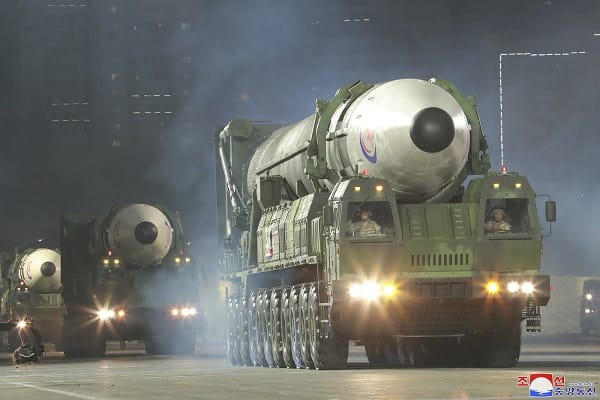
A senior adviser to Vladimir Putin has warned that millions of people could die in a nuclear conflict with NATO, while insisting Russia would be prepared to use nuclear weapons if Western forces entered Ukraine or threatened Moscow’s Baltic exclave of Kaliningrad.
Sergei Karaganov, 74, an honorary chairman of the presidium of Russia’s Council on Foreign and Defence Policy and a prominent advocate of a more aggressive nuclear posture, said Moscow would regard either scenario as grounds for a nuclear strike.
“I hope it does not come to that, but Russia would be forced to launch a nuclear strike if NATO countries deployed troops to Ukrainian territory or if there were a direct threat to Russian territory,” he said.
Karaganov, who has previously argued for the use of nuclear weapons as a means of coercing Western governments, added with a smile: “It is absolutely clear that such a war would be nuclear. I do not want that, and I am actively working to prevent such a scenario.”
His comments offer a chilling insight into the calculations surrounding Russia’s nuclear doctrine as the war in Ukraine continues and tensions between Moscow and NATO rise.
Karaganov went further, arguing that a nuclear conflict in Europe could be won by Russia, while acknowledging the catastrophic consequences.
“It’s not too late,” he said when asked about his previous suggestion of a “pre-emptive nuclear strike”.
He later claimed that a nuclear war in Europe would be “easily won”, although it would cause “terrible moral damage” to Russia.
“Millions of innocent people would perish,” he said, referring to populations in NATO countries.
Karaganov said he hoped such an outcome could be avoided, pointing to statements from Putin and Russia’s foreign minister that any future war could be short.
“I hope things won’t come to that, but I am very pleased that both the Russian President and the Foreign Minister have started saying that if a war were to break out, it would be very short,” he said.
The remarks came after Moscow issued an explicit warning over Kaliningrad, the heavily militarised Russian territory wedged between NATO members Poland and Lithuania and separated from mainland Russia.
Russia has repeatedly portrayed the exclave as vulnerable to Western military pressure and has warned that any attempt to threaten its territory could trigger an extreme response.
NATO responded by rejecting Moscow’s accusations and condemning what it described as reckless nuclear rhetoric.
“We strongly denounce the threat of force, including any irresponsible nuclear rhetoric,” the alliance said.
NATO spokesperson Allison Hart confirmed that Russia had sent the alliance a formal “non-paper” concerning the issue.
“I can confirm that Russia sent a non-paper to NATO and that we have sent a response, noting that NATO is a defensive Alliance and none of our activities or exercises pose a risk to any part of Russia,” Hart said.
She added: “We strongly denounce the threat of force, including any irresponsible nuclear rhetoric. We call on Russia to end its unprovoked war in Ukraine.”
The exchange highlights the increasingly dangerous language surrounding Kaliningrad, whose geographical position gives it outsized importance in European security calculations.
The territory provides Moscow with a strategic foothold on the Baltic Sea, while its location between Poland and Lithuania places it close to several NATO members. Any confrontation around the exclave could therefore rapidly acquire a broader regional dimension.
The nuclear warnings also underline the difficulty facing western governments seeking to support Ukraine while avoiding direct conflict with Russia.
As Kyiv confronts intensified Russian attacks, Moscow continues to frame NATO military activity as an existential threat and to invoke its nuclear arsenal as a deterrent.
The result is a widening gap between diplomatic efforts to contain the war and rhetoric suggesting that any direct confrontation could cross the nuclear threshold — with potentially catastrophic consequences far beyond Ukraine’s borders.



Leave a Comment