
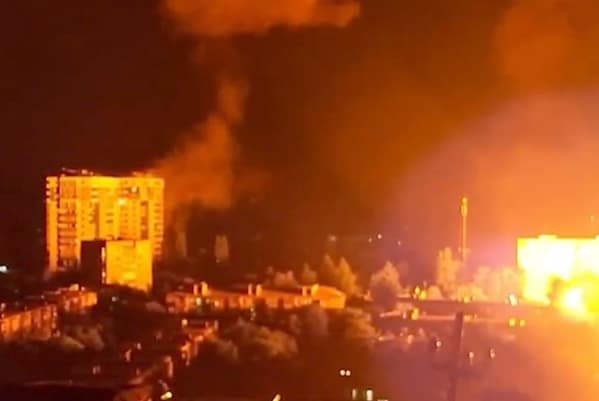
Russia appears to have opened a new phase of its winter campaign against Ukraine, launching one of its largest combined attacks on the country’s energy infrastructure since the end of the previous heating season.
The overnight assault of 29–30 September targeted Kyiv, Kyiv Oblast and other regions with missiles and 188 drones, forcing emergency electricity cuts and damaging generating equipment at the Trypillia Thermal Power Plant.
Ukraine’s Prime Minister Serhii Koretskyi said energy facilities suffered “damage and destruction”, adding that although attacks on the energy system have occurred almost daily since summer, a combined assault on this scale had not been seen since the last heating season ended.
For Ukraine, the timing could hardly be worse.
Temperatures are beginning to fall and another winter is approaching with an electricity network already repeatedly damaged during more than four years of full-scale war.
Power disruption was reported in Kyiv and the Kyiv, Dnipropetrovsk, Donetsk, Sumy and Kharkiv regions following the attacks.
But electricity generation is only part of the developing picture.
Read more related news:
Putin’s army takes staggering losses as September toll reaches record highs
Kremlin goes into meltdown but Putin’s latest warning mocked as NATO refuses to be intimidated
Putin arms up for many more years of war and plans £450bn defence splurge as missile rain on Kyiv
Trump blames Ukrainian attacks for diesel price hikes and not his war on Iran
Russia is increasingly using faster jet-powered drones, including during daylight hours, creating a new challenge for Ukrainian air defence and extending the threat beyond the overnight barrages civilians have become accustomed to.
Foreign Minister Andrii Sybiha described “days of almost uninterrupted air raid alerts across Ukraine”, accusing Russia of intensifying attacks with jet-powered drones during the day and missiles at night.
The result is that the sounds of war increasingly no longer disappear with sunrise, and Russia’s pressure is extending beyond electricity and heating.
Ukraine’s railway network, one of the critical arteries keeping the country functioning, has increasingly come under attack.
Sybiha has accused Russian forces of deliberately striking “passenger trains, locomotives, stations, and railway routes”, describing the campaign as an attempt to “paralyse civilian life”.
The consequences were visible again on 30 September.
So let me get this right…
Trump’s saying don’t hit Putin’s oil refineries, while Putin goes after pretty much anything in Ukraine, while also acknowledging that Putin won’t entertain an energy ceasefire…
WTF? 🤷♂️ pic.twitter.com/bzo12cLHCN
— Shaun Pinner (@ShaunPinnerUA) October 1, 2026
Dozens of trains were delayed following Russian attacks, with some services running more than 13 hours behind schedule. The Zaporizhzhia–Przemyśl and Dnipro–Uzhhorod services were among the worst affected, although Kyiv’s main railway stations escaped damage.
I have experienced the changing reality of Ukraine’s railway system recently myself.
My latest journey from the Polish-Ukrainian border to Dnipro took approximately 27 hours. What would normally be a long but relatively straightforward 15–17 hour journey has become increasingly unpredictable.
At one point, a Russian jet-powered drone was circling close to our train, making it increasingly feel like a deadly game of cat and mouse.
Taken together, the attacks suggest Moscow’s winter strategy is about more than simply reducing Ukraine’s electricity-generation capacity.
Damaging power and heating, disrupting rail transport, forcing businesses to halt during prolonged air alerts and repeatedly driving civilians into shelters all place additional pressure on cities already exhausted by years of war.
Possibly the most dangerous train journey on the planet 🇺🇦 pic.twitter.com/0WMkaZ7n8z
— Shaun Pinner (@ShaunPinnerUA) September 30, 2026
The economic consequences are substantial too with Ukraine’s economy minister estimating that every hour in which businesses are halted during missile alerts costs the economy around $45 million.
Yet at the same time, Washington has publicly pressured Ukraine over its campaign against Russian oil infrastructure.
On 13 September, US President Donald Trump urged President Volodymyr Zelenskyy to stop striking Russian diesel facilities, arguing that the attacks were contributing to shortages and higher global fuel prices.
Kyiv argues that Russian refineries are legitimate military targets because energy revenues and fuel supplies help sustain Moscow’s war effort.
That creates an increasingly stark contrast as winter approaches, Ukraine is being pressed to limit attacks on Russian energy infrastructure while its own electricity, heating and transport networks remain under sustained Russian attack.
Ukraine has survived previous attempts to freeze it into submission, this winter, however, the tactics are evolving.
Jet-powered drones are appearing over Ukrainian cities in broad daylight while passenger transport is being disrupted and actively targeted, while power infrastructure is again being damaged.
The new soundtrack of Ukrainian cities is increasingly one of jets, sirens and explosions throughout the working day.
And winter has not even started.


Leave a Comment