
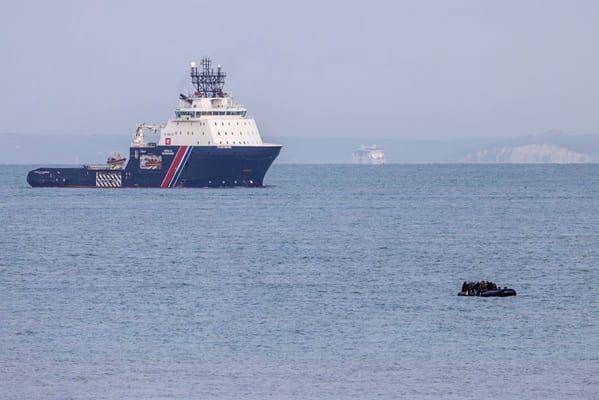
Britain and France are stepping up efforts to disrupt increasingly large migrant crossings in the English Channel, with a new 45-strong French police “surge team” to be deployed west of Calais and equipped with drones, aerial intelligence and riot-control capabilities.
The specialist unit will operate alongside the 1,050 French officers already committed to preventing small boats from reaching the British coast, as authorities respond to a shift in tactics by people-smuggling gangs towards using larger vessels to carry more passengers on fewer crossings.
The new team will use drone and aerial surveillance to identify beaches where boats are being prepared and launched. Officers will also target supply networks involved in sourcing boats and equipment before they reach the coastline.
Border security minister Anna Turley told LBC: “They are using their drone technology and their evidence to see where people are going.
“So they will be led by where the data is telling them to be. We’ve done a lot of work with Belgium as well, because there was a risk that there was displacement to Belgium.
“We’ve managed to push that back fairly successfully and continue to do so. But we need to make sure that we are using our intelligence about the lines that people are crossing, where they’re getting together, where they’re building this equipment, where they’re building the boats, where they’re getting the supply chain from.
“All of this is a multi-faceted approach that we have to work through right before they even get to the coastline.”
The deployment comes as the overall number of Channel crossings has fallen to its lowest level for the summer since 2019. But the reduction in crossings has been accompanied by evidence that smugglers are placing larger numbers of people on individual boats.
Prime Minister Andy Burnham is due to host French president Emmanuel Macron at Downing Street on Thursday for their first bilateral meeting since Burnham took office.
Ahead of the talks, Burnham said Britain and France needed to “stay one step ahead” of criminal networks adapting their methods and warned against becoming “complacent” despite the decline in arrivals.
Downing Street said the 45 officers would be deployed to western French beaches in the coming weeks, almost tripling the resources available in that area.
Burnham said: “The progress we have seen this summer shows what can be achieved when the UK and France work together.
“But I am clear that we cannot be complacent. Smuggling gangs are constantly adapting their tactics, and the UK and France need to respond quickly and stay one step ahead of the criminals facilitating the dangerous crossings.
“The small boats crisis is a shared European challenge, and no country can solve it alone. Working with France and our international partners, we will restore order and control to our borders and prevent smugglers exploiting vulnerable migrants.”
Home secretary Shabana Mahmood said the government was also increasing resources to target the networks behind the crossings.
“We are boosting officer numbers to record highs to crack down on small boat launches and the gangs behind them.
“This work is bearing fruit. Over 48,000 crossing attempts have been prevented, small boat crossing numbers are down and removals of those here illegally are at record levels.
“But we are not complacent and we must be relentless. We will continue efforts on all fronts to tackle these illegal and dangerous crossings.”
The latest measures reflect a broader shift in enforcement strategy, with authorities seeking to disrupt smuggling operations before migrants and boats reach the coast rather than relying solely on interception at sea.
The governments are also expected to discuss the wider security implications of Russia’s war in Ukraine and the conflict involving Iran during Macron’s visit, including their impact on Europe’s economy.
Downing Street said Burnham would push for closer co-operation with European countries as he continues his predecessor Sir Keir Starmer’s policy of a “reset” in UK-EU relations.
The prime minister reiterated the economic case for closer links with Europe during Prime Minister’s Questions on Wednesday, saying Britain’s decade of low growth “has been partly a result of Brexit”.
“I do want a closer relationship – I will build on the work of my predecessor,” Burnham told MPs, ahead of a UK-EU summit later this year.
Macron is the first European leader to visit the UK since Burnham became prime minister in July.
The two leaders joined King Charles and Queen Camilla at the British Museum on Wednesday to view the Bayeux Tapestry, ahead of their formal bilateral talks.
The migration measures are likely to feature prominently in those discussions, with both governments facing pressure to demonstrate that falling crossing numbers can be sustained despite the smugglers’ rapid adaptation of their business model.
For Britain, the renewed focus on French beaches reflects the extent to which controlling Channel migration depends on enforcement action on the French side of the border, while for Paris the deployment represents a further expansion of resources directed at disrupting organised smuggling networks.


Leave a Comment