
Key takeaways for contractors
- American plumbing and pipefitting trades need roughly 44,000 new workers every year, while the estimating profession that prices their work is projected to shrink.
- The take-off, the manual count of pipes and fittings behind every quote, is where the hours disappear, running from about thirty minutes to a full working day per drawing set.
- A mid-sized commercial job can arrive as fifty or sixty sheets, and a handful of missed items can cost a contractor hundreds of thousands.
- Automating the count lets the same estimator price more work without hiring people the market cannot supply.
Commercial plumbing contractors in the United States are bidding under a squeeze that has little to do with demand for their work. While the commercial market demands complex HVAC, piping, plumbing, and sheet metal packages, the specialised preconstruction professionals required to price these jobs are shrinking. Forward-thinking mechanical subcontractors are actively changing their bidding operations. They no longer treat the quantity take-off—the exhausting manual counting of linear pipe runs, fittings, and fixtures—as a task that should tie up senior estimators late on bid day.
The mathematics behind the talent shortage
The plumbing trade itself is expanding. The US Bureau of Labor Statistics counts 504,500 plumbers, pipefitters, and steamfitters, projecting the occupation to grow 4 percent through 2034. The agency expects about 44,000 openings a year over that decade, primarily to replace field personnel who retire or leave the trade.
The estimating bench tells the opposite story. The same agency counts roughly 221,400 cost estimators and projects that role to decline 4 percent by 2034, naming estimating software directly as the reason fewer people can process more bids. Hiring conditions confirm it from the contractor side. The Associated General Contractors of America reported in its 2026 outlook that 80 percent of firms struggle to fill salaried openings, the category estimators sit in. That is a higher proportion than at any point in the previous three years.
Put those together, and the constraint becomes clear. Work is available, but the capacity to price it is not expanding, so the output of each estimator already on the payroll decides how much of that work a firm can realistically chase.
High-friction preconstruction bottlenecks
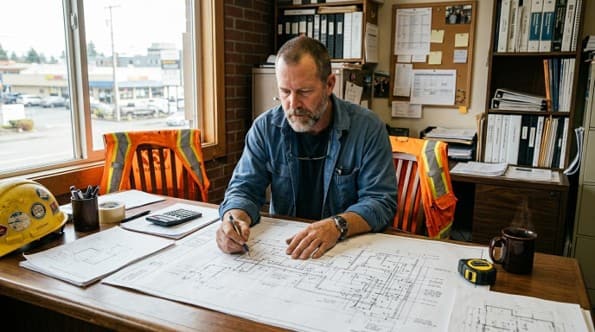
Ask a commercial plumbing contractor where bidding time goes, and the take-off sits near the top of the list. Someone opens the drawing set, traces every pipe run, counts every fitting, valve and fixture, and enters the quantities before pricing can begin. Depending on the size of the set, that count runs from roughly thirty minutes to eight hours, and a mid-sized commercial project can arrive as anywhere from five sheets to sixty.
The stakes on that count are higher than the hours alone suggest. Missing even a few pieces of equipment across a large set can cost a contractor hundreds of thousands once the job is under way, which is why experienced estimators check their counts rather than trusting a fast pass.
What a specialised AI vision system changes
Modern plumbing take-off software works directly from standard flat PDF drawings, utilising a specialised vision system trained on tens of thousands of construction documents. It rapidly extracts linear lengths, exact counts, systems, and sizes in minutes if they are visually represented as symbols on the blueprint, providing an on-screen audit trail for easy human verification. It automates raw counting rather than pricing, ensuring that downstream calculations like fitting allowances, cost swapping, slope, pitch, or gravity adjustments occur seamlessly within Excel or your pricing system. The systems worth using read the size and system labelling on the drawing, which is how they keep domestic cold water, hot water, sanitary waste and vent lines separated into distinct material profiles instead of merging them into a single total.

TaksoAi
To understand how this operates on the estimating desk, the automated take-off process follows a clear three-step execution loop:
- Step 1 (Secure Cloud Upload): The estimator uploads standard flat PDF drawing sets directly to a secure, concurrent cloud workspace.
- Step 2 (Automated Vision Scan): The specialised vision system reads the sizes, labels, and shapes, automatically extracting lengths, counts, and fittings in under 15 minutes.
- Step 3 (Visual Audit and Verification): The estimator uses the on-screen audit trail to instantly verify quantities, manually adjust items, and catch non-standard engineering notes.
Two practical details matter more than the headline speed. Vertical footages that never appear at true length on a 2D drawing are automatically captured from the pipe up and pipe down symbols, carried at a floor-to-floor vertical length set by the user. Furthermore, because modern platforms are cloud-based, files are no longer locked to local desktop workstations. When estimators deal with mixed renovation or demolition blueprints, they can utilise an on-screen paintbrush tool to manually isolate new plumbing scope from demolition layouts in seconds. This prevents material overcounts while protecting the automated AI engine from misrepresenting complex plan flaws.
Optimising this process has an immediate revenue impact. Reducing the manual take-off bottleneck by at least 50 percent allows subcontractors to rapidly process higher volumes of incoming Invitations to Bid (ITBs) each month. More importantly, it insulates profit margins from manual counting omissions that can cost hundreds of thousands of dollars in downstream project rework. This shifts the division of labour perfectly: the machine processes the raw counting, while veteran estimators focus their 20 years of expertise on strategic material choices and risk management.
Marketplace adoption trajectories
Adoption is early, which cuts both ways for a contractor weighing the change. A 2025 survey of more than 2,200 built-environment professionals by RICS found that around 45 percent of firms had not implemented AI in any form and fewer than 12 percent used it regularly in specific processes. That survey covers the built environment broadly rather than take-off practice specifically, but regular embedded use is plainly still uncommon.
Training time is less of a barrier than most contractors expect. A new user typically reaches a review-ready take-off within a couple of hours on current tools, which is a very different proposition from the multi-week onboarding that legacy estimating packages were known for.
Protecting bottom-line profit margins
The numbers describe a market where the trade keeps growing, the estimating bench keeps thinning, and the work still has to be priced. Plumbing contractors cannot recruit their way out of that gap, because the people they would need are the ones the profession is steadily losing. Moving the take-off from the highlighter to software is the most direct way to lift how much accurate work leaves the office each week, and the firms making that change are doing it while most of their competitors have not started.
Frequently asked questions
What is a plumbing take-off?
A take-off is the itemised count of everything a plumbing job requires, from pipe lengths and fittings to fixtures and valves, measured from the project drawings. It forms the quantity basis of every bid price.
Does automated take-off replace the estimator?
No, it replaces the counting. The estimator still reviews quantities, applies rates, and prices risk, spending hours on judgment rather than days on measurement.
What should a contractor look for in take-off tools?
Look for software that reads your actual drawing formats, separates systems by size and system labelling, exports cleanly into your pricing workflow, and shows its measurements so every figure can be checked line by line.



Leave a Comment