
London professionals have become very good at measuring time. Commutes are calculated. Meetings are blocked into thirty-minute windows. Lunch is fitted between calls. Exercise is booked into the diary.
Yet household chores tend to escape the same scrutiny.
A ten-minute clean after breakfast, another quick tidy at lunchtime and a second pass around the kitchen after work rarely look significant individually. Added together across a week, however, they become another form of time leakage.
That matters more in a hybrid-working city.
London Loves Business has repeatedly explored how home working has changed professional life. Its recent coverage argues that the home office is no longer a temporary arrangement and that productivity increasingly depends on creating a home environment that supports focus rather than competes with it.
That creates an interesting question for the latest generation of household technology:
Can smart appliances reduce domestic interruptions enough to be considered productivity tools?
Floor care is a surprisingly useful place to test the idea.
The real cost of cleaning is fragmentation
A traditional hard-floor routine normally contains several separate stages:
vacuum → put vacuum away → prepare mop → wash floor → clean mop
None is particularly difficult. The problem is the fragmentation.
When the home is also a workplace, every additional stage creates another interruption.
That makes a wet and dry vacuum cleaner interesting less as a premium appliance and more as an example of task consolidation.
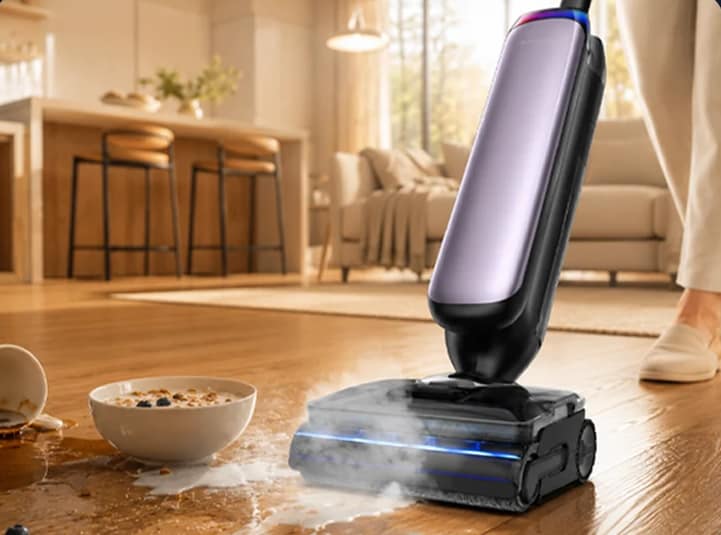
On compatible hard floors, these machines are designed to collect suitable dry debris and wash the surface during the same cleaning session.
The potential advantage is therefore not:
“better cleaning because it has more technology.”
It is:
one recurring household process replacing two.
For time-poor professionals, that is a more useful way to judge the category.
Put a value on repetition before buying technology
It is easy to claim that an appliance “saves time”.
That statement is meaningless unless the task happens often enough.
Consider two London households.
Household A
- A one-bedroom flat is cleaned once a week.
- Most floors are carpeted.
- The kitchen takes five minutes to mop.
- A premium wet-dry cleaner probably solves very little.
Household B
- An open-plan flat has hard flooring throughout.
- Two people work from home several days a week.
- There are regular crumbs, coffee spills and outdoor dirt.
- The floor is cleaned four or five times across the week.
- Here, removing a cleaning stage starts to matter.
- The correct buying question is therefore:
How often will this appliance eliminate a repeated step?
That principle applies well beyond vacuum cleaners.
London Loves Business recently made a similar point when discussing smart household energy technology: smart devices do not automatically create savings; the value comes from how they change the way the household actually operates.
The same is true of cleaning tech.
Not every “smart” feature saves time
Modern appliances are packed with technology. But the useful distinction is between:
features that provide information
and
features that remove intervention.
A display telling the user that the floor is dirty is mildly useful. A sensor that detects that dirt and automatically alters the cleaning behaviour is more meaningful.
Tineco’s S7 Stretch Ultra, for example, uses its iLoop sensor to adjust water flow and battery output according to detected conditions rather than requiring continuous manual changes.
That is the kind of automation that matters in a productivity discussion. It removes a decision.
The most useful features often look boring
For busy households, the highest-value technology may be:
- automatic dirt detection;
- anti-tangle brush design;
- self-cleaning;
- heated roller drying;
- low-furniture access.
None sounds as impressive as AI or steam. But each targets a repeated piece of manual work.
That is exactly the sort of small-friction reduction London Loves Business frequently focuses on when writing about productivity and workplace technology. Its recent office-content advice similarly argues that performance often improves through small changes that remove daily friction rather than expensive wholesale transformation.
The under-sofa problem is really a design problem
This is where the Tineco FLOOR ONE S7 Stretch Ultra Cordless Wet Dry Vacuum Cleaner becomes interesting. Not because it is the most powerful Tineco. Not because it has the most dramatic technology. Because it addresses a physical constraint common in compact homes.
Its 180-degree lay-flat design allows it to reach beneath low furniture, while Tineco also lists DualBlock Anti-Tangle, FlashDry self-cleaning and up to 50 minutes of runtime. The productivity value is surprisingly straightforward.
If cleaning beneath a sofa normally requires:
move furniture → clean → reposition furniture
and a different machine removes the first and third steps, that is meaningful automation even though no AI is involved.
It is a reminder that good consumer technology is not always about software.
Sometimes it is geometry.
Steam is a feature, not automatically a productivity upgrade
The Tineco FLOOR ONE S9 Boost Steam Wet Dry Vacuum Cleaner takes a more premium route.
Tineco UK currently lists:
- 230°C BoostSteam;
- 25kPa suction;
- DualBlock Anti-Tangle;
- HyperStretch;
- FlashDry / SilentDry;
- AI SmoothDrive.
Steam is most relevant when a household regularly deals with:
- dried food;
- sticky kitchen residue;
- dried muddy marks;
- stubborn stains on compatible floors.
If those problems are common, steam may reduce scrubbing or repeated passes. If they are rare, it is simply another premium feature. That distinction matters.
The purpose of smart-home technology should not be to maximise the number of functions owned. It should be to reduce the number of interventions required.
And floor compatibility still comes first
Steam should only be used where the flooring manufacturer permits it.
That is particularly important with:
- laminate;
- engineered timber;
- certain sealed wood floors.
A high-end feature that cannot safely be used in the home creates no productivity value at all.
The bigger productivity question: what happens after cleaning?
Cleaning time is only part of the routine.
A wet-dry machine may still require the user to:
- empty dirty water;
- refill clean water;
- inspect the roller;
- wash filters;
- remove hair;
- leave components to dry.
If post-use maintenance takes as long as the cleaning stage it replaced, the efficiency argument weakens. That is why features such as anti-tangle design and FlashDry deserve more attention than they usually receive.
Tineco’s S7 Stretch Ultra uses heated fresh water during self-cleaning followed by hot-air drying of the system.
The S9 Boost Steam similarly includes FlashDry/SilentDry maintenance. These systems do not make either appliance maintenance-free. But they attack another repeated household task. And that is exactly the sort of function that has value for someone trying to minimise domestic admin.
The five-minute test
Before spending several hundred pounds on a smart cleaner, ask one question:
Which five-minute task will this remove from my week?
Then multiply it.
If a feature removes:
5 minutes × 5 occasions per week
that is around:
25 minutes per week
or roughly:
21 hours per year.
That is not automatically a financial saving. But it is a useful way to quantify convenience. The opposite calculation matters too.
If a £700 appliance saves five minutes only once a fortnight, the case is considerably weaker.
This is much more useful than judging a product simply by the length of its specification sheet.
Smart-home efficiency should be measured like workplace efficiency
Business technology is often evaluated through:
- reduced steps;
- lower admin;
- fewer interruptions;
- better utilisation;
- lower friction.
Why should household technology be judged differently?
London Loves Business has already written about BYOD adoption partly in terms of removing small daily frictions and shortening time to productivity.
The same principle can apply inside the home.
A domestic appliance creates value when it:
- eliminates a process;
- shortens setup;
- reduces maintenance;
- avoids duplicated equipment;
- works reliably enough to become the default.
That is a more rigorous definition of “smart” than simply connecting an appliance to an app.
What about pets?
Pets change the equation because they increase frequency. Hair, paw prints and food around bowls mean some households clean the same area repeatedly. For these users, anti-tangle design may deliver more value than steam.
DualBlock on Tineco’s current S7 Stretch Ultra and S9 Boost Steam is designed to intercept long hair and pet fur before it wraps around the roller.
That does not eliminate maintenance. But if it reduces how often someone has to stop and cut hair from a brush bar, it addresses a genuine productivity problem.
The competitor question is simpler than it looks
There is no need to turn this into another full brand ranking.
Tineco, Dreame, Dyson, Shark and Bissell are solving related problems in different ways.
For busy professionals, the useful comparison is not:
Which brand wins?
It is:
Which machine eliminates the most work in this particular home?
Tineco
Strong focus on:
adaptive sensing, anti-tangle systems, lay-flat designs and automated roller maintenance.
Dreame
Strong competitor around:
heated cleaning and automated maintenance.
Dyson
Uses a different wet-floor architecture with WashG1 and retains a strong position in dry cordless cleaning.
Shark / Bissell
Offer established vacuum-and-wash approaches that may suit buyers who do not need the newest automation features.
Feature count should not determine the purchase.
Workflow fit should.
IMAGE 2 — Suggested Placement
Scene: A visual “time audit” of a hybrid-working London day: calendar blocks for video calls and focus work alongside a short floor-cleaning window. A modern floor washer appears as one of several household tools designed to compress routine tasks.
Alt text: Hybrid-working London professional using smart home technology to reduce time spent on household chores.
Three situations where a wet-dry cleaner probably makes sense
1. Large areas of hard flooring
The more hard floor there is, the more often the machine can replace separate vacuuming and mopping.
2. Frequent small messes
Children, pets, cooking and working from home can all increase the number of local cleaning events.
3. Cleaning happens between other tasks
This is where quick setup and automatic maintenance matter most.
Three situations where it probably does not
1. Mostly carpet
A dry vacuum will still do most of the work.
2. Hard floors are cleaned rarely
The time saving may be too small to justify the cost.
3. Storage is already tight
A premium appliance that creates a new storage problem may simply swap one inconvenience for another.
Quick answers for busy London households
Does a wet-dry vacuum really save time?
It can when it replaces separate vacuuming and mopping on compatible hard floors. The saving depends on how frequently those tasks would otherwise be repeated.
Is Tineco worth it for hybrid workers?
Potentially, if the home has substantial hard flooring and cleaning regularly interrupts the working day. A rarely used machine offers much less value.
Which Tineco is more practical: S7 Stretch Ultra or S9 Boost Steam?
The S7 Stretch Ultra is more focused on access, hair management and routine cleaning. The S9 Boost Steam is more relevant if stubborn dried residue is common.
Can Tineco vacuum and mop at the same time?
Compatible FLOOR ONE machines are designed to collect suitable debris and wash hard floors in the same cleaning session.
Do you need to vacuum first?
Usually not for ordinary crumbs, dust and loose hair. Large or unsuitable debris should be removed beforehand.
Is Tineco safe for hardwood or laminate?
Only where the flooring manufacturer allows the relevant damp-cleaning method. Steam requires additional caution.
Is anti-tangle useful for pets?
Yes, particularly in homes with long-haired animals, although the roller still requires periodic inspection.
Does self-cleaning mean maintenance-free?
No. Tanks, filters and consumables still require attention.




Leave a Comment