
Ukraine’s latest drone assault on Moscow may have exposed an uncomfortable reality for the Kremlin: sometimes Russia’s greatest danger is not the incoming drone, but the missile fired to stop it.
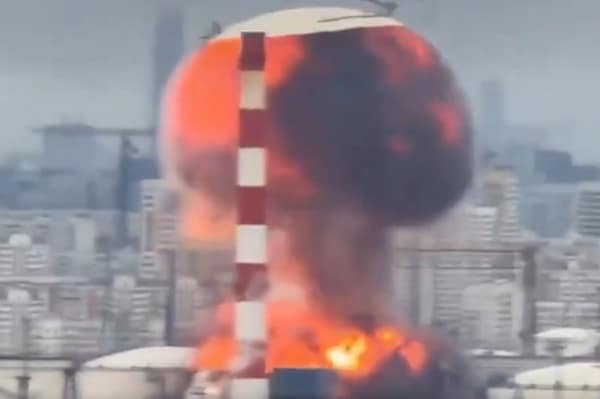
New footage from the attack appears to show a Russian air defence missile striking an oil storage tank at the Kapotnya refinery on the southeastern edge of Moscow, triggering a colossal explosion that lit up the skyline and sent a giant tank hurtling into the air.
The extraordinary images rapidly spread across social media, where they generated a flood of jokes, memes and ridicule aimed at the Russian authorities.
But behind the humour lies a serious military problem.
Read more related news:
Ukraine’s spectacular drone blitz leaves desperate Russians queuing for fuel
Russians warned ‘hell is beginning’ as Crimea is being isolated by drones
Ukraine’s most dangerous mistake isn’t coming from Moscow
Zelensky gives Belarus one week to switch off Putin’s drones or we will
Analysis of videos verified by independent observers and defence experts suggests a Russian shoulder-fired surface-to-air missile may have missed its intended target and detonated fuel infrastructure instead.
If confirmed, the incident would represent one of the clearest examples yet of the risks Moscow faces as Ukraine expands its long-range drone campaign deep into Russian territory.
The challenge for Russian commanders is becoming increasingly difficult.
Ukraine is launching larger drone swarms, often flying at low altitude and approaching from multiple directions simultaneously.
Intercepting such attacks requires an enormous amount of air defence coverage.
Around Moscow, that has forced Russia to supplement sophisticated missile systems with cheaper and shorter-range weapons, including man-portable air defence systems operated close to civilian infrastructure.
Those systems are effective against slow-moving drones.
They are also far less forgiving when deployed over refineries, residential districts and industrial facilities.
Ukraine's latest drone strike on Moscow exposed how weak Russia's air defenses around the city are.
New footage shows that a Russian shoulder-fired surface-to-air missile may have struck and detonated an oil tank at the Kapotnya refinery, less than 20 km from the Kremlin. The… pic.twitter.com/OW3Vdhj3MN
— Vatnik Soup (@P_Kallioniemi) June 20, 2026
Every interception attempt carries its own risks.
A missed shot, falling debris or an errant missile can cause destruction on the ground even when the drone itself fails to reach its target.
The irony is difficult for the Kremlin to ignore.
Russia has spent years presenting Moscow as one of the most heavily defended capitals in the world.
Yet the growing frequency of Ukrainian strikes is exposing vulnerabilities that were previously hidden from public view.
The latest attack reportedly involved almost 200 drones directed towards the Russian capital, the largest such assault since the full-scale invasion began.
Even where drones are intercepted, the images emerging from Moscow increasingly tell a story of disruption, panic and uncertainty.
Roads are closed.
Airports suspend operations.
Residents report explosions overhead.
And now there are growing questions about whether the city’s own air defences are creating hazards of their own.
For Ukraine, this is precisely the point.
Kyiv does not need every drone to hit its target.
The objective is to force Russia into an expensive and increasingly difficult defensive battle, stretching resources and exposing weaknesses far from the front line.
The Kapotnya explosion may become a symbol of that strategy.
Because if the footage proves what many analysts suspect, Moscow’s refinery was not destroyed by a Ukrainian drone.
It was destroyed by Russia’s attempt to stop one.
And that may be an even more troubling message for the Kremlin.


Leave a Comment