
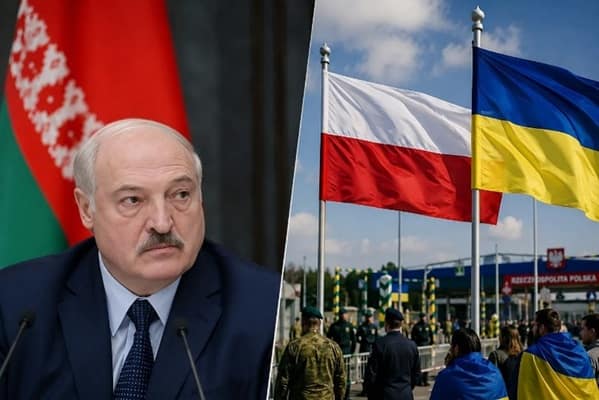
Sometimes I feel we shoot ourselves in the foot.
Whatever your view of President Volodymyr Zelensky, few modern leaders have been forced to navigate diplomatic pressures on the scale he has faced, yet, as Ukraine enters its fifth year of war against Russia, Kyiv finds itself confronting two diplomatic disputes that are often discussed together, despite being fundamentally different in nature.
One concerns Belarus, a country that has provided support, territory and infrastructure for Russia’s invasion since 2022. The other concerns Poland, arguably Ukraine’s most important regional ally and one of the strongest supporters of Ukrainian independence since the beginning of the full-scale invasion.
The question is not whether disagreements exist, but, I do however, question whether all of them needed to become public confrontations at the same time.
Much like the decision last summer to effectively dismantle the anti-corruption agencies NABU and SAPO, a move that saw Ukrainians take to the streets of Kyiv despite air raid sirens and a country fighting for its survival, I sometimes find myself wondering how some of these decisions are ever reached.
Ukraine faces enough challenges from Moscow without creating additional political and diplomatic headaches of its own making.
So why now?
Belarus: A Legitimate Security Concern
President Volodymyr Zelensky’s recent warnings directed at Belarusian leader Alexander Lukashenko are easier to understand through a military lens.
Belarus allowed Russian forces to use its territory during the initial assault on Kyiv in 2022. Russian aircraft, missiles and military infrastructure continue to operate from Belarusian territory, providing Moscow with strategic advantages and forcing Ukraine to divert resources to defend its northern border. Belarus has effectively become a platform enabling Russia to carry out some of the worst atrocities witnessed in Europe since the Second World War.
From Kyiv’s perspective, Belarus remains a potential threat for obvious reasons.
The warning itself was unusually direct. Zelensky claimed that signal relay stations located in Belarusian regions bordering Ukraine were being used to assist Russian strikes against Ukrainian civilians.
“What’s the point of saying he doesn’t want to be in the war? Let him remove this equipment, let him switch it off. I think a week will be enough for him to do that. If he doesn’t do it, we’ll do it,” Zelensky told reporters in Kyiv.
According to Zelensky, the equipment is being used to help guide Russian attacks against Ukrainian territory, making Belarus an active participant in Russia’s war effort regardless of whether Belarusian troops are directly involved. Reuters reported that the systems were described as relay stations located in two Belarusian regions bordering Ukraine, though the agency noted it could not independently verify the claim.
What is clear, however, is that while Lukashenko has so far resisted sending Belarusian troops directly into the war, his country remains deeply integrated into Russia’s military planning, and let’s face it, you can’t be a little bit pregnant.
If Russian missiles are being launched, guided or supported from Belarusian territory, distinctions over whether Belarusian soldiers are physically crossing the border become increasingly academic.
Any Russian military assets operating from Belarus ultimately represent a challenge to Ukrainian security. Belarus increasingly resembles another oblast under Moscow’s influence, despite recent attempts to improve relations with Washington through high-profile political prisoner exchanges that resulted in limited sanctions relief.
Viewed through that prism, Zelensky’s comments were less about opening a new dispute and more about addressing an existing one.
Belarus is not simply a diplomatic issue.
It is a national security one.
Poland: A Different Matter Entirely
The growing dispute with Polish President Karol Nawrocki is far harder to justify through the same strategic lens.
Nawrocki’s decision to strip Zelensky of Poland’s highest state honour, the Order of the White Eagle, has reignited tensions between two countries that have otherwise stood shoulder-to-shoulder throughout the war.
Does it really need to get to this level? https://t.co/keaghIFBrO
— Shaun Pinner (@ShaunPinnerUA) June 20, 2026
The move followed controversy surrounding Kyiv’s decision to honour a military unit linked to the legacy of the Ukrainian Insurgent Army (UPA), an issue that remains deeply sensitive in Poland because of the massacres of Polish civilians in Volhynia during the Second World War.
History matters.
For Ukrainians, the UPA is often viewed through the lens of resistance to both Nazi Germany and Soviet domination. It is a perspective I have repeatedly encountered while living and working in Ukraine: a nation caught between a rock and a hard place, where impossible choices were made during impossible times.
For Poles, however, the memory is understandably different.
Yet while these historical disagreements are real, many observers will question whether this confrontation needed to escalate now.
Poland has been one of Ukraine’s strongest supporters throughout the war and, for me personally, a country I have grown to love—a second home.
It has supplied weapons, hosted millions of refugees, acted as a critical logistical hub for Western military aid and consistently advocated for Ukraine within both NATO and the European Union.
Warsaw and Kyiv will never agree on every aspect of history. Obviously, that is not my point.
The real question is whether a disagreement over historical memory should be allowed to overshadow one of the most important strategic partnerships in Europe at this specific moment.
It also raises another question: is President Karol Nawrocki responding solely to a historical grievance, or is there a domestic political calculation at play? Is an existing disagreement being amplified for political gain at a time when unity between Poland and Ukraine has arguably never been more important?
The White Eagle Controversy
The controversy surrounding the Order of the White Eagle has also raised uncomfortable questions inside Poland itself.
Critics have pointed out that throughout its long and complicated history, the honour has been bestowed upon a number of highly controversial figures, yet it is Volodymyr Zelensky who has become the focus of a highly public political dispute today.
Among those frequently cited are Catherine II of Russia, whose reign culminated in the destruction of the Polish-Lithuanian Commonwealth through the partitions of Poland, and Benito Mussolini, the Italian fascist dictator whose regime became allied with Nazi Germany. Critics have also highlighted figures such as Tsar Nicholas I, who crushed the Polish November Uprising and stripped Poland of much of its autonomy.
The point is not to compare Zelensky to any of these historical figures. However, the hypocrisy door is left somewhat ajar when a wartime president leading a nation defending itself against invasion becomes the focus of such a public dispute, while recipients associated with imperial conquest, authoritarian rule and even fascism remain part of the Order’s history.
That is not an argument against Poland confronting difficult chapters of history. Absolutely not.
It is, however, a fair question to ask whether the standards are being applied consistently, why this issue has been elevated to such prominence at this particular moment, and whether Ukraine itself bears some responsibility for allowing the dispute to reach this point.
At a moment when Ukrainian cities continue to face nightly drone and missile attacks, a public battle over awards and historical grievances appears disconnected from the immediate realities of war.
For many Ukrainians, I suspect the question is not whether difficult conversations about history should take place.
It is whether this was the moment to prioritise them.
A Front That Didn’t Need Opening?
Unlike Belarus, which represents a genuine strategic concern for Ukraine, the dispute with Poland risks becoming a largely self-inflicted diplomatic problem.
That is not to place blame solely on Warsaw.
One uncomfortable question is whether Ukraine should have publicly named and celebrated a military unit linked to the legacy of the UPA, knowing full well the sensitivities such a move would provoke in Poland. Equally, questions can be asked of President Karol Nawrocki and whether stripping Zelensky of the Order of the White Eagle was a proportionate response, or whether domestic political considerations have helped elevate the dispute beyond where it needed to go.
Perhaps both sides have contributed to a controversy that has grown far larger than it should have.
Russia has spent years attempting to divide Ukraine from its allies. It has consistently sought to exploit historical grievances, amplify political disagreements and undermine unity among countries supporting Kyiv.
That does not mean difficult conversations should be avoided. History cannot simply be ignored, but timing matters, and maintaining relationships with key allies remain of the highest importance.
Ukraine’s concerns about Belarus are understandable and rooted in legitimate security fears, but the growing confrontation with Poland, however, feels extremely different.
At a time when Russia remains the primary threat to both Ukrainian sovereignty and European security, many will wonder whether this dispute ever needed to reach the level it has.
Whatever the motivations on either side, historical, political or domestic, this issue now needs to be nipped in the bud before it causes lasting damage to one of Europe’s most important strategic partnerships.
Poland and Ukraine will never agree on every chapter of history, and perhaps they don’t need to. The real question is whether either side gains anything from allowing those disagreements to dominate the present while Russia wages war in the heart of Europe. History matters, but so does perspective, and allowing old grievances to overshadow the common interests of both nations is ultimately a choice.
And in wartime, choices have consequences.


Leave a Comment