
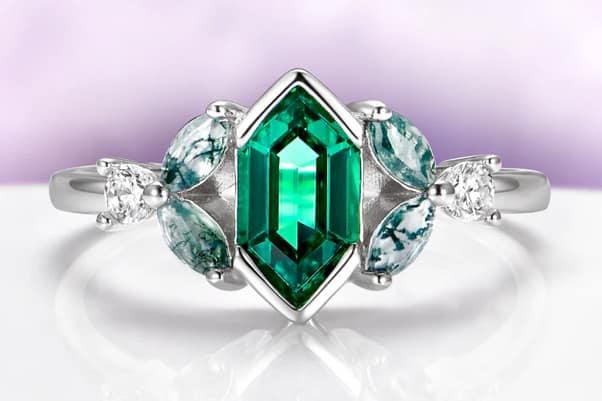
Emerald sits in an unusual place among coloured gemstones. It’s instantly recognisable, historically significant, and grouped with diamond, ruby, and sapphire as one of the “big four” precious stones — yet it behaves nothing like the others once it’s set into a ring. What surprises most first-time buyers is that emerald doesn’t even behave like its own family: it’s a variety of beryl, the same mineral that gives us sky-blue aquamarine rings and blush-pink morganite jewelry, and those cousins run clean and easy-going where emerald is anything but.
This guide covers what actually defines emerald quality, how it compares both to its beryl relatives and to harder stones like sapphire, and what buyers should understand about durability and care before deciding. None of it is about steering you toward a particular stone — it’s about understanding what’s really in front of you.
What is emerald, and why does it behave differently?
Emerald is beryl coloured by trace amounts of chromium and sometimes vanadium. That colouring is the key to its character: the same conditions that produce its saturated green also tend to produce significant internal fracturing, which is why heavily included emeralds are considered normal rather than a sign of poor quality.
This is exactly where emerald splits from the rest of the beryl family. Aquamarine and morganite form from the same mineral but usually grow clean and transparent, so an eye-clean stone is the expectation. Emerald’s chromium is precisely what brings both the prized green and the built-in fractures — you rarely get one without the other.
The contrast is sharper still against sapphire, a variety of corundum rather than beryl, which typically forms with far fewer visible inclusions. Where a moderately included emerald is standard across nearly the whole market, a sapphire with the same visible inclusions would generally be considered lower quality. That difference changes how the stone should be evaluated, set, and worn.
Hardness and durability compared
Emerald measures 7.5 to 8 on the Mohs scale — the same range as its cousins aquamarine and morganite, and notably softer than sapphire at 9. That two-point gap matters more in daily wear than it looks on paper, since the scale isn’t linear; sapphire’s resistance to scratching and chipping is meaningfully higher.
Hardness isn’t the whole story, though. Emerald’s tendency toward internal fracturing compounds it: even a well-cut stone with excellent colour can have inclusions reaching close to the surface, creating weak points a comparably included sapphire simply wouldn’t have. It’s also why emerald rings are more often set in protective styles, while sapphire is regularly set with exposed prong work without the same concern. Tellingly, aquamarine and morganite — the same hardness as emerald — are far more forgiving to set, precisely because they lack emerald’s fracture network.
How emerald quality is evaluated
Colour leads emerald grading. A vivid, slightly bluish-green in a medium-to-dark tone is the most desirable range, while stones that lean too yellow-green or look overly dark are valued lower. Saturation and hue are judged together, much as blue sapphire is graded, though emerald’s acceptable colour window is narrower.
Clarity is treated differently than with almost any other gem. Because emerald nearly always contains visible inclusions — often called jardin, French for garden, for their mossy look — clarity grading focuses on whether those inclusions threaten the stone’s structural integrity, not simply on whether they’re visible. That’s a real departure from how a clean beryl like aquamarine, or a corundum like sapphire, is assessed, where eye-clean stones are both achievable and expected.
Cut plays an outsized role because of the fracture tendency. The rectangular “emerald cut,” with its stepped facets and trimmed corners, was developed specifically to reduce stress during cutting and setting, lowering the chipping risk compared with more angular brilliant-style cuts.
Treatments to know about
Most coloured stones involve accepted trade treatments, and emerald’s is nearly universal: the vast majority are treated with oil or resin to fill surface-reaching fractures, improving clarity and stabilising the stone. It’s so common that untreated emeralds are rare and usually identified as such when sold.
That matters because the treatment dictates the care. Sapphire is most often heat-treated, which alters the stone internally rather than filling fractures, so it tolerates cleaning methods emerald can’t. Emerald’s clean beryl cousins, aquamarine and morganite, are frequently untreated or only lightly heated — another reason they’re lower-maintenance day to day.
Ring settings suited to emerald
Given emerald’s lower effective durability, setting choice carries more weight than for many gems. Bezel settings, which wrap the stone’s edge in metal, offer strong protection against chipping and are frequently recommended for emerald centre stones. Halo settings ring the centre with smaller accents, adding protection while reinforcing the colour.
Prong settings still appear, especially in classic solitaires, but usually call for more numerous or thicker prongs than a harder stone of the same size would need. It’s one of the practical differences you notice moving from browsing clean, easy-to-set stones like aquamarine to comparing emerald rings, where slightly heavier metalwork is the norm.
Caring for an emerald ring at home
Because most emeralds are oil or resin-treated, their care differs meaningfully. Ultrasonic and steam cleaners — generally fine for heat-treated sapphire and for sturdy beryls like aquamarine — are not recommended for emerald, since heat and vibration can degrade or remove the fracture-filling material over time.
The safer routine is gentle hand cleaning: lukewarm water, a mild soap, and a soft-bristled brush, then a gentle pat dry away from strong heat. Take an emerald ring off before impact or abrasive activities, and store it apart from harder stones to avoid surface scratches.
FAQs
Why does emerald almost always have visible inclusions?
Its chromium-and-vanadium colouring tends to produce internal fracturing as a natural byproduct — standard for emerald, unlike its clean beryl cousins aquamarine and morganite, where visible inclusions would lower quality.
Is an emerald ring less durable than sapphire?
In practical terms yes, though “less durable” isn’t “fragile.” Emerald’s 7.5–8 hardness plus its fracture pattern makes it more impact-sensitive than sapphire, which is why protective settings and gentler care are recommended.
Can an emerald ring be cleaned like other gemstones?
Not always. Sapphire and sturdy beryls like aquamarine usually tolerate ultrasonic cleaning, while emerald’s oil or resin treatment can be damaged by it. Gentle hand-cleaning is the safer default for emerald specifically.
What does “jardin” mean?
French for garden — the mossy, web-like inclusions common inside emerald. It’s a trade term, not a flaw designation, reflecting how normal these inclusions are.
Why is the emerald cut named after the stone?
The step-cut was developed to reduce pressure on fracture-prone stones during cutting, so it became associated with — and named after — the gem it was designed to protect.
Are emerald, aquamarine and morganite really the same mineral?
Yes. All three are beryl; the colour comes from different trace elements. That shared origin is why comparing emerald with its cousins is such a useful way to understand what makes it the demanding one of the family.
Conclusion
Choosing an emerald ring comes down to understanding how the gem differs from other precious stones — even from its own beryl relatives — rather than assuming they all perform the same way. Emerald’s rich green, natural inclusions, and specific care needs give it a character unlike sapphire or its cleaner cousins, and that individuality is exactly the appeal for the right buyer. Pay attention to colour, clarity, cut, and setting, follow the right care routine, and choose from a maker like Aquamarise (https://aquamarise.com/) that’s transparent about treatments, and you’ll end up with an emerald ring that stays beautiful for years.


Leave a Comment