
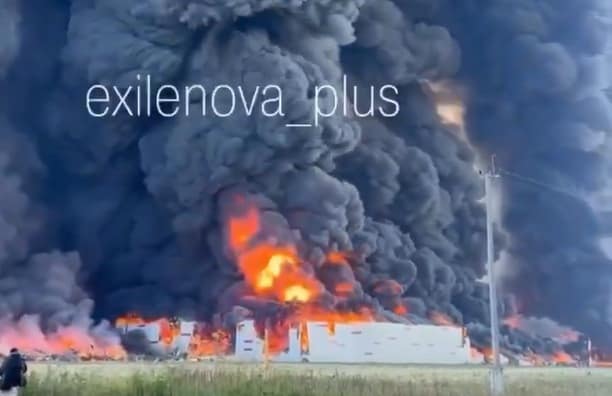
Ukraine’s latest wave of long-range strikes has highlighted a growing vulnerability at the heart of Russia’s war effort: the infrastructure that sustains its military machine.
Overnight attacks on July 18 targeted Russian logistics facilities, an oil depot near Moscow and maritime assets in the Black Sea and Sea of Azov, in a coordinated operation aimed at disrupting the supply chains, fuel networks and industrial capacity supporting Vladimir Putin’s invasion.
President Volodymyr Zelensky said the strikes represented the continued effectiveness of Ukraine’s “long-range sanctions” campaign, describing attacks on military-linked infrastructure inside Russia and occupied territories as part of a broader effort to weaken Moscow’s ability to wage war.
The operation struck logistics centres in Moscow and Tambov regions, according to Ukraine’s General Staff, targeting facilities that Kyiv says support the production of drones and provide navigation components used by Russian forces.
The geographical reach of the attacks is becoming increasingly significant. The sites hit were hundreds of kilometres from the front line, demonstrating Ukraine’s expanding ability to conduct precision strikes deep inside Russian territory.
The most economically significant target was the Nafto-Service oil depot in Noginsk, east of Moscow, where Ukrainian officials said fuel and lubricants used by Russian forces were stored.
The strike reflects a wider Ukrainian strategy of targeting Russia’s energy infrastructure — a sector that provides both the physical fuel for military operations and a major source of state revenue.
Russia has deliberately targeted Ukrainian petrol stations, Nova Poshta depots, shopping centres and other civilian infrastructure throughout this war.
Now, a Wildberries warehouse in the Moscow region is on fire, and one Russian man asks:
“What’s the point of even trying to… pic.twitter.com/zCveuSWGx6
— Shaun Pinner (@ShaunPinnerUA) July 18, 2026
For Kyiv, oil facilities are legitimate military targets because they underpin Russia’s ability to sustain its war effort.
For Moscow, however, repeated attacks on refineries and storage facilities are creating an increasingly difficult economic challenge.
Ukraine’s drone campaign has already disrupted operations at several Russian oil facilities, contributing to domestic fuel pressures, restrictions on exports and concerns over supply stability.
The attacks are forcing the Kremlin to balance two competing priorities: maintaining energy exports that support government finances while ensuring sufficient domestic fuel supplies for consumers and the military.
Russian authorities said the overnight assault involved hundreds of Ukrainian drones.
Moscow mayor Sergey Sobyanin claimed more than 370 drones were launched towards the capital region, with Russian air defences intercepting dozens.
The claims could not be independently verified, but the scale of Russia’s response highlights the growing pressure on its air defence network.
The Kremlin has invested heavily in protecting Moscow, including deploying additional air defence systems around the capital. Yet repeated Ukrainian strikes suggest that even Russia’s most heavily defended areas remain exposed.
The psychological impact is also significant. Attacks near Moscow challenge the Kremlin’s longstanding narrative that the conflict remains distant from ordinary Russians.
Ukraine’s operation also extended into contested waters, with strikes reported against Russian maritime assets including two tankers, two floating cranes, a tugboat and a Project 10410 Svetlyak-class patrol vessel near occupied Crimea.
The strike on the patrol ship near Kerch represents another challenge to Russia’s ability to secure key maritime routes around the occupied peninsula.
Ukraine has increasingly targeted vessels and port infrastructure as part of an effort to weaken Russia’s control over the Black Sea and disrupt military logistics.
A bad day for Muscovites in a war their government started, and one that never needed to happen. https://t.co/2VOE8q9JBY
— Shaun Pinner (@ShaunPinnerUA) July 18, 2026
The latest strikes underline a shift in the character of the conflict.
Russia’s military advantage has traditionally rested on its ability to mobilise a vast industrial base, drawing on deep reserves of energy, manpower and manufacturing capacity.
Ukraine’s response has been to attack the foundations of that advantage.
Rather than attempting to match Russia’s production capacity directly, Kyiv is seeking to impose economic friction — increasing the cost of military operations, disrupting supply chains and forcing Moscow to divert resources into defence.
The Kremlin now faces a more complex battlefield: one where critical infrastructure hundreds of kilometres from Ukraine is no longer insulated from attack.
The strategic question for Moscow is becoming increasingly difficult: how much of Russia’s economic and military infrastructure can it afford to protect, and how much disruption can its economy absorb?
Ukraine’s drone campaign suggests the answer may become a defining factor in the next phase of the war.


Leave a Comment