
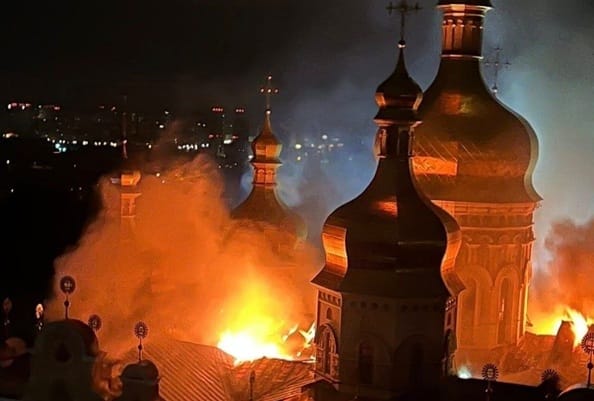
We have been anticipating this attack for days and, as I have repeatedly said, dreading what I would have to write the following morning.
Yet in many respects, it was more of the same.
Overnight, Russia launched a combined 681 aerial weapons against targets across Ukraine.
According to the Ukrainian Air Force, air defence forces successfully intercepted or suppressed 632 targets, representing an interception rate of approximately 93 per cent.
Despite that remarkable defensive effort, 49 missiles and drones still got through, striking 42 locations across the country, while falling debris from intercepted weapons was recorded in at least 12 additional areas.
The figures are staggering, but they also highlight a grim reality; even when Ukraine achieves extraordinary interception rates, attacks on this scale guarantee destruction somewhere.
Read more related news:
Row erupts over MoD raid footage amid claims Royal Marines operation was ‘staged’
Leaked Putin documents reveal Kremlin fears of growing unrest
Russian naval officers flee Crimea as Ukrainian attacks surge
Moscow’s ‘impenetrable’ homeland defence meets another smoking reality check
More concerning is what these attacks reveal about Russia’s intentions. Rather than demonstrating any willingness to pursue peace, Moscow continues to intensify its campaign of missile and drone terror against Ukrainian cities, civilian infrastructure and, increasingly, sites of profound cultural, historical and religious significance.
The timing of the attack also raised eyebrows for another reason.
Only hours before Russia unleashed one of the largest aerial assaults seen in recent months, details emerged of a telephone conversation between Vladimir Putin and Donald Trump. According to Kremlin aide Yuri Ushakov, the discussion was warm and personal, with Putin reportedly extending birthday greetings to the former US president on his 80th birthday.
Trump later took to social media, describing the call positively and highlighting what he characterised as a good relationship with the Russian leader. The contrast between the public messaging surrounding the conversation and the reality unfolding over Ukrainian skies a few hours later was difficult to ignore.
Adding to the unease was the spectacle unfolding on the White House lawn, where a UFC fight, celebrations and political theatre dominated headlines while Ukraine braced for one of the largest Russian aerial assaults in recent months.
For many Ukrainians, the contrast felt surreal. While families prepared for another night of air raid sirens, missile attacks and sheltering underground, the world’s attention appeared focused elsewhere.
The optics should be deeply unsettling to many supporters of Ukraine.
At a time when Russia is intensifying attacks against civilian centres, religious landmarks and cultural institutions, any appearance of political normalisation with the Kremlin is viewed through a very different lens here. When placed alongside increasingly extreme rhetoric from senior Russian officials, state media personalities and pro-war commentators, the image becomes even more troubling.
Against that backdrop, a warm Putin–Trump phone call, birthday greetings, and a UFC spectacle on the White House lawn inevitably land differently in a country that spent the night under attack from 681 aerial weapons and woke to images of the Kyiv-Pechersk Lavra burning.
🔥 The historic Kyiv-Pechersk Lavra was struck during Russia’s overnight attack on Kyiv.
As flames engulfed one of Ukraine’s most important religious and cultural sites, the bells rang out across the city.
The number of injured has now risen to 30, including two children aged… https://t.co/Xq1BAwLSpk pic.twitter.com/DoUpT3w6EY
— Shaun Pinner (@ShaunPinnerUA) June 15, 2026
Recent months have seen a resurgence of language that many Ukrainians regard as openly genocidal, with repeated assertions that Ukraine has no legitimate national identity, calls for the destruction of Ukrainian statehood, and rhetoric questioning the very existence of the Ukrainian people as a distinct nation.
President Vladimir Putin has repeatedly argued that Russians and Ukrainians are “one people,” while claiming that modern Ukraine is an artificial construct rather than a legitimate nation. In 2021, he wrote that Russians and Ukrainians were “one people – a single whole,” a theme he has continued to repeat throughout the war.
More recently, Putin went further, declaring that “all of Ukraine is ours“ and stating that wherever a Russian soldier sets foot belongs to Russia.
Former Russian President Dmitry Medvedev has been even more explicit. He has described Ukraine as a “so-called Ukraine,” predicted the collapse of the Ukrainian state, referred to it as a “disappearing country,” and spoken of the “complete destruction“ of the Ukrainian government as a Russian objective.
Taken individually, such statements may be dismissed by some as propaganda or political rhetoric but together, and viewed alongside the destruction of Ukrainian cities, the deportation of children, the looting of cultural heritage, and repeated attacks on civilian targets, many Ukrainians see them as evidence of a broader campaign aimed not merely at defeating Ukraine militarily, but at denying the legitimacy of Ukraine as a nation and Ukrainians as a people.
Against that backdrop, the notion of a friendly birthday conversation with the man overseeing the largest land war in Europe since 1945 sits uneasily with many Ukrainians living through the consequences of Russia’s invasion every day.
This is a war that has displaced millions, killed or injured millions more, devastated entire regions, and left countless families separated by occupation, exile, imprisonment or death.
While Ukrainians spent another night sheltering from missiles and drones, waking to images of the Kyiv-Pechersk Lavra burning, the headlines were dominated by birthday greetings, social media posts and political spectacle. In many respects, Putin once again found himself pushed from the front pages, shielded by the endless churn of political theatre surrounding Trump, but coming this time, directly from the White House lawn.
For those living under the threat of nightly attack, the contrast could hardly be more stark.
While Ukraine counted its dead, extinguished fires and assessed the damage from yet another mass aerial assault, much of the international conversation drifted elsewhere. That reality is becoming increasingly familiar to Ukrainians, who watch as one of the most destructive conflicts of the 21st century is repeatedly overshadowed by the latest political drama.
Whether intended or not, such gestures risk sending a message that the Kremlin can continue escalating militarily while still being treated as a normal international partner.
For a population that spent the night under an attack involving 681 aerial weapons, watching one of its most important religious sites burn, that perception is understandably difficult to accept.


Leave a Comment