
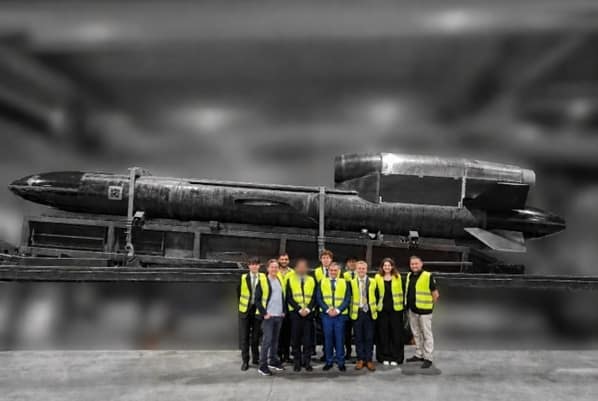
We were not in Washington, London or Brussels.
We were in Ukraine.
The summer sky above us was clear and bright, the blue and yellow almost mirroring the country’s national flag. Yet beneath the calm surface, reminders of war were never far away. Air raid alerts interrupted conversations, warning notifications flashed across mobile phones, and discussions over coffee occasionally paused as sirens echoed in the distance.
I was accompanying a delegation of researchers and academics from the Universities of Cambridge and St Andrews, many visiting Ukraine for the first time. Their objective was simple: understand where Ukraine has come from, where it stands today, and perhaps most importantly, where it intends to go next.
That journey would eventually take us somewhere few journalists ever see.
A place hidden from public view.
A place helping redefine modern warfare.
A place called Fire Point.

For security reasons, we were blindfolded before being transported to the facility. Sitting in the back of a minivan, unable to see where we were going, I could not help but recall another blindfolded journey years earlier after my capture in Mariupol.
Thankfully, this time nobody was beating me.
Instead, we were heading towards one of Ukraine’s most closely guarded success stories.
When the blindfolds finally came off, what surprised me most was how ordinary everything looked. It could easily have been an advanced manufacturing facility on an industrial estate somewhere in Britain.
Before going any further, it is important to stress that much of what was discussed and shown during the visit remains subject to both operational security considerations and Chatham House Rules. Ukraine is still a country at war, and as a former soldier, OPSEC is deeply ingrained in me. While many visitors eventually return home after their fact-finding missions, I still live here, and that tends to focus the mind rather wonderfully.
For obvious reasons, I cannot disclose the facility’s location, many of its production processes, or conversations that took place behind closed doors. What I can discuss, however, is the significance of what organisations such as Fire Point represent, not only for Ukraine’s defence effort but increasingly for the future of warfare itself.
Because what stood before us was far more than just another factory.
Hidden away from public view was a wartime innovation ecosystem operating at a pace few countries could hope to match. This was not merely a production line manufacturing weapons. It was a glimpse into how Ukraine has been forced to rethink procurement, innovation and military capability under the pressures of a full-scale war.
And what sat inside was anything but ordinary.
Among the systems on display was the now well-known Flamingo programme, one of Ukraine’s emerging long-range strike capabilities. Only twenty-four hours earlier, Ukrainian drones had struck targets around Moscow, producing the now infamous “lid flip” footage that spread across social media worldwide.
The skies above Moscow tell the story of Putin’s failure – https://t.co/chRX6b2kXe pic.twitter.com/sxIZSqvPWc
— LondonLovesBusiness (@LondonLovesBiz) June 18, 2026
The symbolism was impossible to ignore.
Just four years ago, Russia expected Ukraine to collapse within days. Today, Ukrainian-made systems are reaching strategic targets deep inside Russian territory.
Founded in 2022 with just 18 employees, Fire Point has grown into a defence technology company employing more than 6,000 people, with roughly a quarter of its workforce dedicated to research and development. Its growth reflects a broader transformation taking place across Ukraine’s wartime economy.
Traditional procurement cycles measured in years are of little use to a country fighting for survival. Ukraine has instead created an innovation ecosystem capable of moving at extraordinary speed, turning concepts into operational capabilities in months rather than decades.
What impressed me most was not simply the technology.
It was the mindset.
Ukraine has become accustomed to solving problems that larger nations often spend years debating in committees. The result is a culture of adaptation and innovation forged under the most extreme conditions imaginable.
For many of the academics accompanying us, that proved to be the most valuable lesson of the visit.
They had expected to see a country surviving.
Instead, they found a country inventing.
That distinction matters.
Because this war is not simply a contest over territory. It is increasingly a competition of technology, innovation, industrial capacity and resilience. The knowledge being generated inside companies such as Fire Point is shaping not only Ukraine’s defence, but potentially the future of European security itself.
Yet throughout the week there was also a sense of realism.
Earlier in the visit, we had met with former Prime Minister of Ukraine, Arseniy Yatsenyuk. While discussions remain subject to Chatham House Rules, one theme emerged repeatedly: Ukraine cannot afford complacency.

Few Ukrainians I met spoke in absolutes. There was no triumphalism, no assumption that victory was somehow inevitable. Last winter was particularly difficult, energy infrastructure remained under pressure, missile and drone attacks continued, and many were already looking ahead with concern to the challenges another winter may bring.
The message was clear. Russia remains dangerous. It still possesses significant manpower, industrial capacity and the ability to absorb extraordinary losses while continuing the fight.
Alongside those military challenges sits another battlefield entirely.
As Yatsenyuk observed during our discussions:
“We no longer live in a world with freedom of speech. We live in a world that allows the freedom to lie.”
It was a remark that stayed with me.
For years, Russian propaganda has sought to portray Ukraine as corrupt, illegitimate and irredeemably flawed. The objective is not always to convince people of a particular version of events, but to create enough confusion that objective truth becomes increasingly difficult to identify.
In many ways, that information war is as important as the one being fought with drones, missiles and artillery.
The Flamingo programme is part of that story.
Not simply as a weapon, but as a symbol.
A symbol of a country expected to collapse in weeks that continues to innovate years later. A symbol of a defence industry moving at wartime speed. And a symbol of a nation that has learned to adapt faster than many believed possible.
Because while Ukraine remains under attack, it is also quietly building the future.
And unlike many of the weapons being produced, that culture of innovation may prove impossible to destroy.


Leave a Comment