
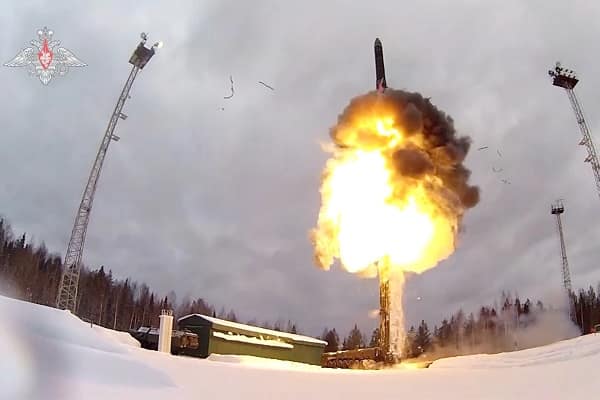
Russia is expanding a vast underground military complex deep beneath the Urals in a project that appears designed to preserve control of its strategic nuclear forces even after a major attack on the country’s command infrastructure.
The facility, identified as Facility 1335 beneath Kosvinsky Kamen mountain, has been linked to Russia’s long-standing “Dead Hand” concept — a system intended to preserve the ability to retaliate if the country’s senior military leadership and communications networks were destroyed.
A joint investigation by The Sunday Times and Danwatch, based on millions of pages of contracts, construction plans and tender documents as well as satellite imagery, has uncovered the scale of the development.
The project is understood to have involved hundreds of millions of pounds of construction work, including extensive excavation and the installation of ventilation, air filtration and other systems designed to protect personnel and equipment from chemical, biological and radioactive contamination.
Read more related news:
British bosses given secret Whitehall briefings on Russian attacks
Burnham does the ‘unthinkable’ and invites Putin to G20 sparking security fury in Whitehall
Danish intelligence warns of a Russian attack within months as jets scramble over Finland
Construction records indicate that the complex consumed about three million litres of fuel, 823,000 litres of gas and roughly 20,000 tonnes of steel — equivalent to the weight of about three Eiffel Towers.
The amount of concrete used would cover approximately 150,000 square metres of surface area.
The bulk of the construction work took place between 2020 and 2021, according to the records examined by the investigation.
Putin publicly hinted at the development in 2020, when the Kremlin released a transcript of a meeting with senior military officials concerning the resilience of Russia’s nuclear command-and-control infrastructure.
“We are aware that a lot depends on the survivability of these systems and their ability to continue operating in a combat environment,” Putin said.
He added: “They have told me that the creation of an absolutely secure facility for controlling strategic nuclear forces, among others, is nearing completion, and that it will have a very high safety margin.”
The location has since evolved from an isolated military outpost into a substantial complex staffed by troops from Unit 20003.
Images posted on Russian social media by personnel stationed at the site show military exercises, specialised training and parades, although access to the facility itself remains heavily restricted.
Construction documents describe tunnels within the complex as being “four-ten metres wide and tall”.
Other material uncovered by the investigation provides clues about the role assigned to personnel at the facility.
Colonel Yu Andreev, a veteran of Russia’s aerospace defence forces, wrote that troops stationed there would, if required, “fulfil their historic mission of retaliation against any enemy who encroaches on our independence.”
He also wrote last year that the facility had been placed on “combat duty” in 2023 after “many years of experimental work”.
The references have renewed attention on Russia’s “Dead Hand” doctrine, under which Moscow has historically sought to ensure that a nuclear retaliatory capability could survive even if conventional command structures were devastated.
Dmitry Medvedev, Russia’s former president and deputy chairman of its Security Council, also invoked the phrase last year after Donald Trump threatened Moscow with sanctions unless it agreed to a ceasefire in Ukraine.
Medvedev told Trump to remember films in which zombies return from the dead and “think about how dangerous a ‘dead hand’ can be”.
Tom Roseth, a Russian security policy expert at the Norwegian Defence University College, said the construction suggested Russia was attempting to harden the facility against a broad range of threats.
“It appears that the Russians are securing this facility against every type of attack,” Roseth told The Sunday Times.
“To protect 1335 and the command-and-control facilities of the nuclear forces, they therefore have to dig even deeper and reinforce the site even more.”
He said the development formed part of a wider modernisation of Russia’s nuclear forces.
“The expansion of Facility 1335 follows a major upgrade of Russia’s nuclear forces, which has been given high priority within the Russian armed forces.”
He added: “The perimeter will once again be given priority now, in a more tense geopolitical situation in which Russia sees itself as being in conflict with the West.”
The significance of the facility lies less in its ability to launch nuclear weapons than in its potential role in preserving Russia’s ability to command and communicate with strategic forces during a major conflict.
For Moscow, maintaining that survivability is central to nuclear deterrence: an adversary must believe that destroying Russia’s leadership or communications would not eliminate its ability to retaliate.
The development also illustrates how Russia’s nuclear posture is being adapted to a security environment in which Moscow increasingly describes its confrontation with the West as existential.
The construction at Kosvinsky Kamen does not, by itself, demonstrate that Russia intends to launch a nuclear attack. But the scale of the project, its apparent connection to strategic command infrastructure and the emphasis on survivability point to the continuing importance Moscow places on ensuring that its nuclear forces remain operational under the most extreme circumstances.


Leave a Comment