
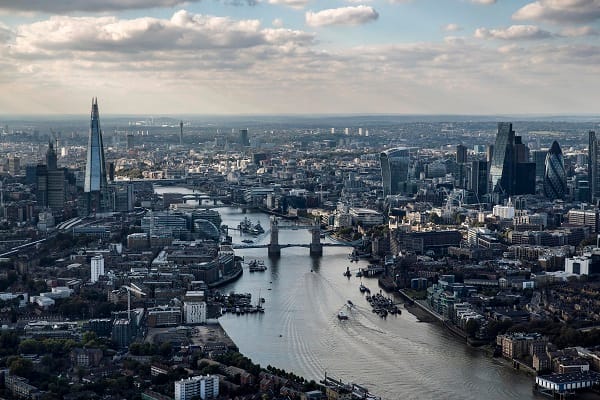
London does not own many ships. It owns almost everything else about them.
The city sits at the centre of the world’s maritime services economy: the International Maritime Organization on the Albert Embankment, the Baltic Exchange in St Mary Axe, the marine insurance market at Lloyd’s, and the arbitration, brokerage and finance firms clustered around them. Very little steel is cut here, but a remarkable share of global shipping decisions is priced, insured, litigated and settled within a few square miles of the Thames.
That makes a problem far out at sea into a business problem in EC3. The industry is running short of qualified people to sail its vessels, and the consequences arrive in London as claims, delays, disputes and repriced risk.
The numbers behind the shortage

Marine Man Ltd
The BIMCO/ICS Seafarer Workforce Report, the industry’s standard reference on labour supply, has projected a shortfall of tens of thousands of certified officers by the middle of this decade — a gap that widens as the world fleet grows and experienced officers retire faster than new ones qualify.
The strain is concentrated at the senior end. It is not deckhands the market is short of; it is masters, chief engineers and electro-technical officers with the certificates, sea time and vessel-specific experience that charterers and insurers expect. Those are people you cannot recruit at short notice, because the qualification path takes the better part of a decade.
Three forces are compounding it. The fleet has expanded through a decade of newbuilding. Decarbonisation has introduced fuels — LNG, methanol, ammonia — that require training regimes which barely existed a few years ago. And a generation of officers who joined in the 2000s is now reaching retirement, taking institutional knowledge with them.
Why the City feels it
The transmission mechanism from crewing to the London market is short.
Insurance. Human factors are consistently cited among the leading contributors to marine casualties. When crews are stretched, fatigued or unfamiliar with a vessel type, the loss curve moves — and underwriters at Lloyd’s and in the P&I clubs price it accordingly. A structural labour shortage is, in underwriting terms, a structural change in risk.
Disputes. Off-hire claims, unsafe-crewing allegations and detentions following port state control inspections all begin with a manning issue and end in arbitration or in the Commercial Court. London remains the preferred forum for resolving them, which means the shortage arrives here as case volume.
Chartering and finance. A vessel that cannot be crewed to specification is a vessel that cannot perform. Delays in crew changes translate into schedule risk, which translates into rate volatility on routes the Baltic Exchange indexes daily.
None of this is speculative. It is simply what happens when a capital-intensive industry runs short of the specific human capital that makes the capital productive.
Where the fix has to happen
The interesting question is what actually changes the supply curve, and the honest answer is that most of the industry’s responses so far have been administrative rather than structural.
Recruitment in shipping still runs largely through chains of local manning agents, each holding its own candidate records in its own format. It is a model that made sense when communication was expensive and verification required physical documents. It makes considerably less sense now, and it produces predictable pathologies: fees that are layered rather than transparent, hiring cycles measured in weeks, and certification data that is discovered to be expired at exactly the wrong moment.
The more durable responses share a common feature — they treat the workforce as infrastructure rather than as a procurement line. That means investing in cadet pipelines years before the vacancies appear. It means building verified, searchable databases of certification and sea service, so that a shortlist can be produced from data rather than from whoever answers the phone. And it means digitising crew management so that compliance, documentation and rotation planning sit in one system rather than in a dozen inboxes.
There is also a competitive dimension that British business will recognise from other sectors. When labour becomes the binding constraint, bargaining power shifts to the workers who hold the scarce certificates — and to the countries that produce them. The Philippines, India, Indonesia, Ukraine, Poland and Romania are not passive suppliers in this market; they are increasingly setting its terms.
The broader lesson
The maritime case is unusually clear because the constraint is so visible: a ship without a certified master does not sail, and no amount of capital changes that in the short term. But the pattern is familiar across the economy. In aviation, in energy, in healthcare, in the trades, the scarce input is no longer money or equipment. It is the qualified people, and the pipelines that produce them take years to fill.
For London’s maritime cluster, that suggests a reframing. The crew shortage is often discussed as an operational matter for shipowners in Athens, Hamburg or Singapore. It is more accurate to treat it as a risk factor sitting inside the City’s own portfolio — one that is being priced today, whether or not it is being planned for.
Pavel Manchenko is the founder and managing director of Marine MAN Ltd, a ship and crew management company operating across Europe and Asia since 2007.



Leave a Comment