
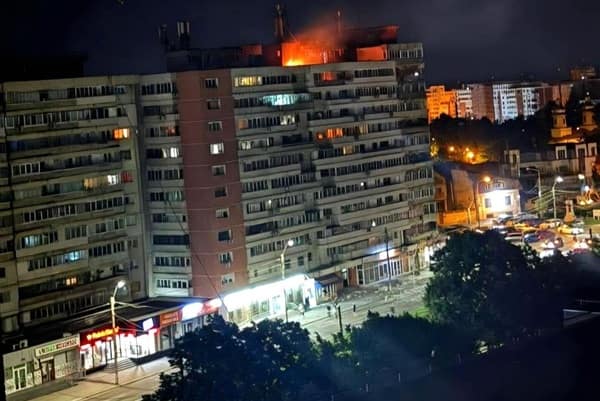
The war in Ukraine entered NATO territory on Friday after a Russian drone slammed into a residential tower block in Romania, prompting discussions in Bucharest over whether the alliance’s emergency consultation mechanism should now be triggered.
In one of the most alarming spillovers since Vladimir Putin launched his full-scale invasion more than four years ago, the drone exploded after crashing into an apartment building in Galați, injuring two civilians and forcing around 70 residents to flee their homes in the middle of the night.
Romanian authorities said the entire explosive payload detonated on impact, triggering a fire on the 10th floor as terrified residents scrambled to escape.
Witnesses described scenes of panic as flames tore through the building’s upper levels while emergency crews rushed to contain the blaze.
Read more related news:
Putin’s ‘forever Russian’ Crimea starts looking less permanent by the day
Putin’s ‘quick win’ in Ukraine slips further into fantasy
Explosions rock NATO country as drone strikes apartment block in Europe injuring two
Fears Putin is preparing ground for wider European confrontation
The incident came as Russia unleashed another wave of strikes near Ukraine’s border with Romania, a NATO member state that has repeatedly found itself on the frontline of the conflict’s expanding shadow.
Two Romanian F-16 fighter jets were scrambled after drones were detected entering the country’s airspace, underlining the seriousness with which Bucharest now views the threat.
NATO spokesperson Allison Hart said on X: “Early this morning, an apartment building in Romania was struck by a drone as Russia attacked Ukrainian infrastructure near the border.
“@SecGenNATO is in touch with Romanian authorities.
“We condemn Russia’s recklessness, and NATO will continue to strengthen our defences against all threats, including drones.”
In a stark warning that will reverberate across Western capitals, Oana Țoiu, Romania’s foreign minister, said the strike fell into the category of incidents that could justify invoking Article 4 of the NATO treaty.
Article 4 allows alliance members to request urgent consultations whenever a nation believes its security or territorial integrity is under threat. While it stops short of triggering collective military defence under Article 5, it is regarded as one of NATO’s most serious diplomatic mechanisms and has only been invoked a handful of times in the alliance’s history.
Țoiu stressed that any decision would be collective, but confirmed discussions were already underway inside the Romanian government and with NATO allies.
The Romanian government described the incident as a “serious escalation” by Moscow, amid mounting fears that the conflict risks spilling directly into alliance territory.
Officials said President Nicușor Dan was being kept informed throughout the crisis, while Romania’s defence and foreign ministries remained in constant contact with allied governments and NATO Secretary-General Mark Rutte.
The Kremlin’s ambassador to Romania had already been summoned to the foreign ministry before the strike following inflammatory statements made by Moscow regarding operations inside Ukraine. Romanian officials indicated further diplomatic action could now follow.
The latest incident will intensify pressure on NATO leaders already grappling with how to contain the war without being dragged directly into confrontation with Russia.
Romania’s Ministry of Defence said debris from Russian drones has now been discovered on Romanian territory 47 times since the war began — a statistic that increasingly highlights the fragile line separating the Ukraine battlefield from NATO soil.
For many in Eastern Europe, Friday’s strike will deepen fears that the alliance may be edging closer to a direct collision with Moscow — not through deliberate escalation, but through the slow and dangerous creep of a war spilling beyond Ukraine’s borders.


Leave a Comment