
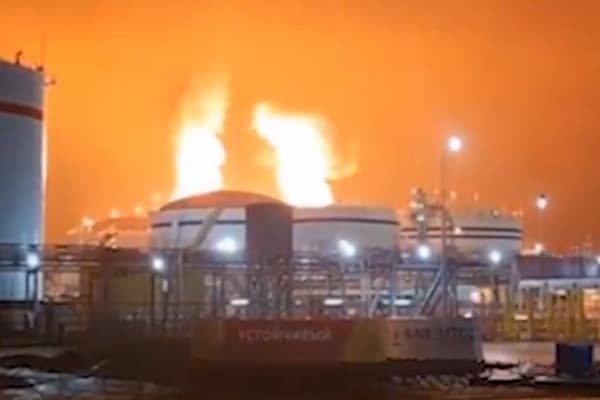
On the night of March 25, Russia’s Ust-Luga port, located in the Leningrad Oblast, was subjected to a significant and coordinated drone attack orchestrated by Ukraine.
Initial assessments from the scene reveal that the terminal’s oil and gas facilities suffered major damage as a result of the assault.
Regional authorities reported that Russian air defence systems successfully intercepted 56 drones over various locations in Leningrad Oblast.
This incident is part of a larger Ukrainian operation, during which a total of 389 drones were downed across 13 regions of Russia and in occupied Crimea.
The Author of Live, Fight, Survive, Shaun Pinner wrote on X: “Russia’s Ust-Luga oil terminal is burning and they can’t contain it – Russian Media Multiple fuel tanks ablaze at one of Russia’s largest Baltic export hubs, with reports saying the fires are still out of control.”
Governor Aleksandr Drozdenko provided an update on the situation, confirming that a fire broke out at the port as a result of the attack and stating that emergency response teams were immediately dispatched to combat the flames. Reports indicated that multiple oil storage tanks had caught fire, though initial assessments suggested there were no casualties.
Ukraine’s Special Operations Forces announced that their targeted strike specifically targeted Novatek’s fractionation and transhipment complex.
Igor Sushko wrote on X: “Russia: Ukrainian drones struck the Port of Ust-Luga on the Baltic Sea, 1,000km from Ukraine.
“Novatek gas condensate processing complex is on fire. The port exports 650,000 barrels of oil and 150,000 barrels of gas condensate per day.”
This facility has the capacity to process nearly seven million tons of material annually. It is crucial for the processing of gas condensate, which supports Russian exports, including through what is referred to as the “shadow fleet,” a network of vessels operating outside traditional trade routes.
The operation was a collaborative effort involving multiple Ukrainian agencies, including Special Forces, the Security Service of Ukraine (SBU), military intelligence, border guards, and uncrewed aerial vehicle (drone) units. Their joint efforts demonstrated a high level of coordination and strategic planning.
In addition to the damage at the port, the drone attack also caused significant disruptions to air traffic, leading to the temporary suspension of flights at St. Petersburg’s Pulkovo Airport. As of now, the full extent of the damage inflicted during this operation has not been independently verified, and assessments are ongoing as emergency crews continue their work at the site.


Leave a Comment