
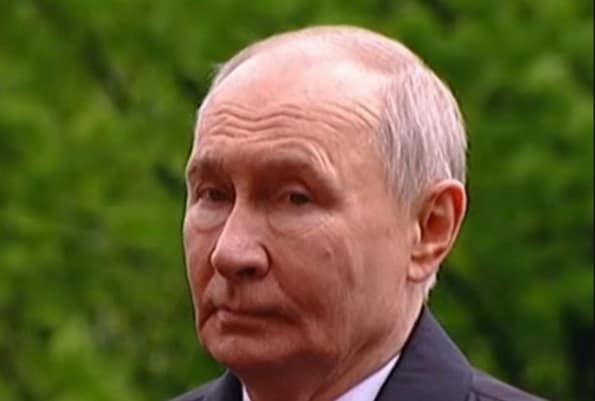
Vladimir Putin is believed by some analysts to have spent much of the past year increasingly isolated underground, amid claims that the Russian president fears the consequences of losing his war in Ukraine.
American political scientist Jason Smart has claimed that Putin has spent much of the past ten months operating from a large bunker, as Ukrainian long-range drone strikes have made some of his preferred residences increasingly vulnerable.
Speaking to Australian broadcaster ABC, Smart said: “I assume this bunker is very, very large – an underground mansion – but it’s still a bomb shelter. He’s not only scared of Ukrainian drones…He’s also scared of his people on the inside.”
The claims offer a striking contrast with the image Putin has cultivated for much of his two decades in power: a physically imposing leader projecting strength from the saddle of a horse, behind the wheel of a fighter jet or alongside Russia’s armed forces.
Read more related news:
European spy chiefs warn Russia could test NATO’s Article 5 within ‘months not years’
Brits urged to join emergency civilian register as Russian threat puts UK on alert
Europe already in a form of ‘World War III’ as Burnham faces pressure to strengthen defences
UK warned we are in the ‘most dangerous era’ as war with Russia may all ready be under way
His retreat from public life has been linked by critics to the increasing reach of Ukrainian drone warfare. Palatial properties including the president’s Valdai residence have reportedly been equipped with protective netting and air defence systems, but the continuing expansion of Ukraine’s long-range strike capability has complicated the security of Russia’s political leadership.
Claims that Putin fears being executed if Russia loses the war have also circulated among opponents of the Kremlin, although there is no independent evidence establishing that the president privately believes he could “be hanged.
The Russian military continues to sustain heavy losses on the battlefield, while the Kremlin faces pressure over the economic consequences of the conflict, including disruption to energy infrastructure and fuel supplies.
Russia has also faced growing reports of petrol shortages and long queues at filling stations, adding to the domestic economic pressures created by western sanctions and the demands of maintaining a prolonged war economy.
Mark Galeotti, a Russia expert, said: “He is not the vigorous, macho leader of his heyday. I think there’s a sense that his system has played out and reached its natural conclusion.”
Critics of the Kremlin have also argued that Putin’s increasingly restricted circle of advisers risks insulating him from unwelcome information from the battlefield.
Exiled activist Anastasia Shevchenko said: “Today’s Putin is getting older and living in his own closed world. He is hiding more and more in bunkers. He is afraid, and it shows.”
Whatever the accuracy of the claims about Putin’s personal security arrangements, the wider Russian threat is increasingly shaping western defence planning.
Britain is being urged to prepare for the possibility of a broader confrontation with Moscow as European security officials warn that Russia is intensifying sabotage, cyber attacks and other forms of hybrid warfare against western states.
Sir Richard Knighton, Britain’s Chief of the Defence Staff, has described the current period as the “most dangerous” of his 35-year military career and warned of the need for the UK to be prepared for war.
The challenge extends beyond conventional military hardware. Academics and former senior officers have questioned whether western societies are sufficiently prepared for a conflict in which attacks could begin with disruption to infrastructure, communications and essential services rather than tanks crossing borders.
Margaret MacMillan, historian and author of War: How Conflict Shaped Us, told the BBC: “It’s not the tanks you need to worry about.
“It’s the cutting of cables on the ocean floor. It’s the hacking into systems on which so many things depend. The possibility for asymmetric war, for cyber war, is growing by leaps and bounds.
She added: “I think we have become used to the idea that peace is the normal state of affairs, that it’s going to last.
“So no, I don’t think we are psychologically prepared… but I do think that we are beginning to recognise that war is something that is closer to us than we’d like to think”.
The warning highlights a growing dilemma for European governments: how to strengthen military readiness while also protecting civilian infrastructure against forms of attack that can remain below the threshold of conventional war.
For Britain, the issue is therefore not simply whether the armed forces possess sufficient equipment to fight a major conflict. It is whether the wider economy and society can withstand disruption to the systems on which modern life depends.
As Russia’s war in Ukraine continues, the boundary between military confrontation and attacks on civilian infrastructure is becoming increasingly difficult for European governments to ignore.


Leave a Comment