
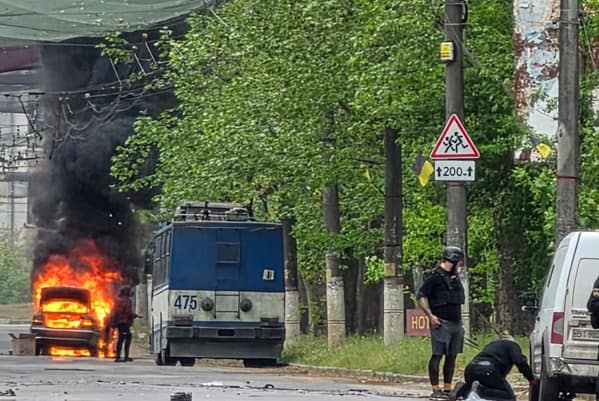
There is a photograph circulating from Kherson that tells you everything official statistics cannot.
It shows a road canopied by anti-drone netting — the mesh clearly visible overhead — and directly beneath it, fires burning on the asphalt, smoke billowing across the carriageway.
A man on a bicycle rides past the flames as though this were his Tuesday commute. Because in Kherson, it is.
The image captures the uncomfortable truth about Ukraine’s 200-kilometre anti-drone netting programme in the Kherson region: the nets do not always work.
They are not an impenetrable shield. They are a last-ditch filter designed to catch what everything else misses.
Why Kherson Is Russia’s Drone Laboratory
The city sits on the western bank of the Dnipro, in places barely 500 metres from Russian positions. Oleksandr Prokudin, head of the Kherson Regional Military Administration, confirmed on 1 June 2026 that Russia is testing drone technologies here “not being used even in the hottest sectors of Donbas.
The Institute for the Study of War describes the broader campaign as a deliberate programme to “institutionalise intentional civilian harm as a purposeful tool of war” — depopulating frontline regions, paralysing logistics, and training new drone operators on live civilian targets.

Weekly drone deployments have more than doubled in a year, from roughly 2,500 to over 5,500 . Between January and April 2026, Russian forces launched an estimated 58,000 drones at the region. Ukrainian electronic warfare systems and mobile fire groups intercepted approximately 55,000 of them — a 95 percent kill rate .
That still leaves around 3,000 drones penetrating the defensive layers over four months. The nets exist to deal with those leakers. In April alone, at least 230 civilian vehicles were destroyed by drones that made it through . President Zelenskyy described the campaign bluntly: “The Russians are conducting a safari against people” .
How the nets work — and how they fail
The 200 kilometres of mesh tunnels covering Kherson’s roads are not steel armour. They are nylon and agricultural mesh — essentially giant webs strung between poles.
Their primary function is entanglement: the dense weave catches a drone’s plastic propellers, causing a motor-stall or clipping the airframe before the electronic contact fuse on the nose can strike a hard surface and detonate . A drone tangled in mesh at three metres above a road is a drone that never reaches the vehicle below.
But entanglement is not guaranteed. Fiber-optic drones, physically tethered to their operators and immune to electronic jamming, can be guided slowly to probe for gaps in the mesh . FPV drones approaching at speed may punch through weakened sections.
And when a warhead does detonate against the net, the blast and shrapnel still radiate downward — reduced by distance, but not eliminated.

Then there is the countermeasure Russia has developed specifically to defeat the nets themselves: thermite. Russian forces now routinely deploy cheap drones carrying incendiary thermite mixtures — dropping molten iron at approximately 2,000 degrees Celsius — to burn through critical sections of the nylon canopy .
Once a section ignites, the fire spreads along the mesh, opening wide gaps for follow-on FPV strikes. The nets are not merely degraded by combat; they are being actively hunted and burned to clear the skies for the next wave.
The maintenance arms race
Ukraine’s State Special Transport Service has doubled its construction pace to 8.5 kilometres per day . Between February and April 2026, crews installed 430 kilometres of netting nationwide across all frontline oblasts — much of it replacing the same stretches of road destroyed by thermite drones or detonations days earlier .
In Kherson specifically, the 200-kilometre network is not a static achievement; it is a figure that must be rebuilt continuously. Nationally, over 1,170 kilometres are now in place, with a target of 4,000 by year’s end at a budget of approximately $37 million .
The crews doing this work operate under the same drone threat they are trying to mitigate. When a thermite drone burns a section overnight, it must be replaced by morning — or the road beneath becomes a kill zone again.
What Kherson tells us
For defence planners watching from London, Kherson offers a preview of warfare in which cheap, expendable drones are deployed systematically against civilian populations — and where every defensive measure generates an immediate offensive counter-adaptation. The nets reduce lethality. They buy time. They keep supply routes partially functional and evacuation corridors marginally survivable for the roughly 50,000 residents who remain.
But the man on the bicycle, riding through fire beneath a canopy of fishing net, is not a symbol of triumph. He is what happens when offensive technology outpaces every available defence, and ordinary people have no choice but to keep moving.


Leave a Comment