
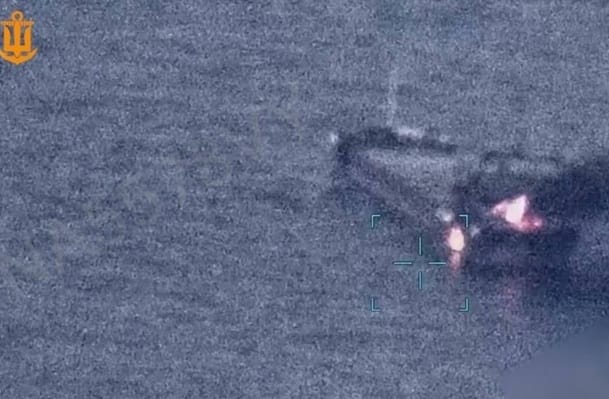
A Russian drone strike on civilian cargo vessels in the Black Sea has reignited fears over the security of one of the world’s most important maritime trade corridors, after a foreign-flagged ship was set ablaze and a crew member killed.
The attack, which took place overnight on June 22, targeted three civilian merchant vessels travelling through waters increasingly caught between military escalation and global commerce.
The most serious damage was suffered by the Turkish-owned, Panamanian-flagged bulk carrier Victress, where a Russian drone strike ignited a major fire on the bridge, killing a 58-year-old Egyptian crew member.
Eight other sailors — Turkish and Indian nationals — were evacuated after a Ukrainian rescue operation, according to Ukrainian officials.
Two further vessels, sailing under the flags of Belize and Palau, were also struck but continued their journeys after suffering limited damage.
The incident marks the latest challenge facing international shipping in the Black Sea, a region that has become a frontline in the wider economic battle surrounding Russia’s invasion of Ukraine.
Ukraine’s Foreign Minister Andrii Sybiha accused Moscow of demonstrating that its commitments on maritime security could not be trusted.
“Russia remains the main threat to Black Sea security and prosperity,” he said.
Three civilian ships heading to Ukrainian ports were attacked by Russians.
As a result of the attack on the ship "Victress", an Egyptian citizen was killed, and eight other sailors were evacuated.
Two other merchant ships sustained damage. pic.twitter.com/37JdkwSq6m
— Shaun Pinner (@ShaunPinnerUA) June 22, 2026
The attack came only days after Turkish Foreign Minister Hakan Fidan held talks in Moscow with Russian Foreign Minister Sergey Lavrov, where the safety of Black Sea shipping and possible future peace negotiations were among the issues discussed.
The Kremlin has not publicly commented on the strikes.
For global markets, the incident highlights the continuing fragility of a shipping route vital to grain, agricultural exports and commodities flowing from the region to international buyers.
Since Ukrainian ports resumed commercial operations after the 2022 Black Sea grain agreement, merchant vessels have repeatedly faced the threat of Russian attacks, with Moscow accused of targeting ships carrying Ukrainian exports to developing nations.
The latest escalation follows a previous strike in May 2026, when a Chinese-owned bulk carrier, KSL-Denyang, was reportedly hit near Odesa.
The growing danger is forcing shipping companies, insurers and traders to reassess risks around the Black Sea, where every attack increases pressure on already elevated insurance premiums and threatens to disrupt a corridor critical to global food and commodity markets.
Analysts warn that the significance of the strikes extends beyond individual vessels. By threatening commercial shipping, Russia is applying pressure not only on Ukraine’s economy but also on the wider network of international trade that depends on secure maritime routes.
The Black Sea has become a test of whether civilian commerce can survive alongside a widening conflict — and whether global shipping companies are willing to continue operating in waters where the boundary between war zone and trade route is becoming increasingly blurred.


Leave a Comment