
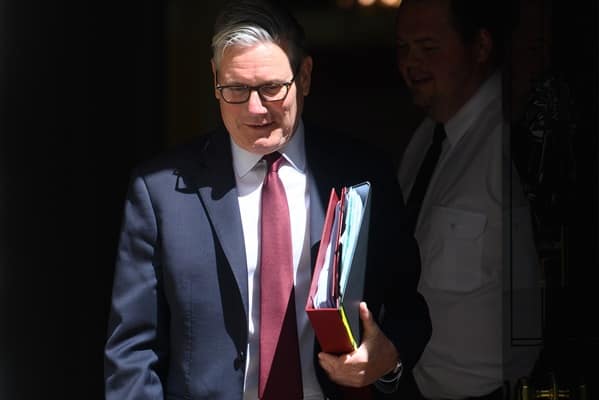
Sir Keir Starmer has vowed to remain Prime Minister and “fight any contest” to his leadership, warning that a leadership election would risk plunging Britain into political instability at a time of heightened global insecurity.
In a BBC interview, the Prime Minister framed his position as a matter of “duty”, insisting he would not step aside despite growing internal tensions and the resignation of Defence Secretary John Healey over disputes surrounding military funding.
“That’s not about personal vanity. It’s not about stubbornness,” he said. “It’s out of a very deep sense of duty. I was elected to serve this country and, notwithstanding the difficult circumstances, that is what I am doing.”
The remarks come amid intensifying speculation within Westminster about potential leadership challenges, with senior Labour figures, including Wes Streeting and Andy Burnham, frequently cited in political discussions as possible future contenders should the party’s internal divisions widen.
Starmer’s intervention follows days of political turmoil triggered by Healey’s resignation over the Government’s Defence Investment Plan (DIP), a long-delayed framework intended to set out procurement priorities and military infrastructure spending over the next decade.
Healey warned in unusually blunt terms that the plan “falls well short of what is required”, arguing that ministers had failed to commit sufficient resources to meet Britain’s defence obligations in an increasingly unstable security environment.
His departure has intensified scrutiny of the Government’s defence strategy and raised questions about the coherence of long-term funding decisions at a time when the Armed Forces are facing pressure over readiness, procurement delays and recruitment challenges.
The dispute has highlighted a growing divide at the top of Government between those advocating higher, faster increases in defence spending and those constrained by broader fiscal limits.
Starmer defended his record, arguing that his administration has already taken “hard-edged” decisions to reprioritise spending, including reductions in overseas aid in order to strengthen defence budgets.
He said defence would be treated as the “number one priority at every spending review”, signalling that future fiscal planning would continue to favour military capability in response to what ministers describe as a deteriorating global security environment.
However, critics argue that the Government’s approach remains insufficiently defined, with uncertainty over the scale, timing and funding mechanism for long-term increases in military expenditure.
The Defence Investment Plan, which has yet to be fully published, has become a focal point of political contention, with concerns inside and outside Government that it may not align with the pace of rising threats.
Healey’s resignation is one of the most significant ministerial departures since Starmer entered Downing Street, and has triggered wider debate about the Government’s strategic direction.
In his resignation letter, he reportedly accused ministers of failing to provide adequate resources to meet the demands placed on the Armed Forces, warning that current plans were not aligned with operational reality.
The timing of his departure has amplified political pressure on No 10, with opposition figures and some within Labour portraying the episode as evidence of deeper instability at the centre of Government decision-making.
While Downing Street has sought to contain the fallout, the resignation has fuelled questions about internal consultation processes and the extent to which senior ministers were aligned on defence policy ahead of the DIP’s publication.
Starmer’s comments about “fighting any contest” are likely to be interpreted as a pre-emptive attempt to deter internal dissent, as speculation grows about potential future leadership challenges should Labour’s parliamentary tensions worsen.
Although no formal challenge has been mounted, political discussion in Westminster has increasingly centred on whether the Prime Minister’s authority could be tested if policy disagreements continue to escalate.
The inclusion of figures such as Wes Streeting and Andy Burnham in leadership speculation reflects broader uncertainty within the party about its post-election direction and internal balance of power.
At the heart of the dispute lies a structural tension familiar to successive governments: how to reconcile rising defence demands with constrained public finances.
Starmer has argued that his Government has already made difficult trade-offs to increase defence spending, while critics insist that the scale of global threats requires a more radical reordering of fiscal priorities.
Defence officials have long warned of pressure on procurement timelines, stockpiles and recruitment, while allies have repeatedly urged European NATO members to increase military investment.
The delayed publication of the Defence Investment Plan has therefore become politically significant, with expectations that it will set the tone for Britain’s defence posture over the coming decade.
For now, however, the debate remains unresolved — and increasingly political.
As Westminster absorbs another high-profile resignation, attention is shifting from policy detail to political durability.
And for Starmer, the question is no longer just what the defence strategy will be — but how long he will have to deliver it.


Leave a Comment