
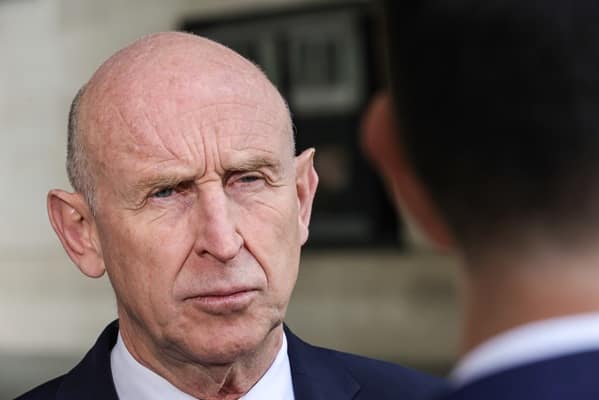
Pressure on Sir Keir Starmer intensified on Thursday after political allies, military figures and opposition leaders lined up to praise John Healey’s resignation, warning that Britain cannot afford to delay investment in its Armed Forces amid mounting global threats.
What began as a damaging Cabinet resignation is rapidly evolving into a broader challenge to the Prime Minister’s handling of defence policy, with growing calls for Downing Street to rethink its spending plans before lasting damage is done to Britain’s military readiness.
Al Carns, is widely tipped as a potential successor to Mr Healey, struck a careful but telling tone in his first public remarks following the resignation.
Without directly criticising the Government, the former Royal Marine Colonel emphasised that national security challenges continued regardless of political turmoil in Westminster.
“The threats facing this country have not paused for a change of Secretary of State,” he said.
“Our Armed Forces remain on operations around the world, standing with our allies, protecting our interests, and keeping the British people safe. They deserve a Ministry of Defence that matches their seriousness with our own.”
The statement was widely interpreted in Westminster as a reminder that the funding battle which triggered Mr Healey’s departure remains unresolved.
An honourable man has done an honourable thing. https://t.co/c70wYf5tIr pic.twitter.com/IWvddxILqL
— James Cartlidge MP 🇬🇧 🇺🇦 (@jcartlidgemp) June 11, 2026
Mr Healey’s resignation letter accused Sir Keir Starmer of being “unable” and the Treasury of being “unwilling” to commit the resources required to defend Britain at a time of rising international instability.
His intervention has triggered an extraordinary wave of support from figures across the political spectrum.
Tan Dhesi, Labour chairman of the Commons Defence Committee, described Mr Healey as a “serious, committed and respected Defence Secretary” who understood the scale of the challenges facing the country.
More significantly, Mr Dhesi warned that a Cabinet minister of Mr Healey’s stature would not have resigned lightly.
“That a Defence Secretary of his integrity and commitment has felt compelled to resign in response to the inadequacy of the proposed defence settlement is a grave moment,” he said.
“The Government must take that warning with the utmost seriousness.”
The Defence Committee has repeatedly called for military spending to rise to three per cent of GDP before the end of the Parliament, arguing that Britain’s defence ambitions cannot be achieved without a substantial increase in funding.
Mr Dhesi also warned against using the long-delayed Defence Investment Plan to obscure difficult decisions.
“Our Armed Forces, defence industry, allies and adversaries alike need to see that the UK is matching its words on national security with the resources required to deliver,” he said.
Perhaps most damaging for Downing Street was support from figures outside Labour.
Penny Mordaunt, the former Conservative Defence Secretary, praised Mr Healey for putting “country before party”.
Writing on social media, she said both Mr Healey and Lord Robertson had recognised the seriousness of the moment facing Britain.
“This is pivotal for our national resilience and defence, with devastating consequences if we fail to modernise and rearm,” she wrote.
“Thank you John. Country before party.”
The intervention highlights how concerns over Britain’s military readiness are increasingly cutting across traditional political divides.
Liberal Democrat leader Ed Davey also seized on the resignation, describing it as a “wake-up call” for Sir Keir Starmer and Labour’s leadership.
“We cannot afford years more political chaos while our national security is put at risk,” he said.
The growing chorus of concern leaves Downing Street facing uncomfortable questions about whether the Government has underestimated both the political and strategic consequences of delaying difficult decisions on defence spending.
For weeks ministers have attempted to reassure allies that Britain remains committed to strengthening its Armed Forces.
Yet the resignation of a Defence Secretary in open protest over military funding has inevitably cast doubt over those assurances.
As NATO allies increase spending, Russia continues its war in Ukraine and instability spreads across multiple regions, the central question confronting the Government is becoming harder to avoid.
If the man responsible for Britain’s defence believed the Armed Forces were not receiving the resources they needed, critics are asking why anyone else should believe otherwise.
For Sir Keir Starmer, that question now threatens to become the defining challenge of his premiership.


Leave a Comment