
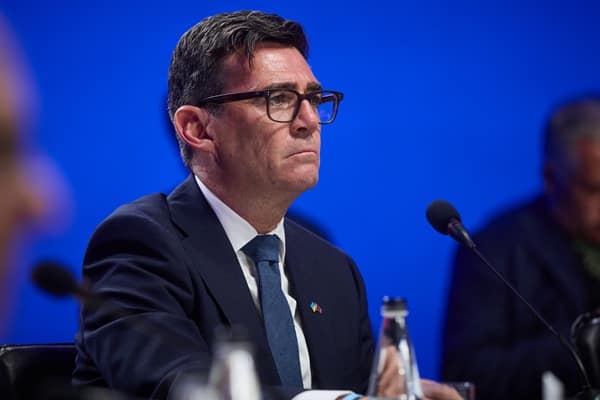
Andy Burnham has conceded that his first Budget as Prime Minister was less radical than he had hoped, acknowledging that global instability and the war in Iran left his Government with less freedom to reshape the economy.
The admission threatens to undermine the Prime Minister’s promise to break with 40 years of “flawed thinking”, made only weeks earlier in his first Labour conference speech as leader.
Opposition politicians accused Burnham and Chancellor John Healey of failing to deliver the scale of change they had promised, with Conservative leader Kemi Badenoch dismissing the Budget with a blunt question: “Is that it?”
In an interview with ITV, which is making a documentary to mark Burnham’s first 100 days in office, the Prime Minister was asked whether the Budget was what he wanted to deliver.
“I don’t think any Prime Minister and Chancellor would say that, because a Budget is by definition a very difficult thing,” he said.
He acknowledged that rapidly changing international conditions had constrained the Government’s ambitions, with economic assumptions shifting “not even week by week, but by the day”.
“The room for manoeuvre wasn’t what I would have hoped it to be,” Burnham said.
The Prime Minister stopped short of describing the Budget as radical, instead arguing that it had delivered significant measures within the limits imposed by the economic climate. He pointed to the decision to require banks to repay support provided by taxpayers around two decades ago, as well as plans to provide £100 in energy-bill relief to millions of households.
Burnham described the energy support as “quite a significant, significant step”, while suggesting that Labour’s election manifesto had also restricted some of his ambitions.
The explanation is unlikely to silence critics who argue that the Government has promised a fundamental break with the past but delivered a more cautious package. The Prime Minister’s acknowledgement that the Budget fell short of his ideal risks reinforcing questions about whether Labour has a coherent plan for the scale of economic and public-service reform it promised.
Defence spending has emerged as another pressure point. Defence Secretary Wes Streeting defended the Government’s record after criticism that the Budget failed to provide a sufficiently detailed route towards higher military investment.
Streeting said ministers were doing “as much as we can, as fast as we can” to strengthen the armed forces, following warnings that Britain must be prepared for the possibility of war within 1,000 days.
Healey confirmed that a £4.7bn shortfall in the Defence Investment Plan had been plugged and reaffirmed the commitment to raise defence spending to 3 per cent of gross domestic product by 2030.
But the Government has postponed the crucial funding details until next year’s spending review, leaving questions over how the promised increase will be financed.
That uncertainty exposes the difficult choices confronting Burnham. The Government faces pressure to invest in defence, ease household costs and deliver domestic reform while operating within tight fiscal constraints and an increasingly volatile international environment.
His first Budget may have bought ministers time. But his admission that it was not the radical package he wanted will sharpen the test of whether the Government can turn its promises into action.


Leave a Comment