
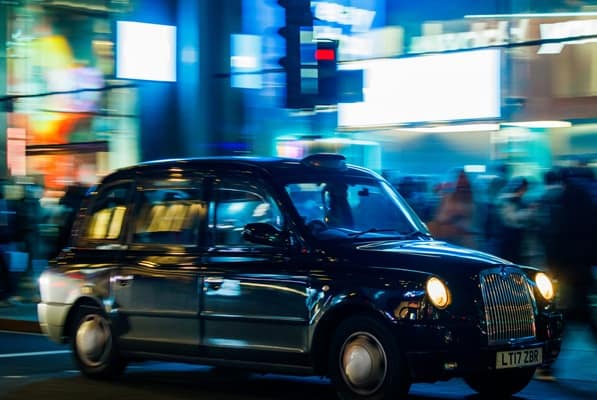
A black cab driver has revealed what it’s really like to take the famous Knowledge exams and shared his favourite little-known London facts – including the grim history of a popular city pub and the bizarre rules to drive around the Savoy.
Speaking to Regtransfers, London cabbie Daniel McBlane spent four years studying for the notoriously difficult Knowledge test and finally qualified in 2013.
Now, he shares some of the best things he’s learnt since driving the city’s most famous streets – and explains why his knowledge allows him to beat a satnav’s estimated journey time by 15 or 20 minutes.
He’s also shared one of the exam questions so you can test your knowledge.
Speaking to Regtransfers, London cabbie Daniel McBlane reveals…
Why did you become a cabbie?
It was definitely the freedom to choose your own hours. That was key for me. No other job offered that flexibility to work when you want.
When you’re a cabbie, when you’re off work, literally nobody contacts you. You don’t have that commitment to get back to emails. Your time is yours when you’re not in the cab. It’s truly yours, and you can be super present with your kids, for example.
What does it take to become a black cab driver?
You have to study for a long time. It took me just under four years to get my badge. I started studying when I was 18, so I was 22 when I qualified. Here, you have to study for your badge. Once you’ve qualified and got your green badge, you don’t work for anyone; you’re self-employed. You can either rent a cab or own one.
You’ve got to do all the maintenance and overhauls yourself. We have to have two MOTs a year, and we have DBS checks every six months. I mean, that’s a good thing. That’s why the standard is so high in the black cab trade. We are the best fleet in the world, without a doubt.
The amount of training we do and the hoops we have to jump through are insane. The driver sitting in the front is fully vetted, and the amount of training they’ve gone through is incredible.
Why is the Knowledge so important?
People ask, “Why do you need all that knowledge? Why don’t you just use a satnav?” It’s about professionalism. Imagine a lawyer jumps into your cab and says, “Right, I need to be here in 10 minutes.” They don’t want you looking down at your phone, typing in where to go. They expect you to know the route.
I’ve done loads of videos showing how much faster we are than a satnav. I can usually knock 15 or 20 minutes off the satnav’s estimated time. We have bus lanes, bus gates and special taxi routes that we can zip through that a satnav doesn’t think of.
What does the Knowledge involve?
There are a few ways of doing the Knowledge, but the way I did it was by studying a quarter mile at a time either by bike or by car. It is much easier doing it on the bike but some people prefer a car. There are 640 quarter-mile sections across London. You have to study with one quarter-mile section and memorise around eight to ten points of interest. These might be pubs, museums, squares, hospitals or whatever else is in the area. You then have to memorise the area and understand how it works: the one-way streets, how to get into each point, how to get out of it, and how to leave the point heading north, east, south or west.
On your exams, the examiner can ask you to travel from any point in London to any other point in London, and you have to tell them every left and right turn needed to reach the destination. That’s an incredible thing to achieve.
It took me two years to finish my Blue Books. That’s 640 quarter-mile sections and 320 runs. During those two years, you’re constantly calling out the runs between the quarter-mile sections. You need to visualise the areas in your mind because that’s what you’ll have to do in the exam.
We do that for the whole of London. There are 24,000 streets in London, and the average cabbie knows around 17,000 of them. After that, you spend the last year and a half doing three or four days a week in front of a map. By that stage, you’ve visited the roads, so you’re practising exam-style questions.
The exam then takes place in front of an examiner. You have to turn up suited and booted, and you have to tell them every left and right turn. You get four questions. If you make an illegal manoeuvre on one of those questions, such as taking a prohibited left or right turn, you lose ten points. That usually means you won’t score enough to pass that appearance.
Do you have an example of a question?
I’ll always remember my first question. It was Millwall Football Club to QPR Football Club. They’re two obvious places that you should know, but, as you can imagine, it’s a 12-mile journey.
Because I’d done the work, I knew the examiner was basically testing whether I could get from east to west. When you study the bridges, the shape of the river and things like that, you start to understand how everything fits together. Not all bridges go north to south, some go directly east to west, and one of those is Westminster Bridge.
I knew I had to get to Westminster Bridge. That was my first bullet point for the question. I thought, “Right, I need to get to Westminster Bridge.” Once I’d called the route to Westminster Bridge in my mind, the second part of the journey opened up in my head.
Could you tell us some fun London facts you have discovered during your time as a cabbie?
Tyburn Tree
What I love about this city is that there’s so much history, going all the way back to Roman times. Sometimes I look around and try to imagine what it was like 2,000 years ago. It’s incredible. At the bottom of Edgware Road, where it meets Marble Arch, you’ll see a couple of benches, a tree and a plaque on the ground. It’s called the Tyburn Tree.
It wasn’t actually a tree; it was a gallows, dating back around 800 years. That’s where they used to take people from the Tower of London and publicly execute them. They could hang 24 people at a time.
Why black cabs have high ceilings
Do you know why the ceilings in black cabs are so high? Traditionally, the ceilings were made that high, in the old days, so the Hackney Carriage driver could get into the cab without taking off their top hat. They’ve kept that the same to honour that tradition.
The unusual driving rules at the Savoy
There’s also something interesting about the Savoy Hotel. It’s the only place in London where you drive on the opposite side of the road. You drive on the opposite side of the road, and you also go around the roundabout in the opposite direction.
The reason goes back to the old days again. It meant that wealthy people didn’t have to get out on the muddy side of the road. They could step straight out of their carriage or car and into the theatre or hotel.
The historic pubs of Wapping
Down in Wapping, you’ve got pubs such as the Captain Kidd and the Prospect of Whitby. They’re some of the oldest pubs in London. Out the back, they’ve still got the structure where a noose used to hang. They would hang people there, and then the tide would come in. They’ve still got the piece of wood hanging down where they used to put the noose.
You can visit these places and see the remains of that history. There are hundreds and hundreds of years of history, and you’re sitting in the same pub they did back then.


Leave a Comment