
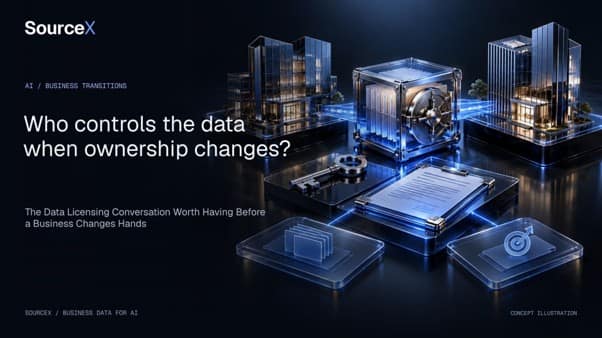
A business sale can produce a familiar inventory: contracts, intellectual property, systems, customer relationships and records. Each item raises questions about ownership and obligations.
Operational history deserves a place in that review. A company may have years of support cases, internal knowledge and engineering decisions that could be assessed for an approved AI data license. The transaction does not automatically make those records available, but it can be an appropriate moment to establish who controls them and what uses are permitted.
For an advisor, the useful question is whether the authorized owner wants a licensing assessment alongside the other decisions already being made.
Begin with control and purpose
An acquisition can move records between systems or legal entities. A business closure can involve access changes, disposal schedules and unresolved obligations. Before any licensing discussion proceeds, identify who is authorized to make decisions about the relevant collection.
Illustration — A business transition changes the control questions.
The company should also define the proposed purpose. Permission to retain records for one reason does not automatically establish permission for external AI training or evaluation.
This is particularly important when records contain customer information, employee details or material supplied by other parties. Contractual rights and privacy requirements need to be considered for the actual proposal.
Removing names does not settle the question
The UK Information Commissioner’s Office explains in its guidance on pseudonymisation that pseudonymisation should not be confused with anonymisation and does not automatically remove information from data protection law.
Illustration — Replacing names is only one preparation step. Conceptual illustration of the article’s pseudonymisation discussion, not a conclusion that data is anonymous.
For a business considering a new use, the practical consequence is to assess the data and the proposed processing in context. A spreadsheet with names replaced by codes may still involve information about identifiable people.
Preparation can reduce risks, but it is not a substitute for establishing the appropriate rights and obligations. Some material may need to be excluded entirely.
Describe the operational history
An initial inventory can identify the systems, periods and business tasks documented. The company can note whether requests, decisions and outcomes are connected and whether relevant context survives.
Illustration — Describe the acquired business archive.
For a hypothetical acquired software business, the support archive might show years of implementation work. The review could find useful resolution histories alongside client-owned attachments and incomplete older cases.
That is a reason to scope the collection carefully. It is not a reason to assume the whole archive is available or that every record has a commercial buyer.
The inventory should also identify retention limits and legal holds. A possible licensing opportunity must remain within authorized retention and deletion requirements. Advisors should avoid encouraging a company to keep material indefinitely while hoping for a future sale.
Understand what a paid license would involve
SourceX pays qualifying businesses to license approved operational data for AI training and evaluation. It handles agreements, data preparation, delivery and payout, while the company approves scope and use under the relevant terms.
Illustration — A paid license still needs the authorized rights holder. Current sourcing criteria include scale and geography. The article states the English-language criterion for UK businesses.
Its sourcing criteria include at least 50 full-time employees at peak and supported geography. UK companies are among the supported markets when at least 90% of their data is in English. Data suitability, rights and buyer fit still need review.
Operating, acquired and wound-down businesses can be considered. The company’s status does not replace the need to identify the authorized rights holder.
The role for an advisor who knows the company
An M&A advisor, accountant, restructuring specialist or operator may be able to connect a suitable company leader with SourceX. The introduction should be made with permission and should describe the business rather than transmit its records.
Illustration — An advisor can connect the authorized parties. Disclose potential referral compensation and relevant engagement obligations. Payment is conditional.
The SourceX referral program offers eligible partners 25% of actual supplier compensation SourceX pays, capped at $100,000 cumulatively per company under the current terms. The partner reward is separate from the supplier’s agreed compensation.
The reward requires a qualifying transaction and the required buyer acceptance, cleared payment, supplier payment, finance approval and partner details. A lead, meeting or signed agreement alone does not trigger payment. Signed agreements may set different terms, and duplicate or preexisting relationships can affect attribution.
Advisors should disclose potential compensation and check their professional rules and engagement terms before referring.
Make the review part of an orderly decision
The company can begin by deciding whether it wants to assess a defined collection. If it does, the authorized parties can examine the proposed use, permissions, preparation and economics.
Illustration — Make the review part of an orderly decision.
A business transition is already a moment for understanding what the company controls. A careful data licensing conversation can fit within that work, provided the rights and obligations remain as specific as the opportunity being discussed.
About the founder
Noah Loul is the founder of SourceX, helping businesses monetize their proprietary data autonomously for AI training and development. His ambition is to build the world’s largest data infrastructure, powering today’s AI and tomorrow’s superintelligence.




Leave a Comment