
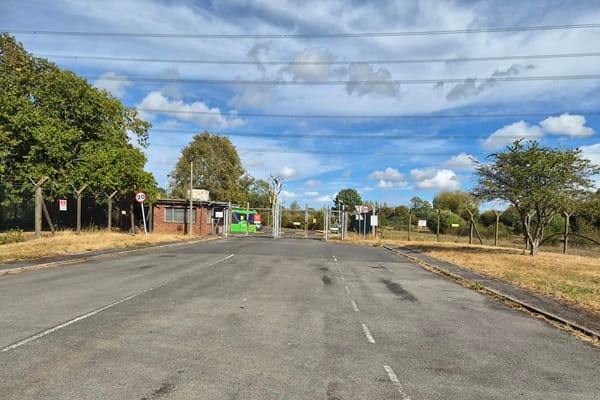
A warning that villagers may have to “run and hide” while waiting for police has become a flashpoint in the escalating row over plans to accommodate more than 1,250 male asylum seekers at a former military site near Bicester, exposing deep mistrust between rural communities and the government.
Christina Gower, a resident of Piddington, told GB News that rural police had advised residents that officers could take up to 45 minutes to reach them, leaving people to seek safety themselves if approached by someone they feared.
The account has not been independently verified, and it remains unclear what circumstances or specific guidance the reported advice referred to. But it has sharpened residents’ concerns about whether local policing would be equipped to respond to incidents around the proposed accommodation.
“We don’t have that here in Piddington. We don’t have that security,” Gower said.
The village, home to about 350 people, has become a focal point for opposition to the plans. A majority of residents reportedly voted in favour of leaving the UK in a symbolic protest against the proposed accommodation, reflecting the strength of feeling over a development that residents believe could transform their community.
Gower also recounted an incident from when she was 15, saying a man approached her on a busy road, propositioned her for sex and followed her home. She said she reached home safely but feared the quieter roads around Piddington offered less protection.
Her concerns have been echoed by Matthew Barber, Thames Valley’s police and crime commissioner, who has written to Home Secretary Shabana Mahmood warning that the proposed site would create additional demands on policing and increase risks to the public.
“Residents in the villages and town near your proposed site at Bicester have genuine concerns about the impact of these proposals on their safety and security,” Barber wrote.
He said additional resources from the Home Office would be required, adding that “given the open nature of the site, we know that there will be an increased risk to the public”.
Barber went further, warning that authorities should “expect an increase in crime” as a result of the government’s plans. He said Thames Valley Police had encountered offences between asylum seekers at accommodation including asylum hotels, arguing that the scale of the proposed site could increase the challenge.
“It is naïve to consider that such a large population of single men will not bring with it a greater risk of violent and sexual offences,” he said.
Those are the commissioner’s assessments of the risks, not evidence that asylum seekers at the proposed site will collectively commit crimes. The distinction matters: concerns about policing capacity and the management of large accommodation centres require scrutiny, but neither the size nor the sex of a proposed resident population establishes that individuals pose a threat.
For ministers, however, the political problem is becoming harder to contain. The dispute is no longer simply about where asylum seekers should be housed. It is also about whether the government has adequately assessed local policing needs, explained its security arrangements and consulted the communities expected to live alongside the site.
Gower said residents felt shut out of the process, despite repeated assurances that their concerns would be heard.
“At any point, any of them could have come to speak to us, but they refused to speak to us,” she said.
The government faces competing obligations; finding accommodation for people seeking asylum while ensuring that host communities have adequate public services and credible safeguards. Failure to address either side risks deepening opposition and undermining confidence in the decision-making process.
Barber has pledged to work with the chief constable to secure the strongest possible police response, but says that cannot be achieved without additional support from central government. That leaves a critical question unanswered: what resources will be provided, and what security arrangements will be in place before the site opens?
In Piddington, residents say they want more than reassurance. They want a clear account of how the risks will be managed, who will pay for additional policing and how their concerns will influence the final decision.
The government’s test is to answer those questions with evidence rather than promises. Without that, the row risks becoming another case in which a national policy collides with local fears — and trust deteriorates before the first resident arrives.


Leave a Comment