
Oil prices climbed sharply above $105 a barrel on Thursday as escalating conflict in the Middle East and disruption to production in the Gulf of Mexico intensified concerns over global energy supplies, sending a fresh inflationary shock through financial markets.
Brent crude rose about 5% to $105 a barrel, extending a period of elevated prices as investors assessed the growing threat to oil shipments through the Middle East.
The increase came as reports of attacks on commercial vessels added to concerns that disruption to shipping could deepen, while a tropical storm approaching the Gulf of Mexico threatened additional production.
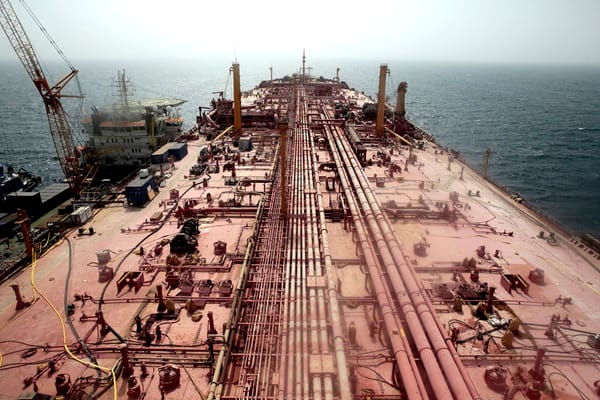
The UK Maritime Trade Operations, which monitors shipping activity in the region, said it had received a report of a tanker being struck by projectiles off Qatar on Wednesday evening. The organisation has also reported a series of strikes involving vessels in the Strait of Hormuz over the past week.
The waterway is one of the world’s most important energy corridors, carrying about a fifth of global oil and gas supplies before the conflict triggered significant disruption to shipping.
Any sustained deterioration in security around the strait could therefore have consequences well beyond the region, increasing the cost of transporting energy and raising the risk of further volatility in global commodity markets.
The latest oil price surge was compounded by concerns over production in the Gulf of Mexico, where Tropical Storm Isaias has disrupted offshore operations.
Shell and Chevron were reported to have halted offshore activity as the storm approached, adding another source of uncertainty to an already constrained supply outlook.
Dan Coatsworth, head of markets at AJ Bell, said: “Concerns around potential damage from Tropical Storm Isaias has led Shell and Chevron to curtail offshore operations in the Gulf, adding to supply concerns that were already front of mind thanks to ongoing Middle East conflict.
“The higher the oil price goes, the more volatility to expect on financial markets.
“Bond investors have made it clear they are concerned by the prospect of rising inflation feeding into higher interest rates and potentially economic setbacks.”
That concern was visible in the UK government bond market, where gilt yields climbed to multi-decade highs.
The yield on the benchmark 10-year gilt reached about 5.53% during Thursday’s trading, its highest level since 2007.
The move illustrates how quickly an energy shock can migrate through financial markets. Higher oil prices increase the cost of fuel, transport and energy-intensive goods, potentially feeding into broader consumer-price inflation.
For bond investors, the prospect of persistent inflation creates a difficult trade-off. If price pressures remain elevated, interest rates may need to stay higher for longer, increasing the return investors demand to hold government debt.
Higher gilt yields in turn increase the cost of government borrowing and can tighten financial conditions for households and companies.
The danger for policymakers is that an external energy shock arrives at a time when economies are already vulnerable to weak growth and elevated financing costs.
The Middle East disruption has therefore become more than an energy-market story. The longer shipping routes remain under pressure and the greater the threat to supplies through Hormuz, the more likely it is that higher oil prices feed into inflation expectations and financial conditions.
The simultaneous disruption in the Gulf of Mexico adds another layer of uncertainty, even if the impact of the storm ultimately proves temporary.
Markets are consequently confronting a combination of geopolitical risk and physical supply disruption at a time when investors are already sensitive to inflation.
For Britain, the immediate concern is that another sustained rise in energy prices could squeeze household purchasing power, raise business costs and complicate the outlook for interest rates.
The sharp rise in gilt yields suggests investors are already pricing in the possibility that the latest oil shock will not remain confined to the energy market.
What began as a series of disruptions to ships and offshore production is therefore threatening to become a broader financial shock — one capable of raising inflation, borrowing costs and economic uncertainty simultaneously.


Leave a Comment