
Home Secretary Shabana Mahmood has ordered immigration chiefs to explain how migrant dinghies were able to reach Kent beaches as the Government faced renewed pressure over Channel crossings.
Mahmood has launched an “urgent review” after at least 21 people reached Samphire Beach on Tuesday, while at least five others were detected at The Warren, a rocky stretch of coastline near Folkestone, on Monday.
The Government said it had detained 21 people following the Dover incident.
“Border Security Command officers alongside Kent police have been responding to an incident in Dover,” a Government spokesperson said.
“21 individuals have already been detained under a swift enforcement response. There is a thorough investigation ongoing, and it would be inappropriate to comment further.”
The incidents have raised questions about how small boats reached the Kent coast without being intercepted, amid concerns about Border Force and other agencies’ ability to track vessels trying to evade enforcement operations in the Channel.
Official figures show that small-boat arrivals remain a continuing pressure on the immigration system. In the week ending September 13, 143 people arrived in two boats, while a further 100 people were prevented from making the crossing, according to provisional Home Office and French operational data.
The latest Kent landings came as officials faced another highly contentious operation involving a migrant boat which spent more than 33 hours at sea before reaching the UK.
The 12-metre dinghy left Port-en-Bessin in Normandy shortly before 10am on Monday carrying around 60 people, according to the French maritime authorities.
Four French lifeboats and the tugboat Abeille Liberté, supported by a French Navy search-and-rescue helicopter, were deployed to monitor the vessel as it travelled across the Channel.
The French coastguard said the passengers refused assistance and were “determined to take all risks to reach the United Kingdom”.
The Maritime Prefecture of the English Channel and North Sea said the vessel was “ill-suited for such a crossing” and that those aboard had been weakened after more than 33 hours at sea in precarious conditions.
“The surveillance of this vessel, ill-suited for such a crossing and whose occupants were weakened after more than 33 hours at sea in precarious conditions, is fully part of the Search and Rescue (SAR) mission,” the authority said.
“The deployment of French assets specifically responds to the duty to render assistance stipulated by international and maritime law.”
The authorities said the operation was complicated by those aboard refusing help.
“This operation is also carried out within the known and delicate context of the migrants’ refusal of assistance, as they are determined to take all risks to reach the United Kingdom.”
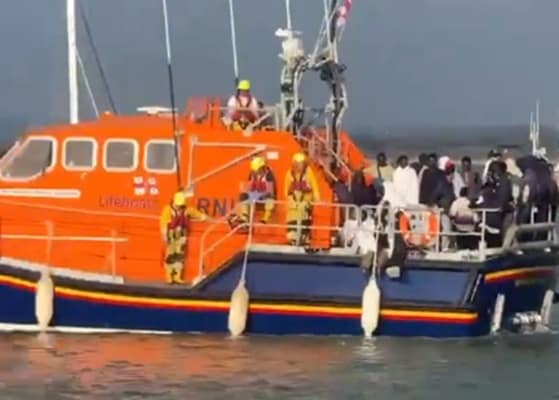
The vessel was eventually intercepted, and the migrants were transferred to UK authorities. Reports said 51 people subsequently arrived in Dover after spending around 36 hours at sea.
The episode also reignited tensions in Hampshire after officials had considered bringing migrants ashore in Gosport.
The plan was abandoned as hundreds of protesters gathered in the naval town, following earlier confrontations over the use of Portsmouth as a landing point.
Hampshire Police and Crime Commissioner Donna Jones has previously warned that repeated Channel landings in the county would place an unsustainable burden on local policing. She said the September 6 Portsmouth operation had required hundreds of officers to manage protests and called for migrants to be transferred directly to Dover by sea.
The Government has made tackling irregular migration a central element of Mahmood’s immigration programme, including reforms intended to create new legal routes while reducing what ministers describe as abuse of the asylum system.
But the latest incidents show the ongoing operational challenge facing authorities along the Channel, where small boats can travel long distances before being intercepted and local police forces must prepare for the consequences of unexpected landings.
For the Government, the urgent review will now have to establish why multiple boats were able to reach British shores and whether existing surveillance and interception arrangements are sufficient to prevent further uncontrolled landings.


Leave a Comment